


Investigation of Stingless Bee Honey from West Sumatra as an Antihyperglycemic Food
- PMID: 38974587
- PMCID: PMC11223919
- DOI: 10.3746/pnf.2024.29.2.170
Investigation of Stingless Bee Honey from West Sumatra as an Antihyperglycemic Food
Abstract
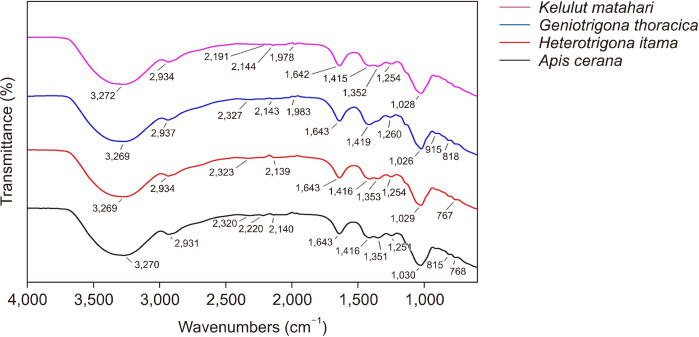
This study aimed to investigate the potential in vitro antihyperglycemic activity of honey sourced from three different species of stingless bees (Heterotrigona itama, Geniotrigona thoracica, and Kelulut matahari) by assessing their α-glucosidase enzyme inhibition, antioxidant activity, and total phenolic and flavonoid contents in comparison with honey from Apis cerana, obtained from West Sumatra, Indonesia. The honey samples were obtained from stingless bee farms at the Faculty of Animal Science, Universitas Andalas. Variations were observed in α-glucosidase enzyme inhibition, antioxidant activity (half maximal inhibitory concentration, IC50), and total phenolic and flavonoid contents among the honey samples from H. itama, G. thoracica, K. matahari, and A. cerana. In terms of α-glucosidase inhibition, honey from the stinging bee A. cerana demonstrated higher inhibition than that from the other three stingless bees species. Honey derived from K. matahari exhibited the lowest IC50 value, indicating its superior antioxidant activity, followed by honey from A. cerana, H. itama, and G. thoracica. The highest total phenolic and flavonoid contents were found in honey from A. cerana, followed by honey from K. matahari, H. itama, and G. thoracica. Analysis using Fourier-transform infrared spectroscopy revealed that the predominant absorptions in all four honey samples were observed at 767∼1,643 cm-1, indicating that absorptions are primarily ascribed to monosaccharides and disaccharides. Additionally, some peaks implied the presence of phenolic and flavonoid compounds. Overall, honey from stingless bees shows promise as an antihyperglycemic food, as evidenced by its α-glucosidase enzyme inhibition activity, antioxidant activity, and relatively high total phenolic content.
Keywords: antihyperglycemic; functional food; honey; stingless bee.
Copyright © 2024 by The Korean Society of Food Science and Nutrition.
Conflict of interest statement
AUTHOR DISCLOSURE STATEMENT The authors declare no conflict of interest.
Figures
References
-
- Al-Hatamleh MAI, Boer JC, Wilson KL, Plebanski M, Mohamud R, Mustafa MZ. Antioxidant-based medicinal properties of stingless bee products: recent progress and future directions. Biomolecules. 2020;10:923. doi: 10.3390/biom10060923. https://doi.org/10.3390/biom10060923. - DOI - PMC - PubMed
-
- Bastos DHM, dos Santos MCM, Mendonça S, Torres EAFS. Antioxidant capacity and phenolic content of stingless bee honey from Amazon in comparison to Apis bee honey. Acta Hortic. 2009;841:483–485. doi: 10.17660/ActaHortic.2009.841.64. - DOI
-
- Belay A, Haki GD, Birringer M, Borck H, Lee YC, Cho CW, et al. Sugar profile and physicochemical properties of Ethiopian monofloral honey. Int J Food Prop. 2017;20:2855–2866. doi: 10.1080/10942912.2016.1255898. - DOI
-
- Bharti SK, Krishnan S, Kumar A, Gupta AK, Ghosh AK, Kumar A. Mechanism-based antidiabetic activity of Fructo- and isomalto-oligosaccharides: Validation by in vivo, in silico and in vitro interaction potential. Process Biochem. 2015;50:317–327. doi: 10.1016/j.procbio.2014.10.014. - DOI
LinkOut - more resources
Full Text Sources