


Xylazine awareness, desire, use and exposure: Preliminary findings from the Rhode Island community-based drug checking cohort study
- PMID: 38974777
- PMCID: PMC11225690
- DOI: 10.1016/j.dadr.2024.100247
Xylazine awareness, desire, use and exposure: Preliminary findings from the Rhode Island community-based drug checking cohort study
Abstract
Background: Xylazine is an ⍺2 adrenergic receptor agonist and a veterinary sedative that can cause severe health complications yet interventions to detect and treat human exposure remain underdeveloped. Community-based drug checking services (DCS) involve the testing of small amounts of drugs to increase community knowledge of unregulated supplies and decrease harms. This study characterized xylazine awareness, desire, use and exposure among people who use drugs (PWUD) in Rhode Island, US.
Methods: We analyzed data from an ongoing PWUD cohort study. In 2023, 125 PWUD were enrolled and surveyed. Using point-of-care Fourier Transform infrared spectroscopy (FTIR-S), we tested a drug sample from each participant onsite and confirmed the results offsite at a laboratory. Results were conveyed in real-time, along with harm reduction education, referrals to resources and care.
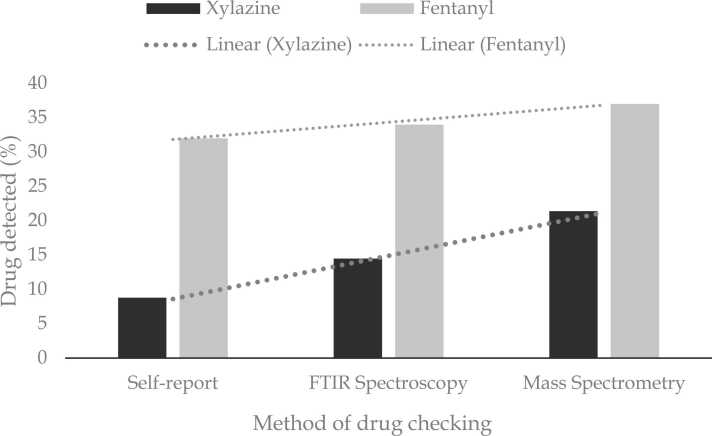
Results: Virtually all participants (99.2 %) wanted to avoid xylazine exposure. Half (51.2 %) knew what xylazine was, and a quarter (26.1 %) suspected previous exposure. Xylazine exposure was primarily surmised through sedating (45.2 %) and ulcerative (29.0 %) effects. Only 8.8 % of participants submitted a sample that they expected to contain xylazine. Xylazine was detected in 14.5 % of samples using FTIR-S and in 21.4 % of samples using a dual laboratory approach of gas chromatography mass spectrometry (GC-MS) and liquid chromatography quadrupole-time-of-flight mass spectrometry (LC-QTOF-MS). Participants thought that these xylazine-positive samples were fentanyl (78.3 %), heroin (13.0 %), or Percocet® (8.7 %).
Conclusion: Implementing point-of-care DCS at harm reduction organizations could be useful in rapidly increasing xylazine awareness and engaging at-risk individuals in prevention, harm reduction, treatment, and rapid care for xylazine-related wounds.
Keywords: Drug testing; Fentanyl; Harm reduction; Opioid use; Substance use.
© 2024 The Authors.
Conflict of interest statement
None.
Figures
References
-
- Bailey K., Abramovitz D., Artamonova I., Davidson P., Stamos-Buesig T., Vera C.F., Patterson T.L., Arredondo J., Kattan J., Bergmann L., Thihalolipavan S., Strathdee S.A., Borquez A. Drug checking in the fentanyl era: utilization and interest among people who inject drugs in San Diego, California. Int J. Drug Policy. 2023;118 doi: 10.1016/j.drugpo.2023.104086. Jun 7. Epub ahead of print. PMID: 37295217. - DOI - PMC - PubMed
-
- Bishnoi A., Singh V., Khanna U., Vinay K. Skin ulcerations caused by xylazine: a lesser-known entity. J. Am. Acad. Dermatol. 2023 Apr 11. - PubMed
Grants and funding
LinkOut - more resources
Full Text Sources
Miscellaneous
