


Efficient genome editing in rice with miniature Cas12f variants
- PMID: 38974870
- PMCID: PMC11224166
- DOI: 10.1007/s42994-024-00168-2
Efficient genome editing in rice with miniature Cas12f variants
Abstract
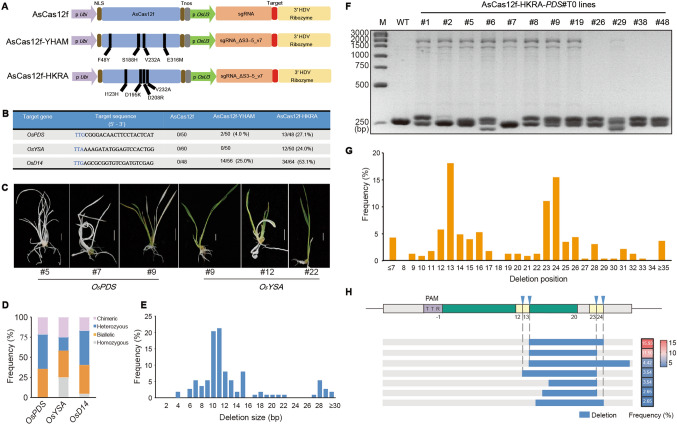
Genome editing, particularly using the CRISPR/Cas system, has revolutionized biological research and crop improvement. Despite the widespread use of CRISPR/Cas9, it faces limitations such as PAM sequence requirements and challenges in delivering its large protein into plant cells. The hypercompact Cas12f, derived from Acidibacillus sulfuroxidans (AsCas12f), stands out due to its small size of only 422 amino acids and its preference for a T-rich motif, presenting advantageous features over SpCas9. However, its editing efficiency is extremely low in plants. Recent studies have generated two AsCas12f variants, AsCas12f-YHAM and AsCas12f-HKRA, demonstrating higher editing efficiencies in mammalian cells, yet their performance in plants remains unexplored. In this study, through a systematic investigation of genome cleavage activity in rice, we unveiled a substantial enhancement in editing efficiency for both AsCas12f variants, particularly for AsCas12f-HKRA, which achieved an editing efficiency of up to 53%. Furthermore, our analysis revealed that AsCas12f predominantly induces deletion in the target DNA, displaying a unique deletion pattern primarily concentrated at positions 12, 13, 23, and 24, resulting in deletion size mainly of 10 and 11 bp, suggesting significant potential for targeted DNA deletion using AsCas12f. These findings expand the toolbox for efficient genome editing in plants, offering promising prospects for precise genetic modifications in agriculture.
Supplementary information: The online version contains supplementary material available at 10.1007/s42994-024-00168-2.
Keywords: AsCas12f; CRISPR/Cas; Cas12; Genome editing; Rice.
© The Author(s) 2024.
Conflict of interest statement
Conflict of interestThe authors declare no conflicts of interest.
Figures
References
-
- Alamillo JM, López CM, Martínez Rivas FJ, Torralbo F, Bulut M, Alseekh S. Clustered regularly interspaced short palindromic repeats/CRISPR-associated protein and hairy roots: a perfect match for gene functional analysis and crop improvement. Curr Opin Biotechnol. 2023 doi: 10.1016/j.copbio.2022.102876. - DOI - PMC - PubMed
-
- Bigelyte G, Young JK, Karvelis T, Budre K, Zedaveinyte R, Djukanovic V, Van Ginkel E, Paulraj S, Gasior S, Jones S, Feigenbutz L, Clair GS, Barone P, Bohn J, Acharya A, Zastrow-Hayes G, Henkel-Heinecke S, Silanskas A, Seidel R, Siksnys V. Miniature type V-F CRISPR-Cas nucleases enable targeted DNA modification in cells. Nat Commun. 2021;12(1):6191. doi: 10.1038/s41467-021-26469-4. - DOI - PMC - PubMed
-
- Duan Y, Zhai C, Li H, Li J, Mei W, Gui H, Ni D, Song F, Li L, Zhang W, Yang J. An efficient and high-throughput protocol for Agrobacterium-mediated transformation based on phosphomannose isomerase positive selection in Japonica rice (Oryza sativa L.) Plant Cell Rep. 2012 doi: 10.1007/s00299-012-1275-3. - DOI - PubMed
LinkOut - more resources
Full Text Sources
Miscellaneous