


Diagnosis of mental disorders using machine learning: Literature review and bibliometric mapping from 2012 to 2023
- PMID: 38975193
- PMCID: PMC11225745
- DOI: 10.1016/j.heliyon.2024.e32548
Diagnosis of mental disorders using machine learning: Literature review and bibliometric mapping from 2012 to 2023
Abstract
Background: Mental disorders (MDs) are becoming a leading burden in non-communicable diseases (NCDs). As per the World Health Organization's 2022 assessment report, there was a steep increase of 25 % in MDs during the COVID-19 pandemic. Early diagnosis of MDs can significantly improve treatment outcome and save disability-adjusted life years (DALYs). In recent times, the application of machine learning (ML) and deep learning (DL)) has shown promising results in the diagnosis of MDs, and the field has witnessed a huge research output in the form of research publications. Therefore, a bibliometric mapping along with a review of recent advancements is required.
Methods: This study presents a bibliometric analysis and review of the research, published over the last 10 years. Literature searches were conducted in the Scopus database for the period from January 1, 2012, to June 9, 2023. The data was filtered and screened to include only relevant and reliable publications. A total of 2811 journal articles were found. The data was exported to a comma-separated value (CSV) format for further analysis. Furthermore, a review of 40 selected studies was performed.
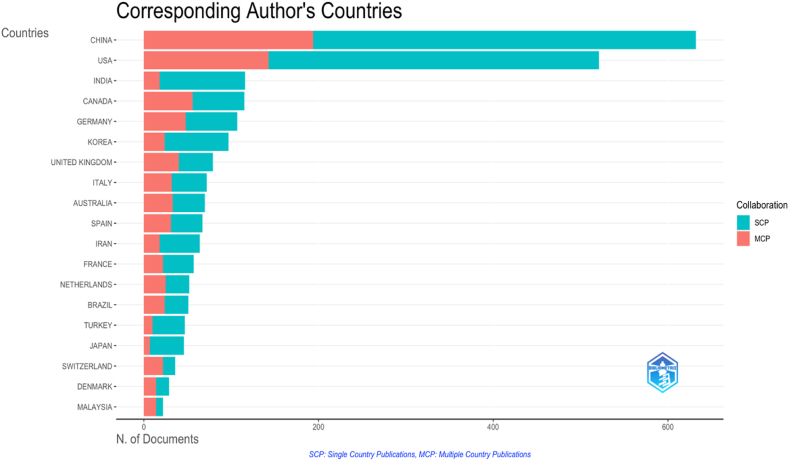
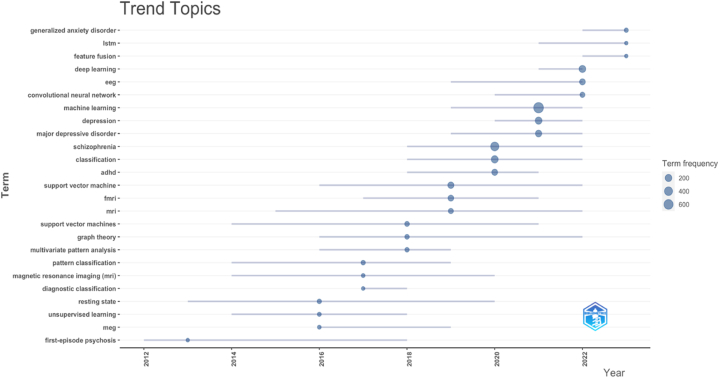
Results: The popularity of ML techniques in diagnosing MDs has been growing, with an annual research growth rate of 17.05 %. The Journal of Affective Disorders published the most documents (n = 97), while Wang Y. (n = 64) has published the most articles. Lotka's law is observed, with a minority of authors contributing the majority of publications. The top affiliating institutes are the West China Hospital of Sichuan University followed by the University of California, with China and the US dominating the top 10 institutes. While China has more publications, papers affiliated with the US receive more citations. Depression and schizophrenia are the primary focuses of ML and deep learning (DL) in mental disease detection. Co-occurrence network analysis reveals that ML is associated with depression, schizophrenia, autism, anxiety, ADHD, obsessive-compulsive disorder, and PTSD. Popular algorithms include support vector machine (SVM) classifier, decision tree classifier, and random forest classifier. Furthermore, DL is linked to neuroimaging techniques such as MRI, fMRI, and EEG, as well as bipolar disorder. Current research trends encompass DL, LSTM, generalized anxiety disorder, feature fusion, and convolutional neural networks.
Keywords: Bibliometric analysis; Classification; Disease diagnosis; Machine learning; Mental disorders.
© 2024 The Author(s).
Conflict of interest statement
We declare that there is no conflict of interest. All authors have read the manuscript and agree on its publication in the journal.
Figures






References
-
- W.H.O. 2022. World Mental Health Report.
-
- Bach B., Zine El Abiddine F. Empirical structure of DSM-5 and ICD-11 personality disorder traits in Arabic-speaking Algerian culture. Int. J. Ment. Health. 2020;49(2):186–200. doi: 10.1080/00207411.2020.1732624. - DOI
-
- Boelen P.A., Lenferink L.I.M., Smid G.E. Further evaluation of the factor structure, prevalence, and concurrent validity of DSM-5 criteria for Persistent Complex Bereavement Disorder and ICD-11 criteria for Prolonged Grief Disorder. Psychiatry Res. 2019;273:206–210. doi: 10.1016/j.psychres.2019.01.006. - DOI - PubMed
-
- Behera P., Parida J., Kakade N., Pati S., Acharya S.K. Addressing barriers to mental healthcare access for adolescents living in slums: a qualitative multi-stakeholder study in Odisha, India. Child. Youth Serv. Rev. 2023;145 doi: 10.1016/j.childyouth.2023.106810. - DOI
Publication types
LinkOut - more resources
Full Text Sources
Research Materials
Miscellaneous
