. 2024 Jul 1;7(7):e2422833.
doi: 10.1001/jamanetworkopen.2024.22833.

Mental Health Hospitalizations in Canadian Children, Adolescents, and Young Adults Over the COVID-19 Pandemic

Collaborators, Affiliations

Mental Health Hospitalizations in Canadian Children, Adolescents, and Young Adults Over the COVID-19 Pandemic

Nadia Roumeliotis et al. JAMA Netw Open. .

Abstract

Importance: The COVID-19 pandemic resulted in multiple socially restrictive public health measures and reported negative mental health impacts in youths. Few studies have evaluated incidence rates by sex, region, and social determinants across an entire population.

Objective: To estimate the incidence of hospitalizations for mental health conditions, stratified by sex, region, and social determinants, in children and adolescents (hereinafter referred to as youths) and young adults comparing the prepandemic and pandemic-prevalent periods.

Design, setting, and participants: This Canadian population-based repeated ecological cross-sectional study used health administrative data, extending from April 1, 2016, to March 31, 2023. All youths and young adults from 6 to 20 years of age in each of the Canadian provinces and territories were included. Data were provided by the Canadian Institute for Health Information for all provinces except Quebec; the Institut National d'Excellence en Santé et en Services Sociaux provided aggregate data for Quebec.

Exposures: The COVID-19-prevalent period, defined as April 1, 2020, to March 31, 2023.

Main outcomes and measures: The main outcome measures were the prepandemic and COVID-19-prevalent incidence rates of hospitalizations for anxiety, mood disorders, eating disorders, schizophrenia or psychosis, personality disorders, substance-related disorders, and self-harm. Secondary measures included hospitalization differences by sex, age group, and deprivation as well as emergency department visits for the same mental health conditions.

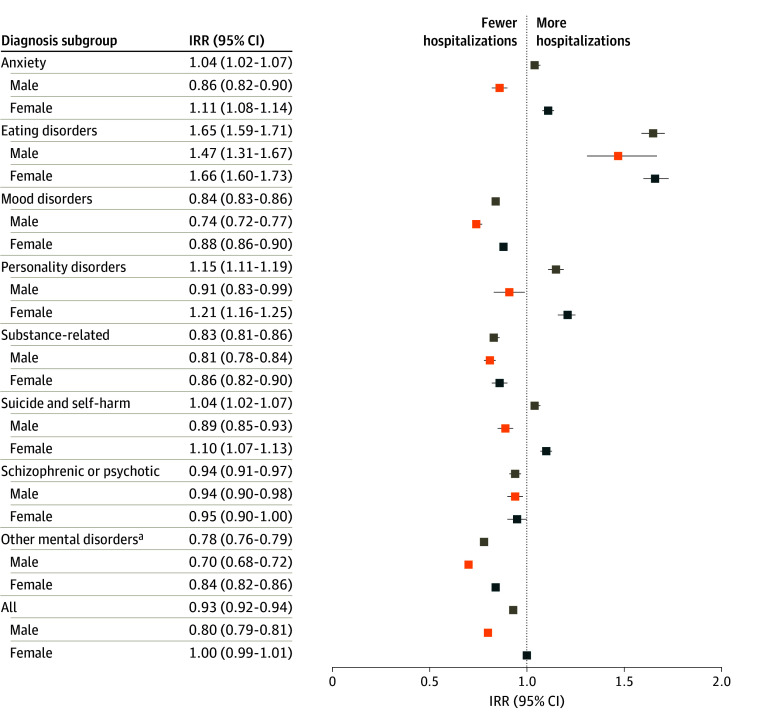
Results: Among Canadian youths and young adults during the study period, there were 218 101 hospitalizations for mental health conditions (ages 6 to 11 years: 5.8%, 12 to 17 years: 66.9%, and 18 to 20 years: 27.3%; 66.0% female). The rate of mental health hospitalizations decreased from 51.6 to 47.9 per 10 000 person-years between the prepandemic and COVID-19-prevalent years. However, the pandemic was associated with a rise in hospitalizations for anxiety (incidence rate ratio [IRR], 1.11; 95% CI, 1.08-1.14), personality disorders (IRR, 1.21; 95% CI, 1.16-1.25), suicide and self-harm (IRR, 1.10; 95% CI, 1.07-1.13), and eating disorders (IRR, 1.66; 95% CI, 1.60-1.73) in females and for eating disorders (IRR, 1.47; 95% CI, 1.31-1.67) in males. In both sexes, there was a decrease in hospitalizations for mood disorders (IRR, 0.84; 95% CI, 0.83-0.86), substance-related disorders (IRR, 0.83; 95% CI, 0.81-0.86), and other mental health disorders (IRR, 0.78; 95% CI, 0.76-0.79).

Conclusions and relevance: This cross-sectional study of Canadian youths and young adults found a rise in anxiety, personality disorders, and suicidality in females and a rise in eating disorders in both sexes in the COVID-19-prevalent period. These results suggest that in future pandemics, policymakers should support youths and young adults who are particularly vulnerable to deterioration in mental health conditions during public health restrictions, including eating disorders, anxiety, and suicidality.


Conflict of interest statement

Conflict of Interest Disclosures: Dr Roumeliotis reported receiving grants from the Fonds de Recherche du Québec Santé (FRQS) Junior 1 Research Scholar and the Canadian Institutes of Health Research (CIHR) Project Grant outside the submitted work. Prof Côté reported receiving funding from the FRQS for the L’Observatoire de l’Éducation et de la Santé des Enfants and holding a Canada Research Chair in Psychosocial Maladjustment. Dr Sadarangani reported receiving grants to the institution from GSK, Pfizer, Moderna, Sanofi Pasteur, and Merck outside the submitted work. Dr Basta reported receiving grants to the institution from CIHR/Pediatric Outcome Improvement Through Coordination of Research Networks (POPCORN) during the conduct of the study and receiving grants to the institution from the Canada Research Chair in Infectious Disease Prevention (Tier 2); the US National Institute of Allergy and Infectious Diseases, National Institutes of Health; and McGill MI4 outside the submitted work. Dr Gantt reported receiving grants from Moderna, Merck, GSK, VBI Vaccines, and Altona for research funding and personal fees from Moderna, Merck, GSK, Curevo Vaccine, and CSL Seqirus for consulting during the conduct of the study. Dr Quach reported having a Canada Research Chair in Infection Prevention and Control. Dr Doan reported receiving grants from the CIHR during the conduct of the study and receiving grants from the CIHR outside the submitted work. No other disclosures were reported.

Figures

Figure 1.
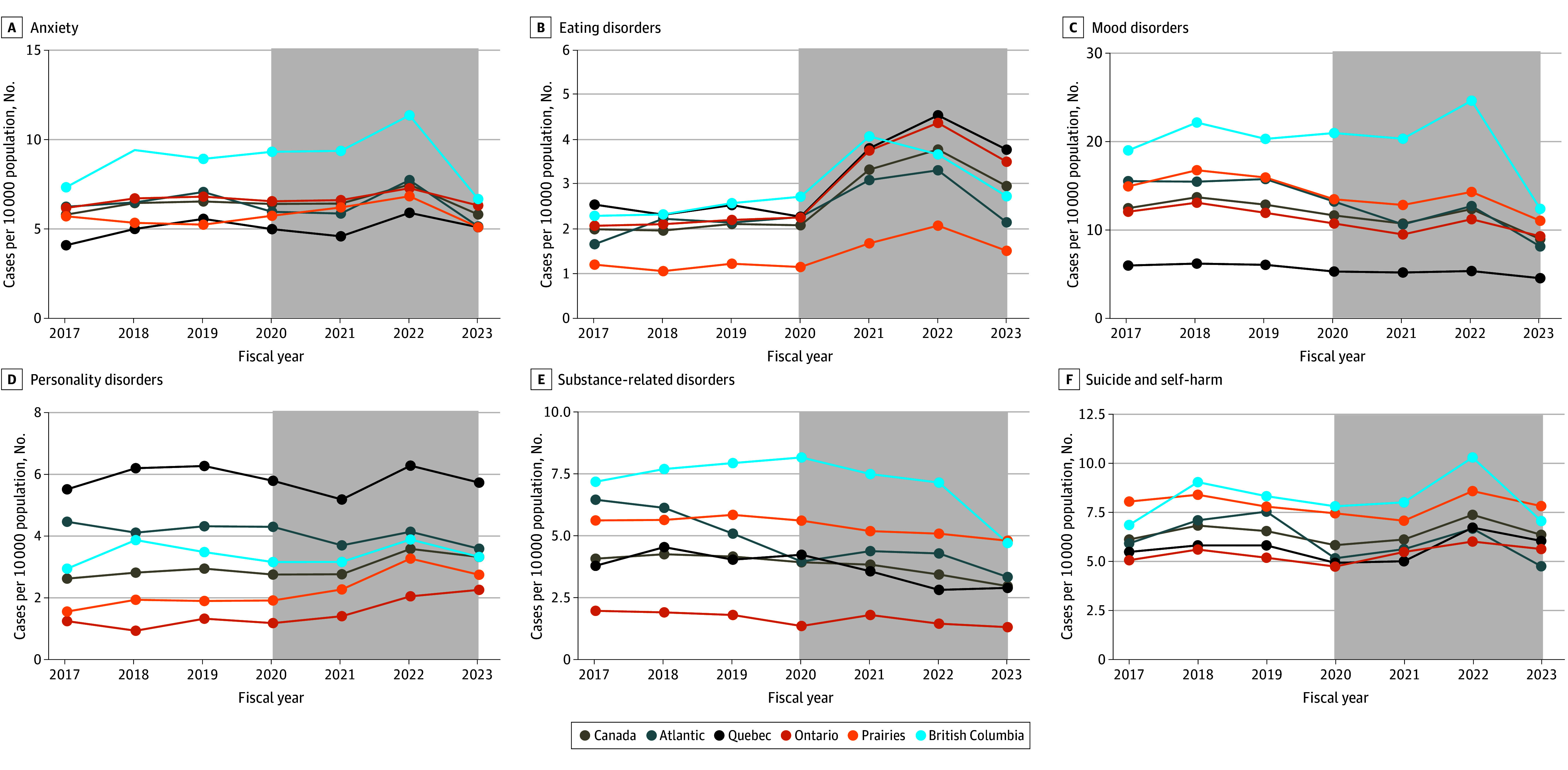
Figure 1.. Rates of Mental Health Hospitalizations by 10 000 Person-Years for Each Diagnostic Subgroup, Stratified by Region
Gray shaded areas indicate the COVID-19–prevalent period from April 1, 2020, to March 31, 2023. Points correspond to aggregate data by fiscal year and are displayed at the end of the fiscal year (March 31). Territories are not included in the figure because of scale and low counts. (Visits in the territories accounted for 1% of mental health visits in the prepandemic period and during the pandemic.) Atlantic indicates Prince Edward Island, Nova Scotia, New Brunswick, and Newfoundland and Labrador; Prairies, Manitoba, Saskatchewan, and Alberta.
Figure 2.
Figure 2.. Forest Plot of Incidence Rate Ratios (IRRs) of COVID-19–Prevalent vs Pre–COVID-19 Hospitalization Rates for Mental Health Disorders, Stratified by Sex
aIncludes adjustment disorders, dissociative disorders, attention-deficit/hyperactivity disorder, tic disorders, and other behavioral disorders (eTable 2 in Supplement 1).
Figure 3.
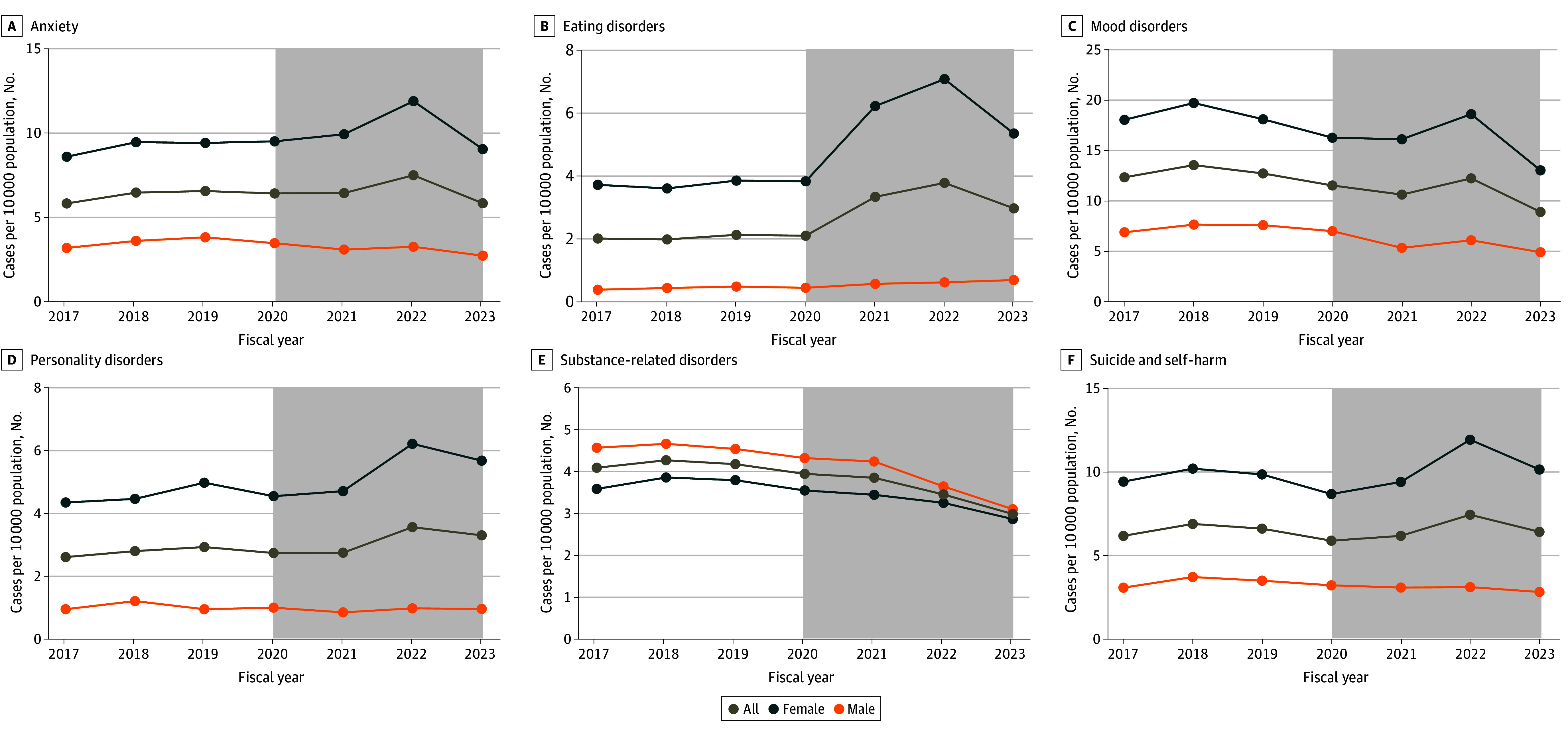
Figure 3.. Rates of Mental Health Hospitalizations by 10 000 Person-Years for Each Diagnostic Subgroup, Stratified by Sex
Gray shaded areas indicate the COVID-19–prevalent period from April 1, 2020, to March 31, 2023. Points correspond to aggregate data by fiscal year and are displayed at the end of the fiscal year (March 31).
Figure 4.
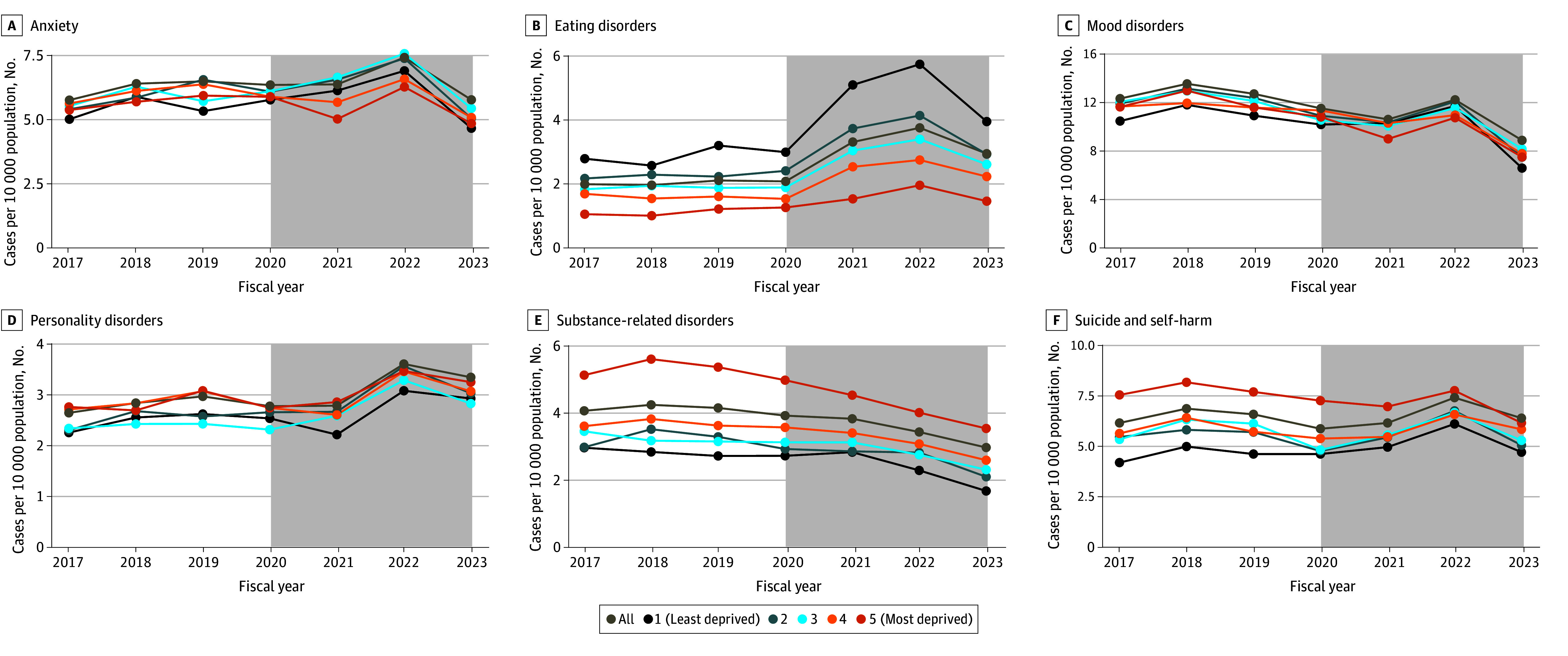
Figure 4.. Rates of Mental Health Hospitalizations by 10 000 Person-Years for Each Diagnostic Subgroup, Stratified by Material Deprivation Quintile
Gray shaded areas indicate the COVID-19–prevalent period from April 1, 2020, to March 31, 2023. Points correspond to aggregate data by fiscal year and are displayed at the end of the fiscal year (March 31).

References

    1. Ludvigsson JF. Systematic review of COVID-19 in children shows milder cases and a better prognosis than adults. Acta Paediatr. 2020;109(6):1088-1095. doi:10.1111/apa.15270 - DOI - PMC - PubMed
    1. Hillis SD, Unwin HJT, Chen Y, et al. . Global minimum estimates of children affected by COVID-19-associated orphanhood and deaths of caregivers: a modelling study. Lancet. 2021;398(10298):391-402. doi:10.1016/S0140-6736(21)01253-8 - DOI - PMC - PubMed
    1. Thompson J, Spencer G, Curtis P. Children’s perspectives and experiences of the COVID-19 pandemic and UK public health measures. Health Expect. 2021;24(6):2057-2064. doi:10.1111/hex.13350 - DOI - PMC - PubMed
    1. Fore HH, Hijazi Z. COVID-19 is hurting children’s mental health. here are 3 ways we can help. World Economic Forum. May 1, 2020. Accessed January 15, 2024. https://www.weforum.org/agenda/2020/05/covid-19-is-hurting-childrens-men...
    1. Cameron-Blake E, Annan H, Marro L, Michaud D, Sawatzky J, Tatlow H. Variation in the stringency of COVID-19 public health measures on self-reported health, stress, and overall wellbeing in Canada. Sci Rep. 2023;13(1):13094. doi:10.1038/s41598-023-39004-w - DOI - PMC - PubMed

Publication types

MeSH terms