. 2024 Jul 17;146(28):19317-19326.
doi: 10.1021/jacs.4c05160. Epub 2024 Jul 8.

Origins of High-Activity Cage-Catalyzed Michael Addition

Affiliations

Origins of High-Activity Cage-Catalyzed Michael Addition

Patrick J Boaler et al. J Am Chem Soc. .

Abstract

Cage catalysis continues to create significant interest, yet catalyst function remains poorly understood. Herein, we report mechanistic insights into coordination-cage-catalyzed Michael addition using kinetic and computational methods. The study has been enabled by the detection of identifiable catalyst intermediates, which allow the evolution of different cage species to be monitored and modeled alongside reactants and products. The investigations show that the overall acceleration results from two distinct effects. First, the cage reaction shows a thousand-fold increase in the rate constant for the turnover-limiting C-C bond-forming step compared to a reference state. Computational modeling and experimental analysis of activation parameters indicate that this stems from a significant reduction in entropy, suggesting substrate coencapsulation. Second, the cage markedly acidifies the bound pronucleophile, shifting this equilibrium by up to 6 orders of magnitude. The combination of these two factors results in accelerations up to 109 relative to bulk-phase reference reactions. We also show that the catalyst can fundamentally alter the reaction mechanism, leading to intermediates and products that are not observable outside of the cage. Collectively, the results show that cage catalysis can proceed with very high activity and unique selectivity by harnessing a series of individually weak noncovalent interactions.


Conflict of interest statement

The authors declare no competing financial interest.

Figures
Scheme 1
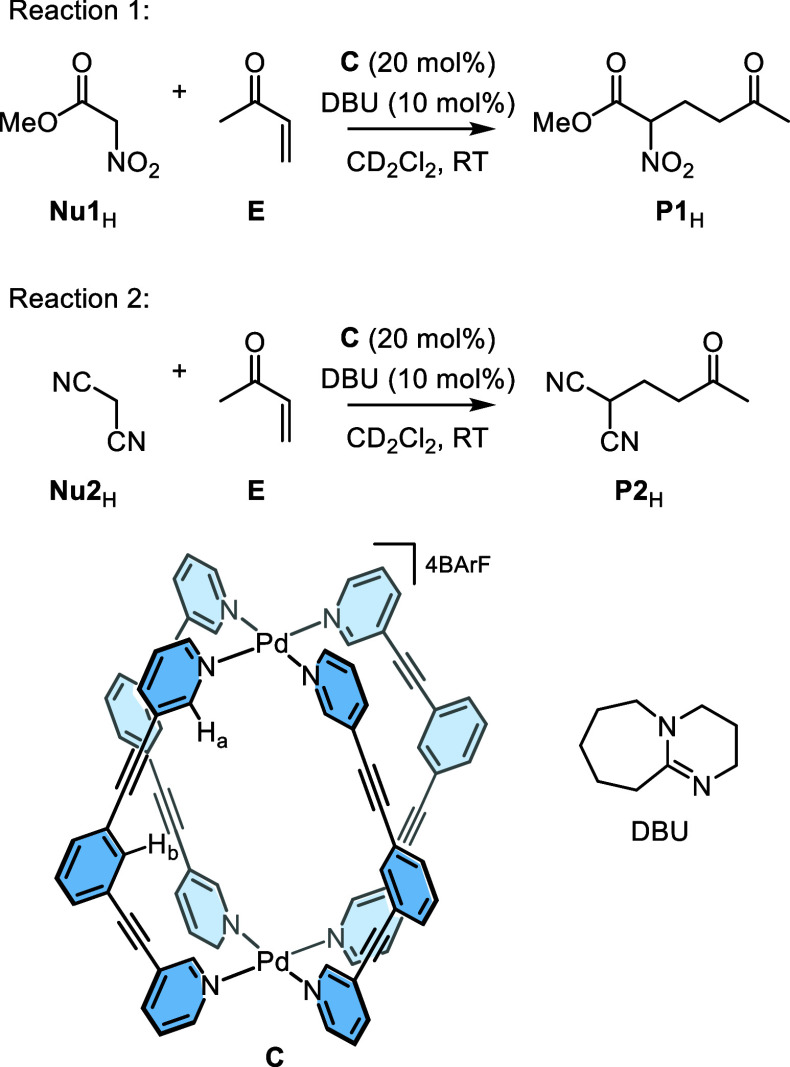
Scheme 1. Cage (C)-Catalyzed Michael Addition Reactions of Electrophile E with Pronucleophiles Nu1H and Nu2H
Figure 1
Figure 1
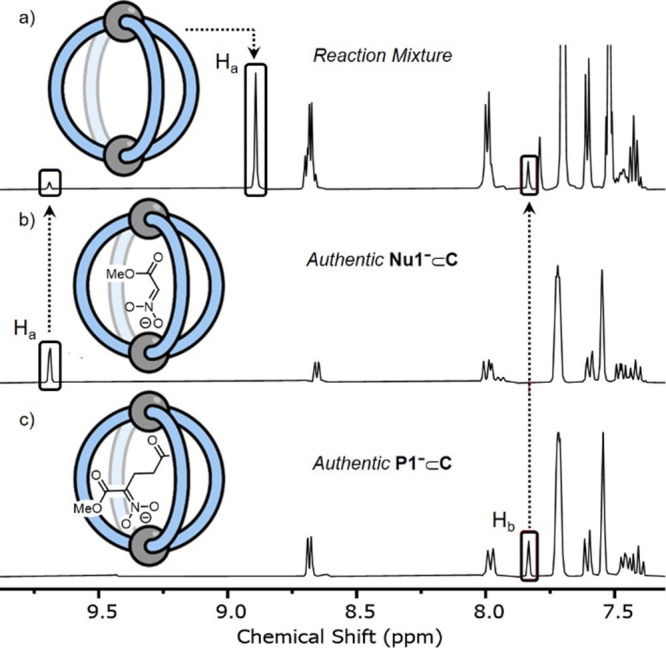
1H NMR spectra (600 MHz, CD2Cl2, 298 K) of (a) reaction 1 immediately following initiation; (b) authentically generated Nu1C (by the reaction of C, Nu1H, and DBU); and (c) authentically generated P1C (by the reaction of C, P1H, and DBU). The identities of protons Ha and Hb in cage C are shown in Scheme 1.
Scheme 2
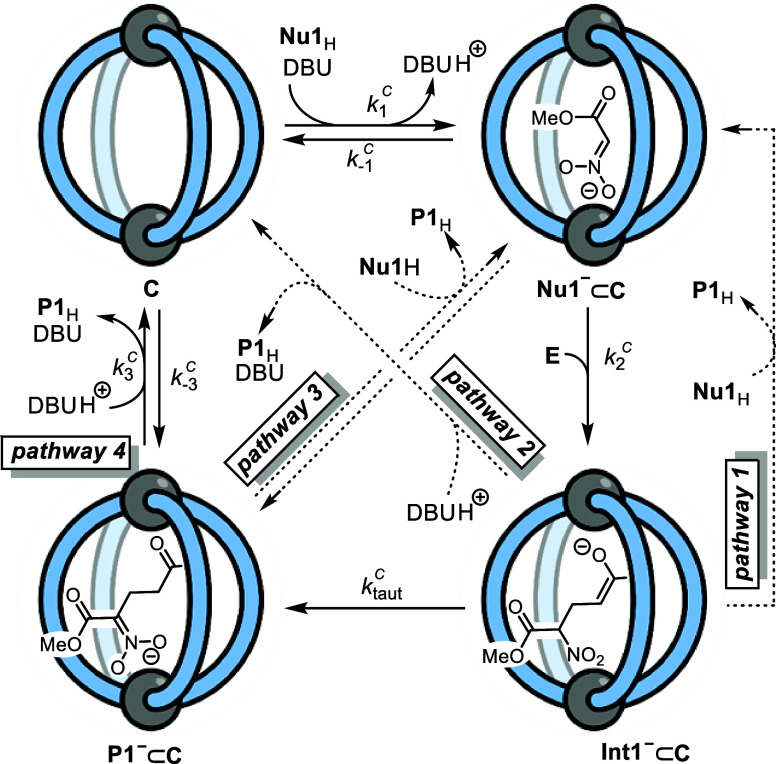
Scheme 2. Pathways 1–4 Used for Numerical Methods Simulations of the Temporal Concentrations of Nu1H, E, P1H, C, NuC, and P1C in Reaction 1
The data is not consistent with catalysis solely via pathway 1. The model based on pathway 4 is marginally more consistent with the experimental data than models based on pathway 2 or 3, see the Supporting Information Section S.1.
Figure 2
Figure 2
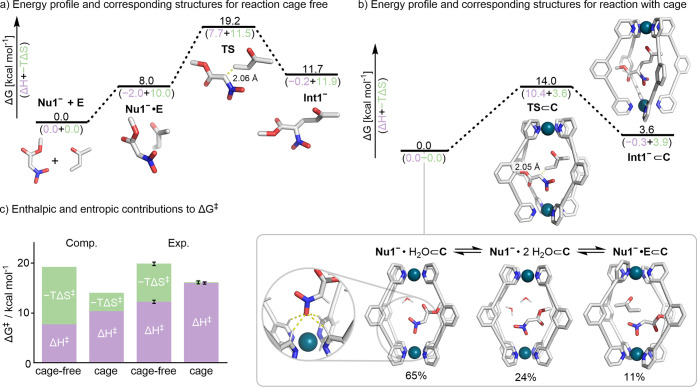
(a) Gibbs free energy and corresponding structures for the cage-free (Nu1 + EInt1) reaction. (b) Gibbs free energy profiles and corresponding structures for the cage-mediated (Nu1C + EInt1C) reaction. The ground state was calculated according to Boltzmann weighting of three states: Nu1·H2O⊂C1, Nu1·2H2O⊂C1, and Nu1·EC1. The magnified region shows the binding of the Nu1 nitronate group to the H-bond donor pocket on the cage interior. (c) Comparison of the activation parameters predicted by DFT to those determined experimentally. Calculations on the CPCM(DCM)-M06-2X/def2-TZVP//CPCM(DCM)-PBE0-D3BJ/def2-SVP level of theory.
Figure 3
Figure 3
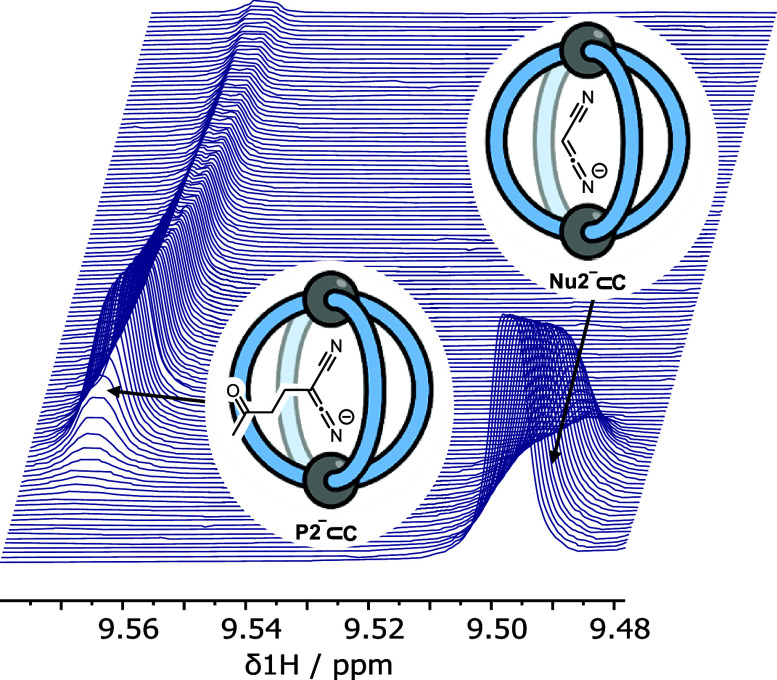
Partial 1H NMR spectra (600 MHz, CD2Cl2, 298 K) for reaction 2 showing the time-dependent evolution of Nu2C and P2C. The signals correspond to the Ha atoms of C (Scheme 1). The first spectrum, obtained immediately after reaction initiation, is shown at the bottom, with subsequent spectra recorded at 30 s intervals.
Scheme 3
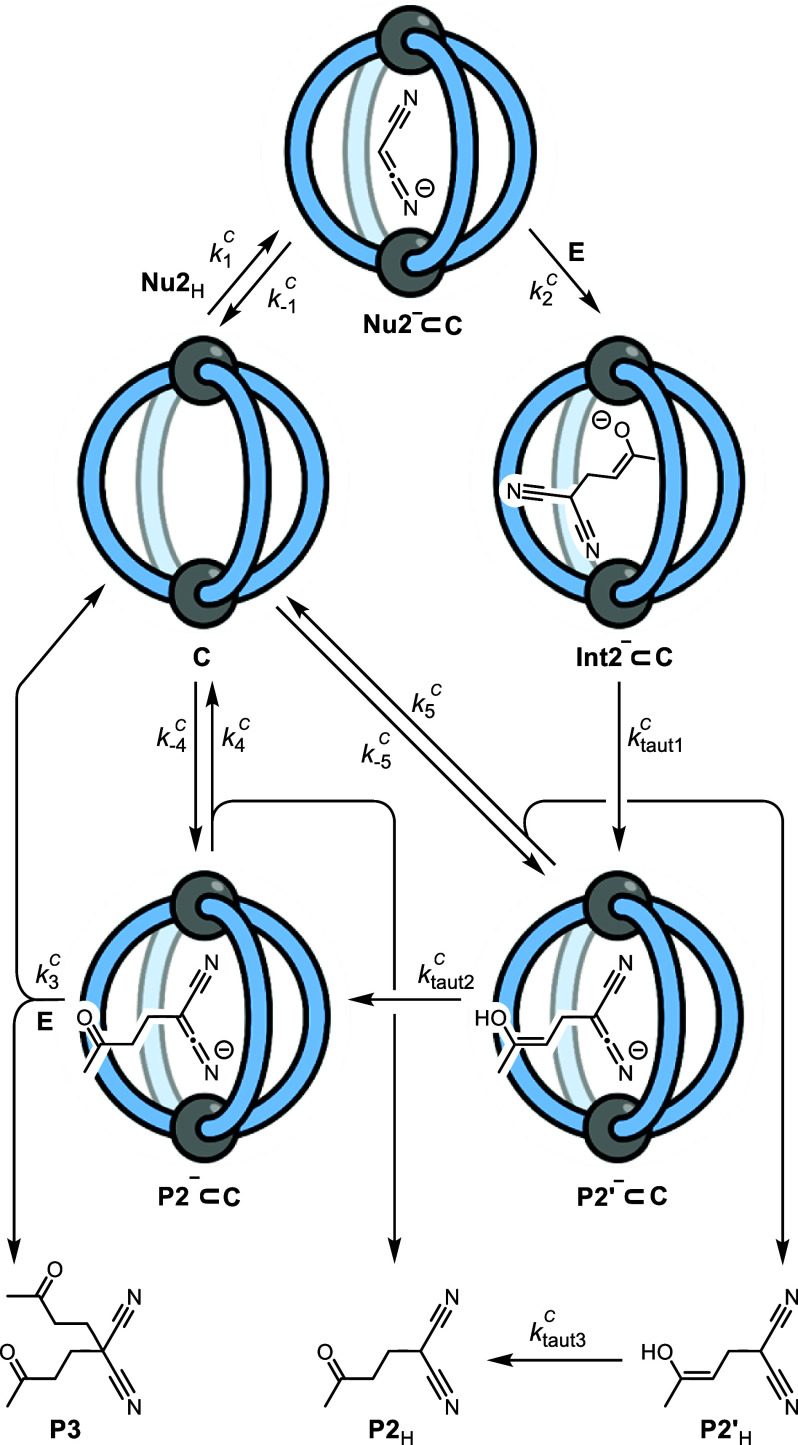
Scheme 3. Proposed Catalytic Cycle for Reaction 2,
This mechanism is supported by kinetic simulation of the temporal concentrations of Nu2H, E, P2H, P3, C and detectable intermediates Nu2C, P2C, and P2′H. DBU and DBUH+ have been omitted from the catalytic cycle for clarity, as has a decomposition step from Int2C, which accounts for a small amount of free ligand (<5%). For key parameter thresholds and relationships, see Table S8.
Figure 4
Figure 4
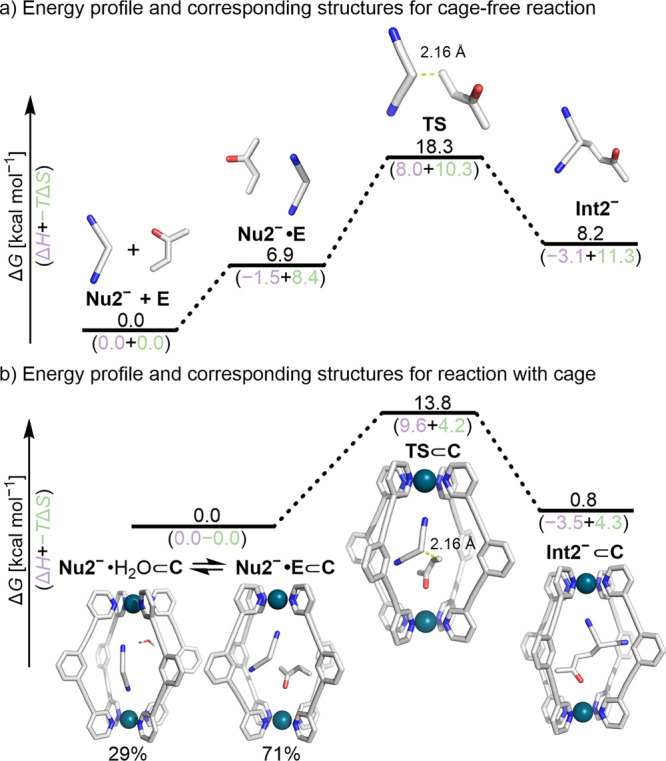
Energy profile and corresponding structures for reaction 2 (a) without and (b) with a cage. For (b), the ground state was calculated as the Boltzmann average of the Nu2·H2O⊂C, Nu2·EC states. Calculations were performed at the CPCM(DCM)-M06-2X/def2-TZVP//CPCM(DCM)-PBE0-D3BJ/def2-SVP level of theory.
Figure 5
Figure 5
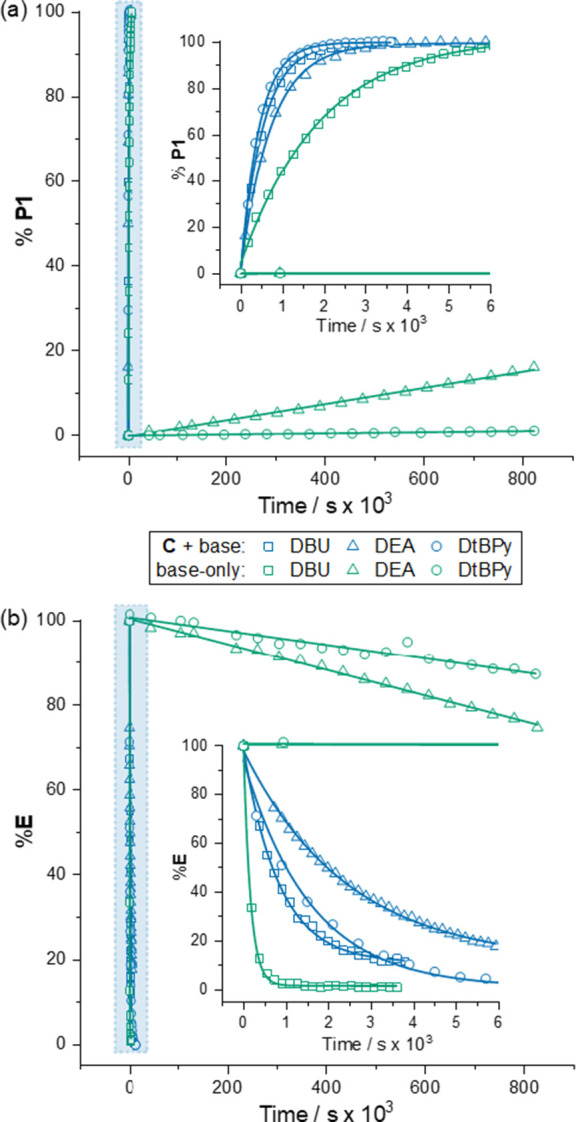
Kinetic plots for (a) reaction 1 and (b) reaction 2 with different bases.a,b The fitted curves for the C + base and DBU alone reactions are kinetic simulations. The DEA and DtBPy alone reactions are the initial rate. aDEA = diethylaniline and DtBPy = 2,6-ditbutylpyridine. bReaction conditions. Cage-accelerated reaction 1: C (0.78 mM), Nu1H (10.5 mM), E (3.95 mM), base (0.27 mM), CD2Cl2, RT; cage-free reaction 1: Nu1H (1050 mM), E (395 mM), base (27.3 mM), CD2Cl2, RT. Cage-accelerated reaction 2: C (0.84 mM), Nu1H (34.9 mM), E (12.4 mM), base (0.34 mM), CD2Cl2, RT. Strong base (DBU) cage-free reaction 2: base (0.34 mM), Nu1H (34.9 mM), E (12.4 mM) CD2Cl2, RT. Weak base (DEA and DtBPy) cage-free reaction 2: base (33.7 mM), Nu1H (3490 mM), E (1240 mM), CD2Cl2, RT.

References

    1. Piskorz T. K.; Martí-Centelles V.; Spicer R. L.; Duarte F.; Lusby P. J. Picking the lock of coordination cage catalysis. Chem.Sci. 2023, 14, 11300–11331. 10.1039/D3SC02586A. - DOI - PMC - PubMed
    1. Cramer F.; Kampe W. Inclusion Compounds. XVII.1 Catalysis of Decarboxylation by Cyclodextrins. A Model Reaction for the Mechanism of Enzymes. J. Am. Chem. Soc. 1965, 87, 1115–1120. 10.1021/ja01083a031. - DOI - PubMed
    1. Rideout D. C.; Breslow R. Hydrophobic acceleration of Diels-Alder reactions. J. Am. Chem. Soc. 1980, 102, 7816–7817. 10.1021/ja00546a048. - DOI
    1. Mackay L. G.; Wylie R. S.; Sanders J. K. M. Catalytic Acyl Transfer by a Cyclic Porphyrin Trimer: Efficient Turnover without Product Inhibition. J. Am. Chem. Soc. 1994, 116, 3141–3142. 10.1021/ja00086a061. - DOI
    1. Tehrani F. N.; Assaf K. I.; Hein R.; Jensen C. M. E.; Nugent T. C.; Nau W. M. Supramolecular Catalysis of a Catalysis-Resistant Diels–Alder Reaction: Almost Theoretical Acceleration of Cyclopentadiene Dimerization inside Cucurbit[7]uril. ACS Catal. 2022, 12, 2261–2269. 10.1021/acscatal.1c05659. - DOI

LinkOut - more resources