Multicenter Study
. 2024 Jul 8;14(1):15739.
doi: 10.1038/s41598-024-66288-3.

A multicenter study of asymmetric and symmetric dimethylarginine as predictors of mortality risk in hospitalized COVID-19 patients

Affiliations
Multicenter Study

A multicenter study of asymmetric and symmetric dimethylarginine as predictors of mortality risk in hospitalized COVID-19 patients

Juliane Hannemann et al. Sci Rep. .

Erratum in

Abstract

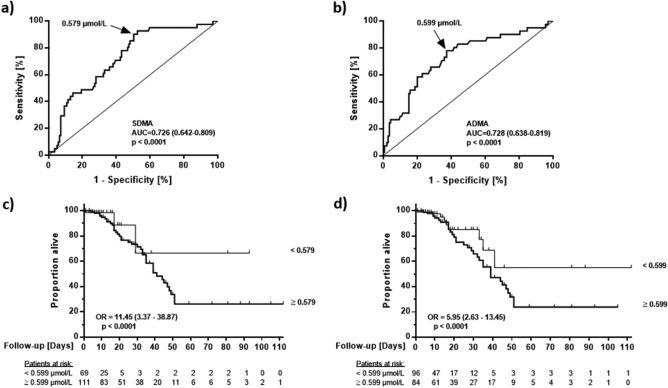
Mortality of patients hospitalized with COVID-19 has remained high during the consecutive SARS-CoV-2 pandemic waves. Early discrimination of patients at high mortality risk is crucial for optimal patient care. Symmetric (SDMA) and asymmetric dimethylarginine (ADMA) have been proposed as possible biomarkers to improve risk prediction of COVID-19 patients. We measured SDMA, ADMA, and other L-arginine-related metabolites in 180 patients admitted with COVID-19 in four German university hospitals as compared to 127 healthy controls. Patients were treated according to accepted clinical guidelines and followed-up until death or hospital discharge. Classical inflammatory markers (leukocytes, CRP, PCT), renal function (eGFR), and clinical scores (SOFA) were taken from hospital records. In a small subgroup of 23 COVID-19 patients, sequential blood samples were available and analyzed for biomarker trends over time until 14 days after admission. Patients had significantly elevated SDMA, ADMA, and L-ornithine and lower L-citrulline concentrations than controls. Within COVID-19 patients, SDMA and ADMA were significantly higher in non-survivors (n = 41, 22.8%) than in survivors. In ROC analysis, the optimal cut-off to discriminate non-survivors from survivors was 0.579 µmol/L for SDMA and 0.599 µmol/L for ADMA (both p < 0.001). High SDMA and ADMA were associated with odds ratios for death of 11.45 (3.37-38.87) and 5.95 (2.63-13.45), respectively. Analysis of SDMA and ADMA allowed discrimination of a high-risk (mortality, 43.7%), medium-risk (15.1%), and low-risk group (3.6%); risk prediction was significantly improved over classical laboratory markers. We conclude that analysis of ADMA and SDMA after hospital admission significantly improves risk prediction in COVID-19.

Keywords: Biomarker; Infectious diseases; Intensive care; Nitric oxide.


Conflict of interest statement

The authors declare no competing interests.

Figures
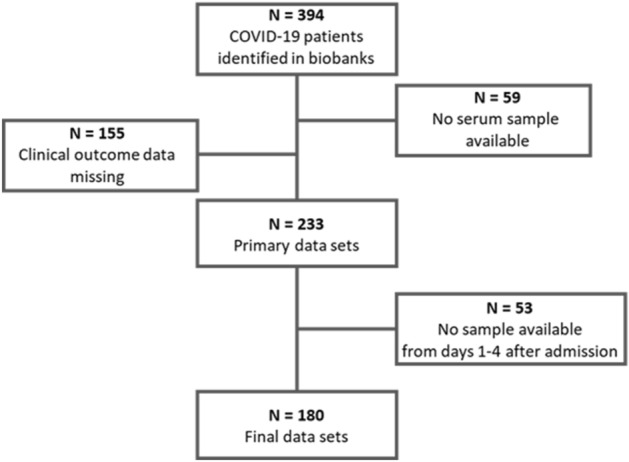
Figure 1
Figure 1
CONSORT flow diagram of our study.
Figure 2
Figure 2
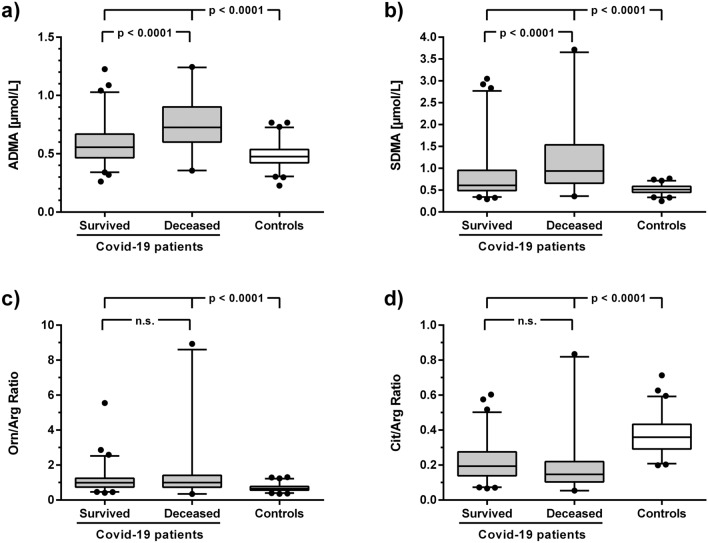
Box plots showing the serum concentrations of ADMA (a), SDMA (b), the L-ornithine/L-arginine ratio (c), and the L-citrulline/L-arginine ratio (d) in hospitalized Covid-19 patients who survived or died during hospitalization, as compared to age- and sex-matched healthy controls. Boxes show the median and interquartile range of the data, with whiskers representing the 2.5th to 97.5th percentiles; data points outside of this distribution are plotted individually. Statistical significances were calculated by one-way ANOVA followed by Tukey's multiple comparisons test. ADMA, asymmetric dimethylarginine; Cit/Arg Ratio, L-citrulline/L-arginine ratio; Orn/Arg Ratio, L-ornithine/L-arginine ratio; SDMA, symmetric dimethylarginine.
Figure 3
Figure 3
Receiver-operated curve (ROC) charts for SDMA (a) and ADMA (b), and Kaplan–Meier survival curves for SDMA (c) and ADMA (d). The serum concentration allowing optimal discrimination between Covid-19 survivors and non-survivors is marked by arrows in (a) and (b); survival curves were constructed by splitting data at these pre-determined concentrations. ADMA, asymmetric dimethylarginine; AUC, area under the curve; OR, odds ratio; SDMA, symmetric dimethylarginine.
Figure 4
Figure 4
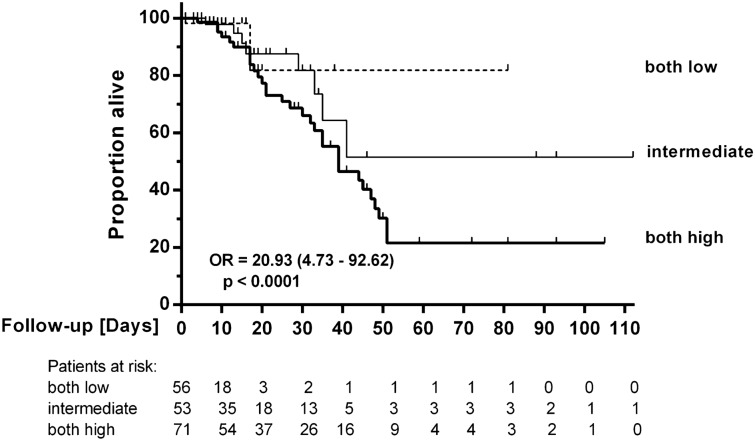
Kaplan–Meier survival curves for combined analysis of ADMA and SDMA serum concentrations. Both low means both biomarker concentrations below their respective cut-off levels from ROC analysis (see Fig. 2a,b); intermediate means that one biomarker is above and the other is below the respective cut-off level; both high indicates that both biomarkers were above their respective cut-off levels. OR, odds ratio.
Figure 5
Figure 5
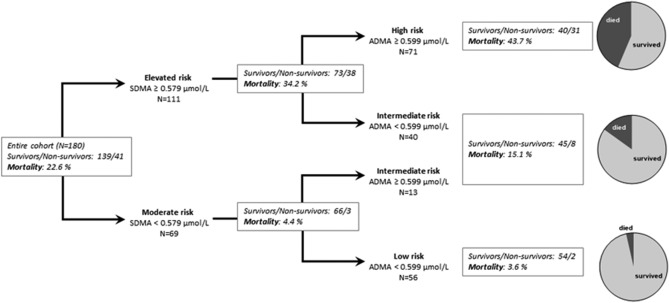
Decision tree analysis for assessing the risk of in-hospital mortality based on sequential analysis of SDMA and ADMA. Out of 180 patients, 41 died (22.6%). First decision step: Patients were identified as having elevated risk when SDMA levels were ≥ 0.579 μmol/L, and moderate risk when SDMA levels were < 0.579 µmol/L. Second decision step: Additional analysis of ADMA allowed identification of patients with high risk (SDMA ≥ 0.579 µmol/L and ADMA ≥ 0.599 µmol/L (mortality, 43.7%), intermediate risk (SDMA ≥ 0.579 µmol/L or ADMA ≥ 0.599 µmol/L (mortality, 15.1%), or low risk (SDMA < 0.579 µmol/L and ADMA < 0.599 µmol/L (mortality, 3.6%).
Figure 6
Figure 6
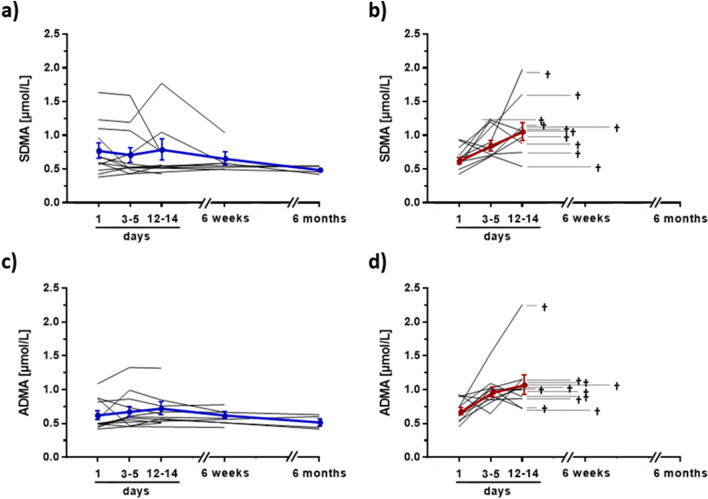
Time course of serum concentrations of SDMA and ADMA in Covid-19 patients who survived (a,c) or died (b,d) during hospitalization. The coloured lines indicate the groups’ means and standard deviations at each time point (blue, survivors, red, non-survivors). Dotted horizontal lines in plots (b) and (d) mark the time that elapsed until the day of death of COVID-19 non-survivors. ADMA, asymmetric dimethylarginine; SDMA, symmetric dimethylarginine.

References

    1. Nugent, M. A. The future of the COVID-19 pandemic: How good (or bad) can the SARS-CoV2 spike protein get?. Cells11(5), 855 (2022). - PMC - PubMed
    1. COVID-19 Excess Mortality Collaborators. Estimating excess mortality due to the COVID-19 pandemic: A systematic analysis of COVID-19-related mortality, 2020–21. Lancet399(10334), 1513–1536 (2022). - PMC - PubMed
    1. Gray, W. K., Navaratnam, A. V., Day, J., Wendon, J. & Briggs, T. W. R. COVID-19 hospital activity and in-hospital mortality during the first and second waves of the pandemic in England: An observational study. Thorax77(11), 1113–1120 (2022). - PubMed
    1. Qin, J. J. et al. Redefining cardiac biomarkers in predicting mortality of inpatients with COVID-19. Hypertension76(4), 1104–1112 (2020). - PMC - PubMed
    1. Zhao, Z. et al. Prediction model and risk scores of ICU admission and mortality in COVID-19. PLoS ONE15(7), e0236618 (2020). - PMC - PubMed

Publication types