Review
. 2024 Jul 9;19(1):55.
doi: 10.1186/s13062-024-00497-8.

Ubiquitin recruiting chimera: more than just a PROTAC

Affiliations
Review

Ubiquitin recruiting chimera: more than just a PROTAC

Tatyana A Grigoreva et al. Biol Direct. .

Abstract

Ubiquitinylation of protein substrates results in various but distinct biological consequences, among which ubiquitin-mediated degradation is most well studied for its therapeutic application. Accordingly, artificially targeted ubiquitin-dependent degradation of various proteins has evolved into the therapeutically relevant PROTAC technology. This tethered ubiquitinylation of various targets coupled with a broad assortment of modifying E3 ubiquitin ligases has been made possible by rational design of bi-specific chimeric molecules that bring these proteins in proximity. However, forced ubiquitinylation inflicted by the binary warheads of a chimeric PROTAC molecule should not necessarily result in protein degradation but can be used to modulate other cellular functions. In this respect it should be noted that the ubiquitinylation of a diverse set of proteins is known to control their transport, transcriptional activity, and protein-protein interactions. This review provides examples of potential PROTAC usage based on non-degradable ubiquitinylation.

Keywords: PROTAC; Protein degradation; Ubiquitin.


Conflict of interest statement

The authors declare no competing interests.

Figures
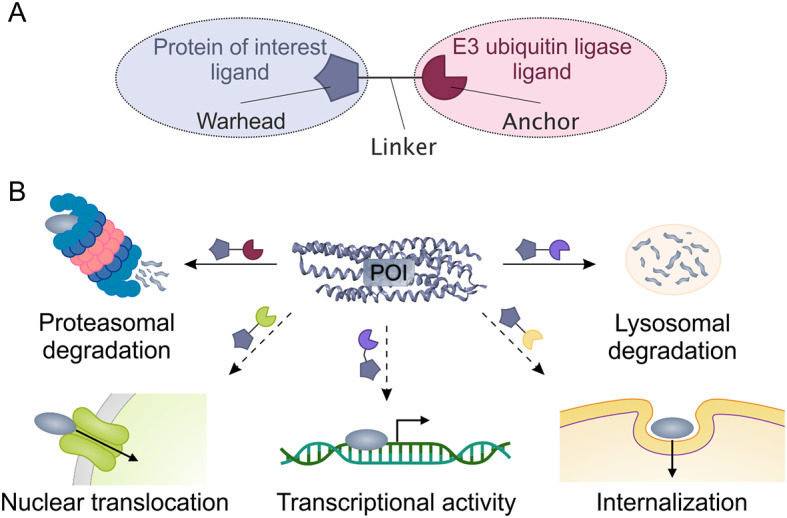
Fig. 1
Fig. 1
PROTAC principle (A): chimeric molecule brings a protein of interest and an E3 ubiquitin ligase together upon binding of its warhead to the protein of interest and its anchor to the E3 ubiquitin ligase, while the warhead and the anchor are connected by the linker of a certain length providing further ubiquitinylation. Prospects for the use of ubiquitin recruiting chimera (B): while the direction of ubiquitin-mediated proteolysis (PROTAC technology) is actively developing, other modalities of forced selective ubiquitinylation of protein substrates, such as modulating transcriptional activity or transport between cellular compartments, remain unexplored
Fig. 2
Fig. 2
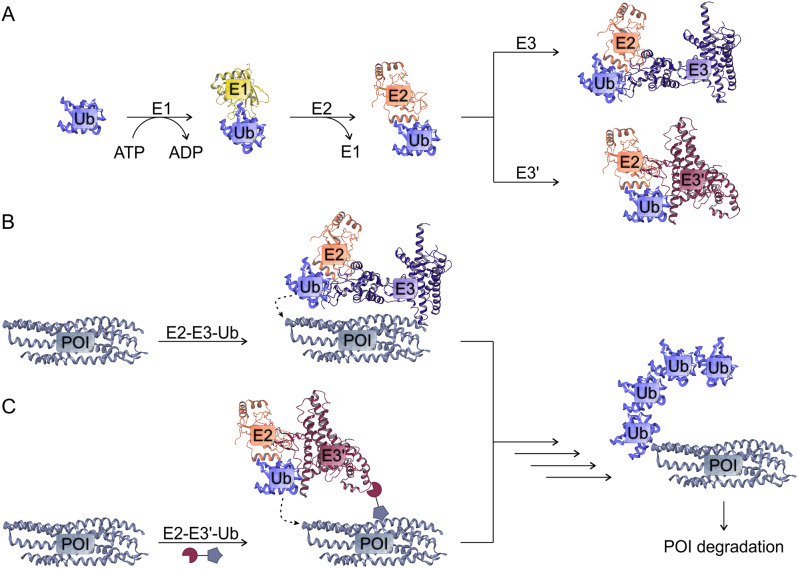
PROTAC in proteasomal degradation. Ubiquitin activation and formation of ubiquitinylation complex (A): the ubiquitin molecule is activated by the formation of a high energy bond between the residue Gly76 of ubiquitin and the cysteine residue of E1; then E1 attaches the activated Ub to E2 providing the binding platform for E1, E3, and activated Ub. Natural ubiquitinylation of the target by E3 ligase (B): highly selective E3 ensures specific recognition of a specific target protein. Ubiquitinylation of the target by PROTAC (C): PROTAC ensures recruitment the desired E3 to the target protein
Fig. 3
Fig. 3
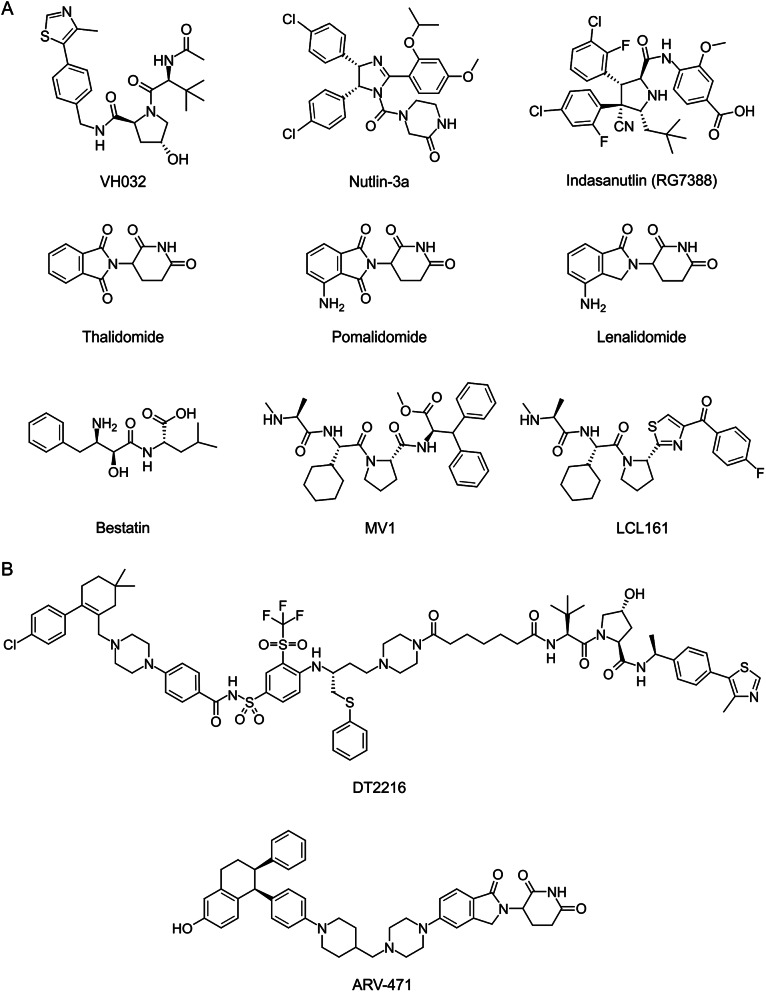
Structures underlying the most common PROTACs: VHL inhibitors, MDM2 inhibitors, CRBN ligands, IAP antagonists (A); examples of PROTACs in clinical trials (B)
Fig. 4
Fig. 4
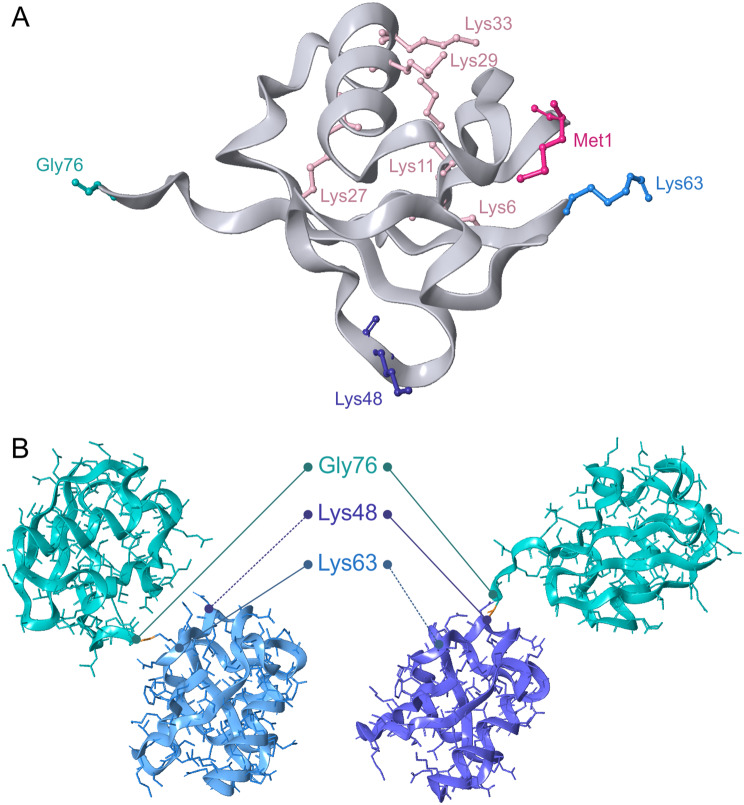
Ubiquitin and its chains. Cartoon representation of ubiquitin; the main residues are shown in colored sticks (A). Diubiquitin conjugates: Lys63 linked (left) and Lys48 linked (right) (B). PDB IDs used: 3A9K [53] and 6Z7V [54]
Fig. 5
Fig. 5
Types of substrate ubiquitinylation and their main effects. Variability in attachment modes allows for the production of diversely configured ubiquitinylated substrates. Differences in the length and composition of the ubiquitin chain allow the substrate to interact with heterogeneous downstream cellular factors leading to various cellular effects
Fig. 6
Fig. 6
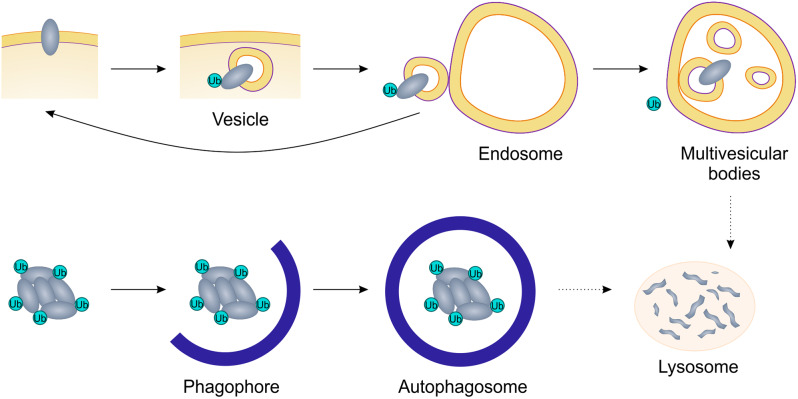
Degradation of substances through endocytosis and autophagy. Mono- or Lys63-linked polyubiquitinylation of membrane proteins acts as a signal for internalization. From early endosomes, the protein can either return to the membrane or be sorted into multivesicular bodies with subsequent degradation by the lysosome. In the case of misused or aberrantly folded proteins, ubiquitin tags initiate the macroautophagy cascade resulting in the formation of the autophagosome, the role of which is to engulf the cytosolic cargo for subsequent fusion with the lysosome

References

    1. Sakamoto K, Kim K, Kumagai A, Mercurio F, Crews C, Deshaies R. Protacs: chimeric molecules that target proteins to the Skp1-Cullin-F box complex for ubiquitination and degradation. Proc Natl Acad Sci USA. 2001;98(15):8554–9. doi: 10.1073/pnas.141230798. - DOI - PMC - PubMed
    1. Fang Y, Wang S, Han S, Zhao Y, Yu C, Liu H, et al. Targeted protein degrader development for cancer: advances, challenges, and opportunities. Trends Pharmacol Sci. 2023;44(5):303–17. doi: 10.1016/j.tips.2023.03.003. - DOI - PubMed
    1. Zhou X, Sun SC. Targeting ubiquitin signaling for cancer immunotherapy. Signal Transduct Target Therapy. 2021;6(1):16. doi: 10.1038/s41392-020-00421-2. - DOI - PMC - PubMed
    1. Martinez-Ferriz A, Ferrando A, Fathinajafabadi A, Farras R. Ubiquitin-mediated mechanisms of translational control. Semin Cell Dev Biol. 2022;132:146–54. doi: 10.1016/j.semcdb.2021.12.009. - DOI - PubMed
    1. Le Guerroue F, Youle RJ. Ubiquitin signaling in neurodegenerative diseases: an autophagy and proteasome perspective. Cell Death Differ. 2021;28(2):439–54. doi: 10.1038/s41418-020-00667-x. - DOI - PMC - PubMed

Publication types

LinkOut - more resources