This is a preprint.
Stratifying Lung Adenocarcinoma Risk with Multi-ancestry Polygenic Risk Scores in East Asian Never-Smokers
- PMID: 38978671
- PMCID: PMC11230324
- DOI: 10.1101/2024.06.26.24309127
Stratifying Lung Adenocarcinoma Risk with Multi-ancestry Polygenic Risk Scores in East Asian Never-Smokers
Update in
-
Stratifying lung adenocarcinoma risk with multi-ancestry polygenic risk scores in East Asian never-smokers.J Natl Cancer Inst. 2025 Oct 1:djaf272. doi: 10.1093/jnci/djaf272. Online ahead of print. J Natl Cancer Inst. 2025. PMID: 41032288
Abstract
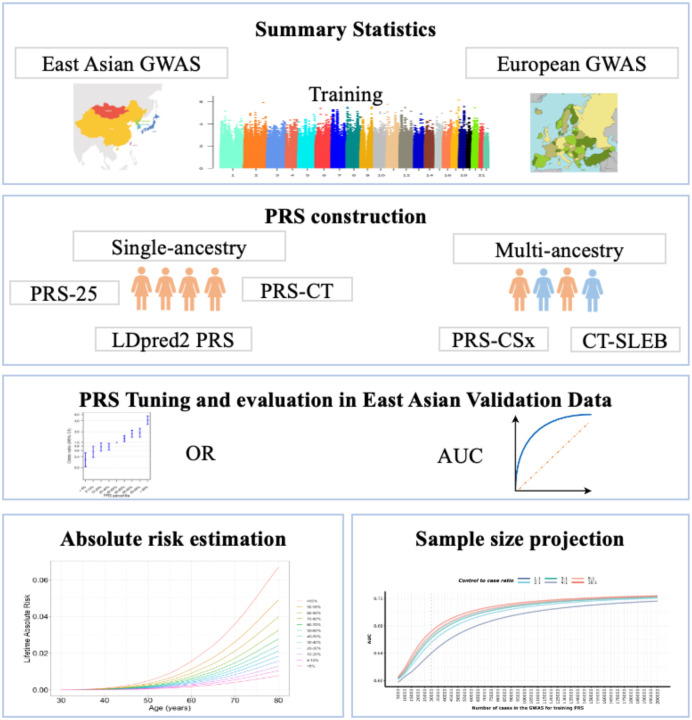
Background: Lung adenocarcinoma (LUAD) in never-smokers is a major public health burden, especially among East Asian women. Polygenic risk scores (PRSs) are promising for risk stratification but are primarily developed in European-ancestry populations. We aimed to develop and validate single- and multi-ancestry PRSs for East Asian never-smokers to improve LUAD risk prediction.
Methods: PRSs were developed using genome-wide association study summary statistics from East Asian (8,002 cases; 20,782 controls) and European (2,058 cases; 5,575 controls) populations. Single-ancestry models included PRS-25, PRS-CT, and LDpred2; multi-ancestry models included LDpred2+PRS-EUR128, PRS-CSx, and CT-SLEB. Performance was evaluated in independent East Asian data from the Female Lung Cancer Consortium (FLCCA) and externally validated in the Nanjing Lung Cancer Cohort (NJLCC). We assessed predictive accuracy via AUC, with 10-year and (age 30-80) absolute risks estimates.
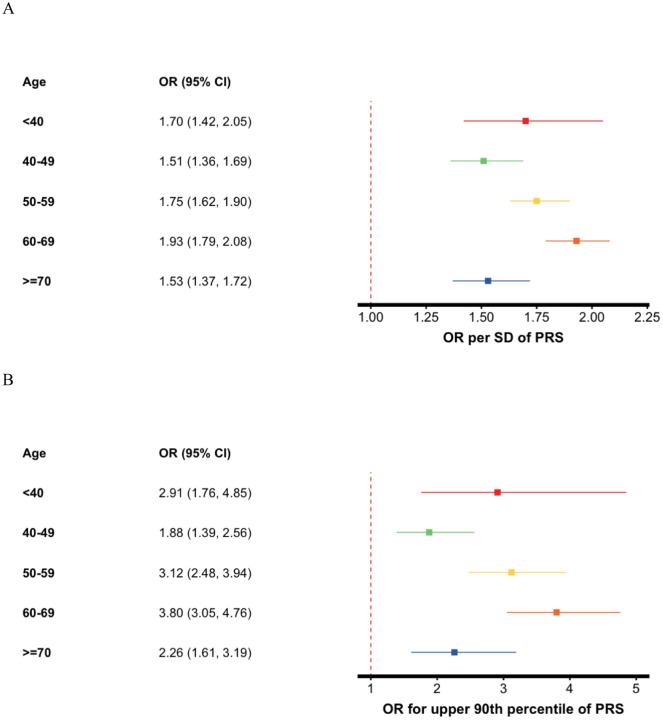
Results: The best multi-ancestry PRS, using East Asian and European data via CT-SLEB (clumping and thresholding, super learning, empirical Bayes), outperformed the best East Asian-only PRS (LDpred2; AUC=0.629, 95% CI:0.618,0.641), achieving an AUC of 0.640 (95% CI:0.629,0.653) and odds ratio of 1.71 (95% CI:1.61,1.82) per SD increase. NJLCC Validation confirmed robust performance (AUC =0.649, 95% CI: 0.623, 0.676). The top 20% PRS group had a 3.92-fold higher LUAD risk than the bottom 20%. Further, the top 5% PRS group reached a 6.69% lifetime absolute risk. Notably, this group reached the average population 10-year LUAD risk at age 50 (0.42%) by age 41, nine years earlier.
Conclusions: Multi-ancestry PRS approaches enhance LUAD risk stratification in East Asian never-smokers, with consistent external validation, suggesting future clinical utility.
Keywords: East Asian never smokers; Genome-wide association studies; Lifetime absolute risk; Lung adenocarcinoma; Polygenic risk scores.
Conflict of interest statement
Conflict of Interest The authors declare no competing interests.
Figures


References
-
- Bray F. et al. Global cancer statistics 2018: GLOBOCAN estimates of incidence and mortality worldwide for 36 cancers in 185 countries. CA. Cancer J. Clin. 68, 394–424 (2018). - PubMed
-
- Sun S., Schiller J. H. & Gazdar A. F. Lung cancer in never smokers--a different disease. Nat. Rev. Cancer 7, 778–790 (2007). - PubMed
Publication types
Grants and funding
- U19 CA148127/CA/NCI NIH HHS/United States
- N01 CN025512/CA/NCI NIH HHS/United States
- U01 CA063673/CA/NCI NIH HHS/United States
- N01 CN025522/CA/NCI NIH HHS/United States
- N01 CN025476/CA/NCI NIH HHS/United States
- R01 CA231141/CA/NCI NIH HHS/United States
- N01 CN025404/CA/NCI NIH HHS/United States
- R01 CA121210/CA/NCI NIH HHS/United States
- R01 CA149462/CA/NCI NIH HHS/United States
- N01 CN025515/CA/NCI NIH HHS/United States
- N01 RC037004/RC/CCR NIH HHS/United States
- UM1 CA167462/CA/NCI NIH HHS/United States
- N01 CN025514/CA/NCI NIH HHS/United States
- U01 CA167462/CA/NCI NIH HHS/United States
- R01 HG010480/HG/NHGRI NIH HHS/United States
- U19 CA203654/CA/NCI NIH HHS/United States
- N01 CN025511/CA/NCI NIH HHS/United States
- R37 CA070867/CA/NCI NIH HHS/United States
- R01 CA080127/CA/NCI NIH HHS/United States
- N01 CN025516/CA/NCI NIH HHS/United States
- N01 CN045165/CN/NCI NIH HHS/United States
- U01 CA209414/CA/NCI NIH HHS/United States
- R03 CA077118/CA/NCI NIH HHS/United States
- UM1 CA182910/CA/NCI NIH HHS/United States
LinkOut - more resources
Full Text Sources