


Investigation of the genetic aetiology of Lewy body diseases with and without dementia
- PMID: 38978726
- PMCID: PMC11228432
- DOI: 10.1093/braincomms/fcae190
Investigation of the genetic aetiology of Lewy body diseases with and without dementia
Abstract
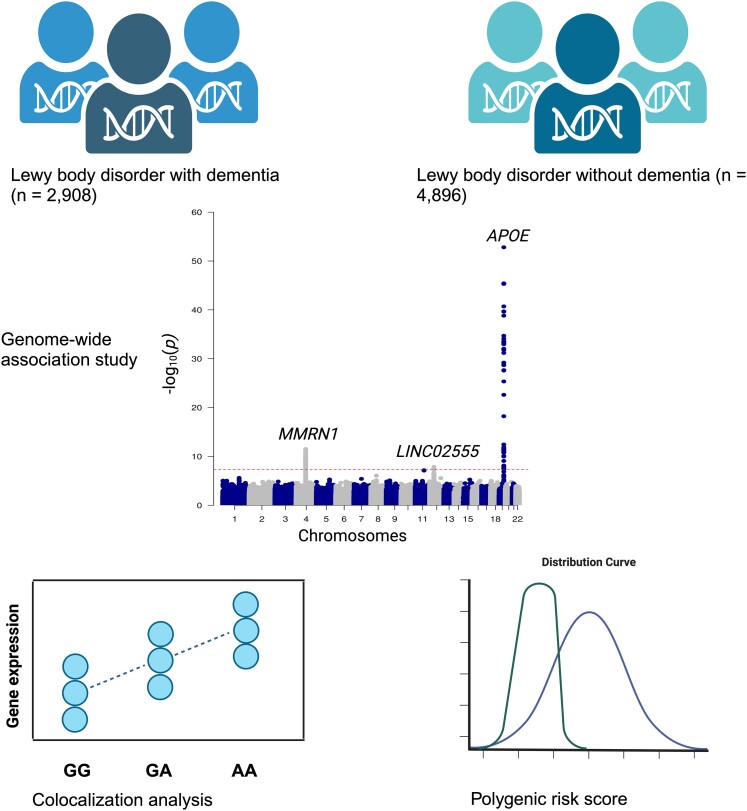
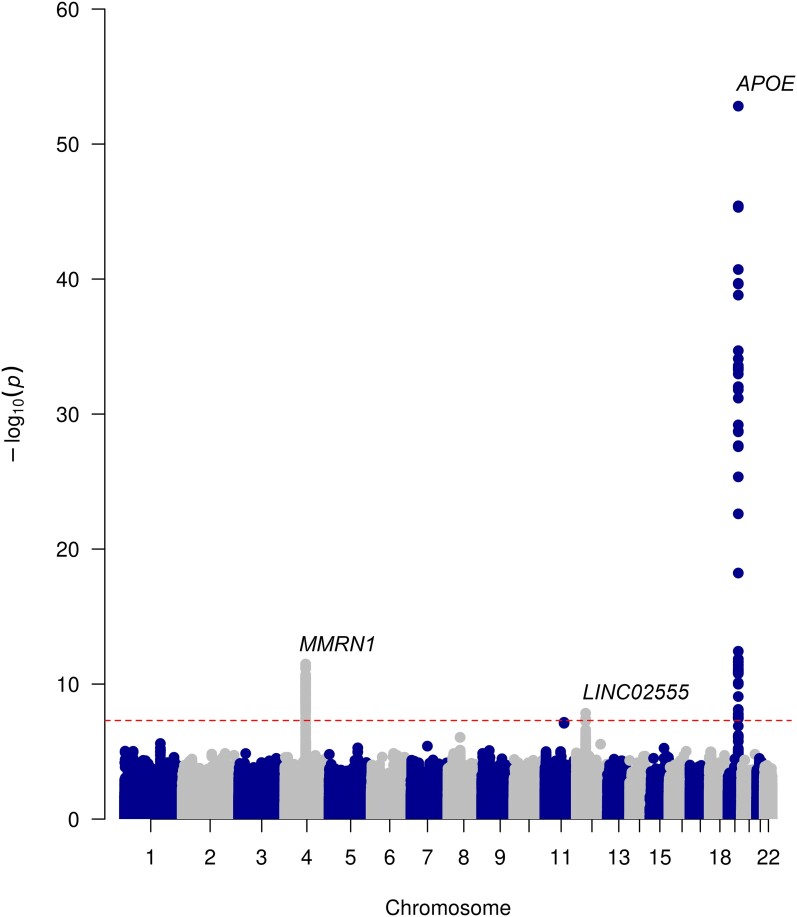
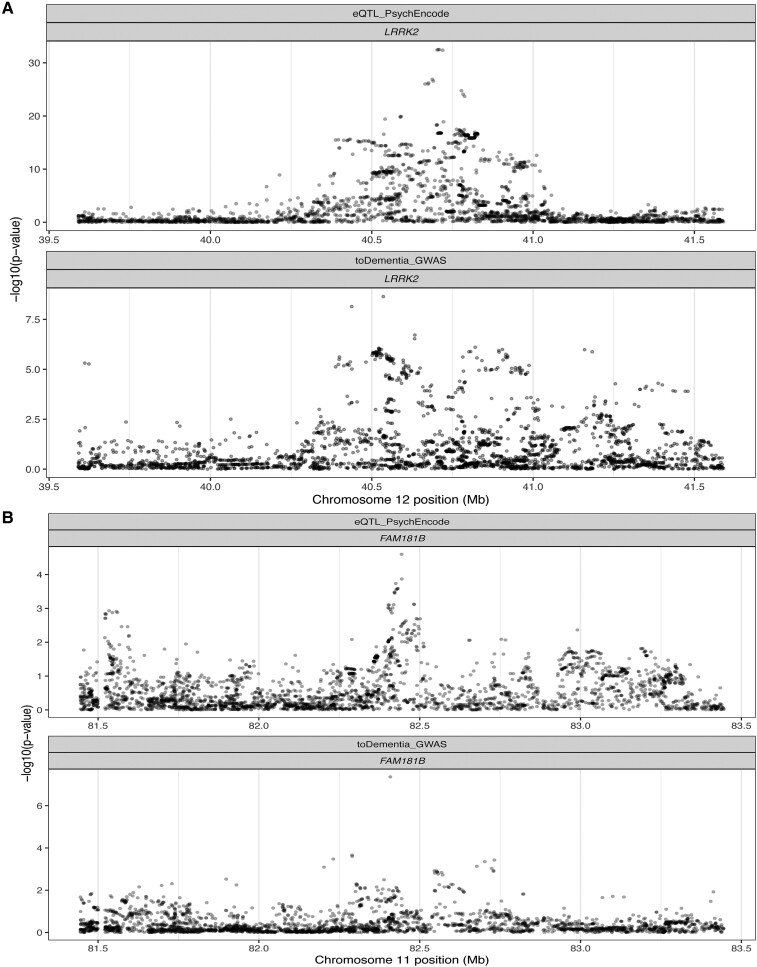
Up to 80% of Parkinson's disease patients develop dementia, but time to dementia varies widely from motor symptom onset. Dementia with Lewy bodies presents with clinical features similar to Parkinson's disease dementia, but cognitive impairment precedes or coincides with motor onset. It remains controversial whether dementia with Lewy bodies and Parkinson's disease dementia are distinct conditions or represent part of a disease spectrum. The biological mechanisms underlying disease heterogeneity, in particular the development of dementia, remain poorly understood, but will likely be the key to understanding disease pathways and, ultimately, therapy development. Previous genome-wide association studies in Parkinson's disease and dementia with Lewy bodies/Parkinson's disease dementia have identified risk loci differentiating patients from controls. We collated data for 7804 patients of European ancestry from Tracking Parkinson's, The Oxford Discovery Cohort, and Accelerating Medicine Partnership-Parkinson's Disease Initiative. We conducted a discrete phenotype genome-wide association study comparing Lewy body diseases with and without dementia to decode disease heterogeneity by investigating the genetic drivers of dementia in Lewy body diseases. We found that risk allele rs429358 tagging APOEe4 increases the odds of developing dementia, and that rs7668531 near the MMRN1 and SNCA-AS1 genes and an intronic variant rs17442721 tagging LRRK2 G2019S on chromosome 12 are protective against dementia. These results should be validated in autopsy-confirmed cases in future studies.
Keywords: APOE; Lewy body diseases; dementia; genome-wide association studies.
© The Author(s) 2024. Published by Oxford University Press on behalf of the Guarantors of Brain.
Conflict of interest statement
H.R.M. is employed by UCL. In the last 12 months, he reports paid consultancy from Roche, Aprinoia, AI Therapeutics and Amylyx; lecture fees/honoraria from BMJ, Kyowa Kirin and Movement Disorders Society; and research grants from Parkinson's UK, Cure Parkinson's Trust, PSP Association, Medical Research Council and Michael J. Fox Foundation. H.R.M. is a co-applicant on a patent application related to C9ORF72—Method for diagnosing a neurodegenerative disease (PCT/GB2012/052140).
Figures
Update of
-
Investigation of the genetic aetiology of Lewy body diseases with and without dementia.medRxiv [Preprint]. 2023 Oct 27:2023.10.17.23297157. doi: 10.1101/2023.10.17.23297157. medRxiv. 2023. Update in: Brain Commun. 2024 May 31;6(4):fcae190. doi: 10.1093/braincomms/fcae190. PMID: 37987016 Free PMC article. Updated. Preprint.
References
-
- Goedert M, Spillantini MG, Del Tredici K, Braak H. 100 years of Lewy pathology. Nat Rev Neurol. 2013;9(1):13–24. - PubMed
-
- Muslimovic D, Post B, Speelman JD, Schmand B. Cognitive profile of patients with newly diagnosed Parkinson disease. Neurology. 2005;65(8):1239–1245. - PubMed
-
- Hely MA, Reid WGJ, Adena MA, Halliday GM, Morris JGL. The Sydney multicenter study of Parkinson’s disease: The inevitability of dementia at 20 years. Mov Disord. 2008;23(6):837–844. - PubMed
-
- Lo RY, Tanner CM, Albers KB, et al. Clinical features in early Parkinson disease and survival. Arch Neurol. 2009;66(11):1353–1358. - PubMed
Grants and funding
LinkOut - more resources
Full Text Sources
Miscellaneous