


J-Shaped Relationship Between Weight-Adjusted-Waist Index and Cardiovascular Disease Risk in Hypertensive Patients with Obstructive Sleep Apnea: A Cohort Study
- PMID: 38978818
- PMCID: PMC11228610
- DOI: 10.2147/DMSO.S469376
J-Shaped Relationship Between Weight-Adjusted-Waist Index and Cardiovascular Disease Risk in Hypertensive Patients with Obstructive Sleep Apnea: A Cohort Study
Abstract
Background: A newly introduced obesity-related index, the weight-adjusted-waist index (WWI), emerges as a promising predictor of cardiovascular disease (CVD). Given the known synergistic effects of hypertension and obstructive sleep apnea (OSA) on cardiovascular risk, we aimed to explore the relationship between the WWI and CVD risk specifically within this high-risk cohort.
Methods: A total of 2265 participants with hypertension and OSA were included in the study. Multivariate Cox regression analysis was used to calculate hazard ratios (HRs) and 95% confidence intervals (CIs) for CVD events. The restricted cubic spline (RCS) was used to further evaluate the nonlinear dose-response relationship.
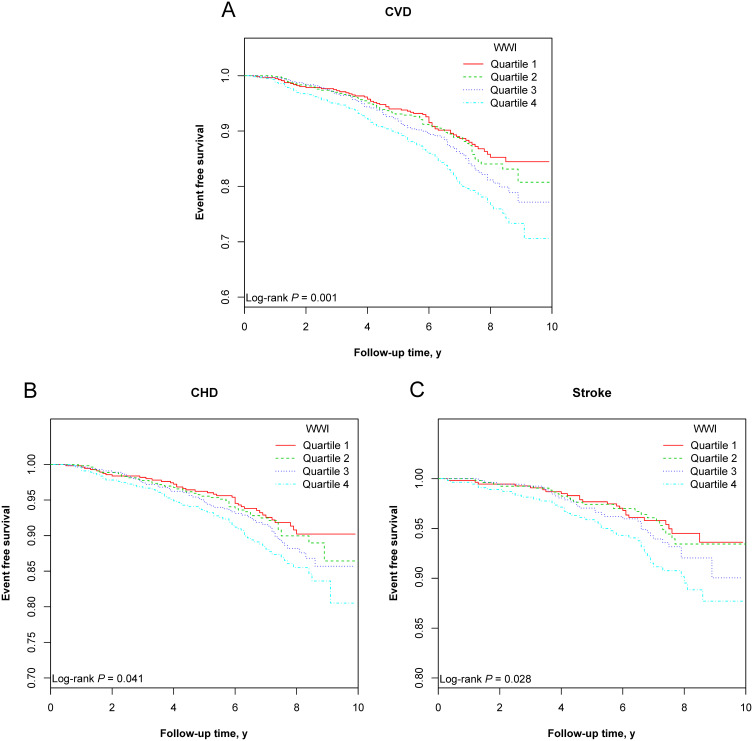
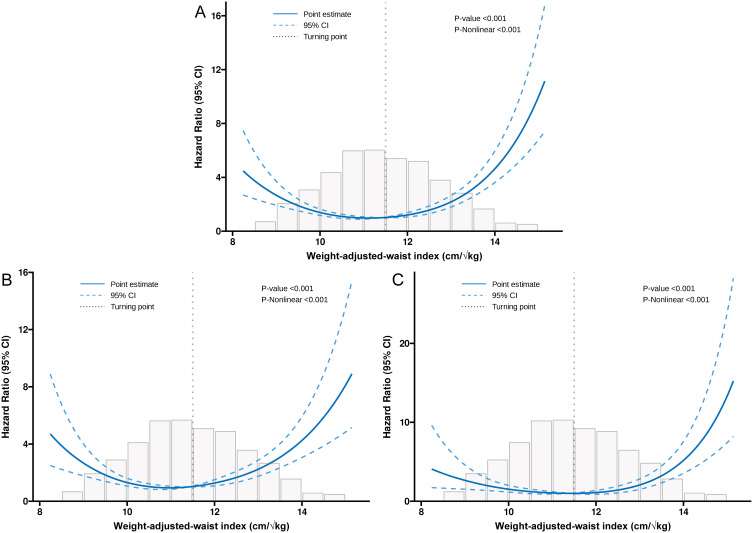
Results: During a median follow-up period of 6.8 years, 324 participants experienced a CVD event. Multivariate Cox regression analysis revealed that compared to the reference group, the HRs for the second, third, and fourth groups were 1.12 (95% CI, 0.79-1.59), 1.35 (95% CI, 0.96-1.89), and 1.58 (95% CI, 1.13-2.22), respectively. Moreover, RCS analysis illustrated a clear J-shaped relationship between the WWI and CVD risk, particularly notable when WWI exceeded 11.5 cm/√kg, signifying a significant increase in CVD risk.
Conclusion: There was a J-shaped relationship between WWI and CVD in hypertensive patients with OSA, especially when the WWI was greater than 11.5 cm/√kg, the risk of CVD was significantly increased.
Keywords: cardiovascular disease; hypertensive; obstructive sleep apnea; visceral obesity; weight-adjusted-waist index.
© 2024 Zhao et al.
Conflict of interest statement
The authors report no conflicts of interest in this work.
Figures
References
-
- Wang H, Naghavi M, Allen C, Barber RM, Bhutta ZA, Carter A. Global, regional, and national life expectancy, all-cause mortality, and cause-specific mortality for 249 causes of death, 1980-2015: a systematic analysis for the Global burden of disease study 2015. Lancet. 2016;388(10053):1459–1544. doi: 10.1016/S0140-6736(16)31012-1 - DOI - PMC - PubMed
LinkOut - more resources
Full Text Sources
