


Predicting inmate suicidal behavior with an interpretable ensemble machine learning approach in smart prisons
- PMID: 38983205
- PMCID: PMC11232594
- DOI: 10.7717/peerj-cs.2051
Predicting inmate suicidal behavior with an interpretable ensemble machine learning approach in smart prisons
Abstract
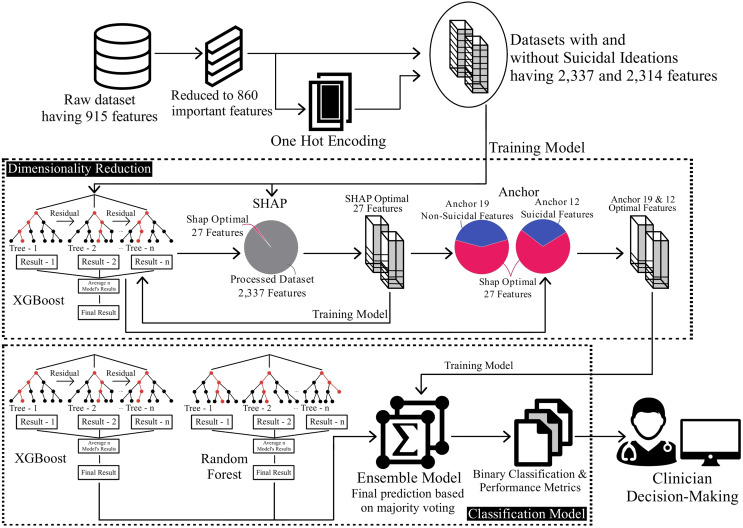
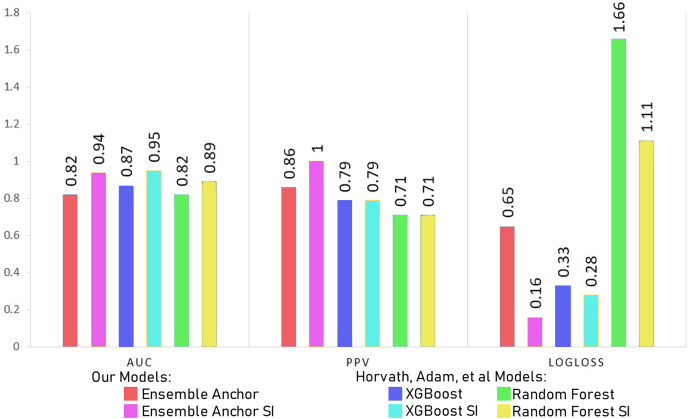
The convergence of smart technologies and predictive modelling in prisons presents an exciting opportunity to revolutionize the monitoring of inmate behaviour, allowing for the early detection of signs of distress and the effective mitigation of suicide risks. While machine learning algorithms have been extensively employed in predicting suicidal behaviour, a critical aspect that has often been overlooked is the interoperability of these models. Most of the work done on model interpretations for suicide predictions often limits itself to feature reduction and highlighting important contributing features only. To address this research gap, we used Anchor explanations for creating human-readable statements based on simple rules, which, to our knowledge, have never been used before for suicide prediction models. We also overcome the limitation of anchor explanations, which create weak rules on high-dimensionality datasets, by first reducing data features with the help of SHapley Additive exPlanations (SHAP). We further reduce data features through anchor interpretations for the final ensemble model of XGBoost and random forest. Our results indicate significant improvement when compared with state-of-the-art models, having an accuracy and precision of 98.6% and 98.9%, respectively. The F1-score for the best suicide ideation model appeared to be 96.7%.
Keywords: Ensemble; Machine learning; Model reduction; SHAP; Smart prisons.
© 2024 Akhtar et al.
Conflict of interest statement
The authors declare that they have no competing interests.
Figures






References
-
- Aldhaheri MAMM, Xia B, Nepal M, Chen Q. Selecting key smart building technologies for uae prisons by integrating analytical hierarchy process (AHP) and fuzzy-TOPSIS. Buildings. 2022;12:2074. doi: 10.3390/buildings12122074. - DOI
-
- Altaf Khattak SB, Nasralla MM, Rehman IU. The role of 6G networks in enabling future smart health services and applications. 2022 IEEE International Smart Cities Conference (ISC2); Piscataway: IEEE; 2022. pp. 1–7.
LinkOut - more resources
Full Text Sources
Miscellaneous