Review
. 2024 Jun 25:12:1413518.
doi: 10.3389/fbioe.2024.1413518. eCollection 2024.

The journey of decellularized vessel: from laboratory to operating room

Affiliations
Review

The journey of decellularized vessel: from laboratory to operating room

Chenbin Kang et al. Front Bioeng Biotechnol. .

Abstract

Over the past few decades, there has been a remarkable advancement in the field of transplantation. But the shortage of donors is still an urgent problem that requires immediate attention. As with xenotransplantation, bioengineered organs are promising solutions to the current shortage situation. And decellularization is a unique technology in organ-bioengineering. However, at present, there is no unified decellularization method for different tissues, and there is no gold-standard for evaluating decellularization efficiency. Meanwhile, recellularization, re-endothelialization and modification are needed to form transplantable organs. With this mind, we can start with decellularization and re-endothelialization or modification of small blood vessels, which would serve to address the shortage of small-diameter vessels while simultaneously gathering the requisite data and inspiration for further recellularization of the whole organ-scale vascular network. In this review, we collect the related experiments of decellularization and post-decellularization approaches of small vessels in recent years. Subsequently, we summarize the experience in relation to the decellularization and post-decellularization combinations, and put forward obstacle we face and possible solutions.

Keywords: bioengineer; decellularization; extracellular matrix; vessel; xenotransplantation.


Conflict of interest statement

The authors declare that the research was conducted in the absence of any commercial or financial relationships that could be construed as a potential conflict of interest.

Figures
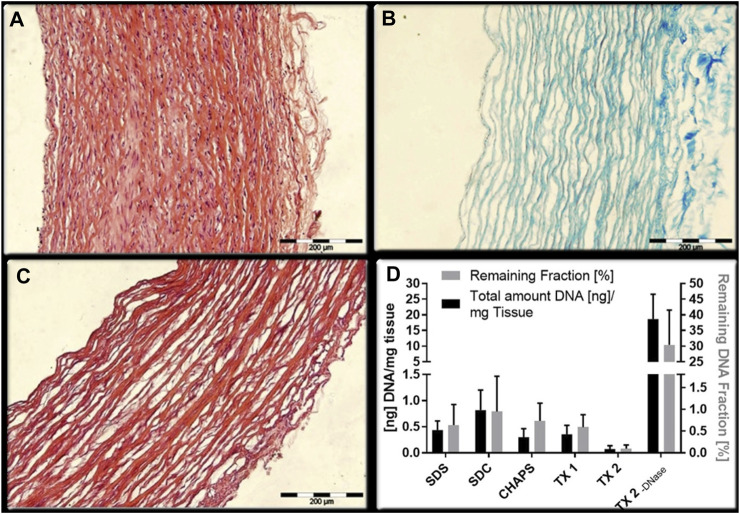
FIGURE 1
FIGURE 1
Comparison of two decellularization combinations. Although the decellularity were measured by microscope images analysis (López-Ruiz et al., 2017) (A): HE staining of natural arterial blood vessel; (B) staining of collagen fibers remaining after decellularization; (C) HE staining after decellularization) or DNA quantification (Dahan et al., 2017) (D): quantification of DNA and proportion of retained fraction after decellularization), they can both reflect the decellularity of the scaffold and the integrity of remaining ECM to a certain extent.
FIGURE 2
FIGURE 2
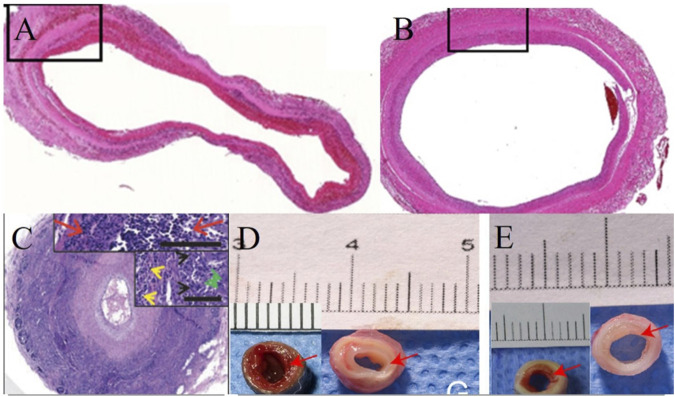
Effect of different treatments and time on remodeling of decellularized blood vessels in vivo. (A,B) Following 49 h of decellularization of human umbilical cord arteries, the internal diameter of the vessels remained almost unchanged and patent on days 3 and 90 in vivo. (Lin et al., 2021); (C) After 270 h of decellularization, the porcine carotid artery was almost occluded at week six in vivo (Dahan et al., 2017); (D,E) After 108.5 h of decellularization, bovine mammary arteries implanted in vivo for 4 weeks showed different degrees of endothelial proliferation before and after post-decellularization treatment (Liu et al., 2022).
FIGURE 3
FIGURE 3
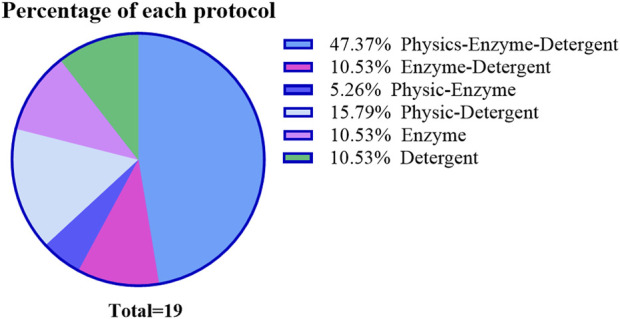
Proportion of different decellularization methods based on included experiments.

Similar articles

Cited by

References

    1. Bachelier K., Bergholz C., Friedrich E. B. (2020). Differentiation potential and functional properties of a CD34-CD133+ subpopulation of endothelial progenitor cells. Mol. Med. Rep. 21 (1), 501–507. 10.3892/mmr.2019.10831 - DOI - PubMed
    1. Bao J., Wu Q., Sun J., Zhou Y., Wang Y., Jiang X., et al. (2015). Hemocompatibility improvement of perfusion-decellularized clinical-scale liver scaffold through heparin immobilization. Sci. Rep. 5, 10756. 10.1038/srep10756 - DOI - PMC - PubMed
    1. Baptista P. M., Siddiqui M. M., Lozier G., Rodriguez S. R., Atala A., Soker S. (2011). The use of whole organ decellularization for the generation of a vascularized liver organoid. Hepatol. 53 (2), 604–17. - PubMed
    1. Beckman J. A., Schneider P. A., Conte M. S. (2021). Advances in revascularization for peripheral artery disease: revascularization in PAD. Circ. Res. 128 (12), 1885–1912. 10.1161/circresaha.121.318261 - DOI - PubMed
    1. Born G. V. (1962). Aggregation of blood platelets by adenosine diphosphate and its reversal. Nature 194, 927–929. 10.1038/194927b0 - DOI - PubMed