. 2024 Jun 19;14(6):954-984.
doi: 10.5498/wjp.v14.i6.954.

This pain drives me crazy: Psychiatric symptoms in women with interstitial cystitis/bladder pain syndrome

Marianna Mazza  1 Stella Margoni  2 Giuseppe Mandracchia  2 Guglielmo Donofrio  2 Alessia Fischetti  2 Georgios D Kotzalidis  2 Giuseppe Marano  3 Alessio Simonetti  2 Delfina Janiri  2 Lorenzo Moccia  4 Ilaria Marcelli  2 Greta Sfratta  2 Domenico De Berardis  5 Ottavia Ferrara  2 Evelina Bernardi  2 Antonio Restaino  2 Francesco Maria Lisci  2 Antonio Maria D'Onofrio  2 Caterina Brisi  2 Flavia Grisoni  2 Claudia Calderoni  2 Michele Ciliberto  2 Andrea Brugnami  2 Sara Rossi  2 Maria Chiara Spera  2 Valeria De Masi  2 Ester Maria Marzo  2 Francesca Abate  2 Gianluca Boggio  2 Maria Benedetta Anesini  2 Cecilia Falsini  2 Anna Quintano  2 Alberto Torresi  2 Miriam Milintenda  2 Giovanni Bartolucci  2 Marco Biscosi  2 Sara Ruggiero  2 Luca Lo Giudice  2 Giulia Mastroeni  2 Elisabetta Benini  2 Luca Di Benedetto  2 Romina Caso  2 Francesco Pesaresi  2 Francesco Traccis  2 Luca Onori  2 Luca Chisari  2 Leonardo Monacelli  2 Mariateresa Acanfora  2 Eleonora Gaetani  6 Monia Marturano  7 Sara Barbonetti  2 Elettra Specogna  2 Francesca Bardi  2 Emanuela De Chiara  2 Gianmarco Stella  2 Andrea Zanzarri  2 Flavio Tavoletta  2 Arianna Crupi  2 Giulia Battisti  2 Laura Monti  8 Giovanni Camardese  2 Daniela Chieffo  8 Antonio Gasbarrini  9 Giovanni Scambia  10 Gabriele Sani  11
Affiliations

This pain drives me crazy: Psychiatric symptoms in women with interstitial cystitis/bladder pain syndrome

Marianna Mazza et al. World J Psychiatry. .

Abstract

Background: Interstitial cystitis/bladder pain syndrome (IC/BPS) is an at least 6-mo noninfectious bladder inflammation of unknown origin characterized by chronic suprapubic, abdominal, and/or pelvic pain. Although the term cystitis suggests an inflammatory or infectious origin, no definite cause has been identified. It occurs in both sexes, but women are twice as much affected.

Aim: To systematically review evidence of psychiatric/psychological changes in persons with IC/BPS.

Methods: Hypothesizing that particular psychological characteristics could underpin IC/BPS, we investigated in three databases the presence of psychiatric symptoms and/or disorders and/or psychological characteristics in patients with IC/BPS using the following strategy: ("interstitial cystitis" OR "bladder pain syndrome") AND ("mood disorder" OR depressive OR antidepressant OR depression OR depressed OR hyperthymic OR mania OR manic OR rapid cyclasterisk OR dysthymiasterisk OR dysphoriasterisk).

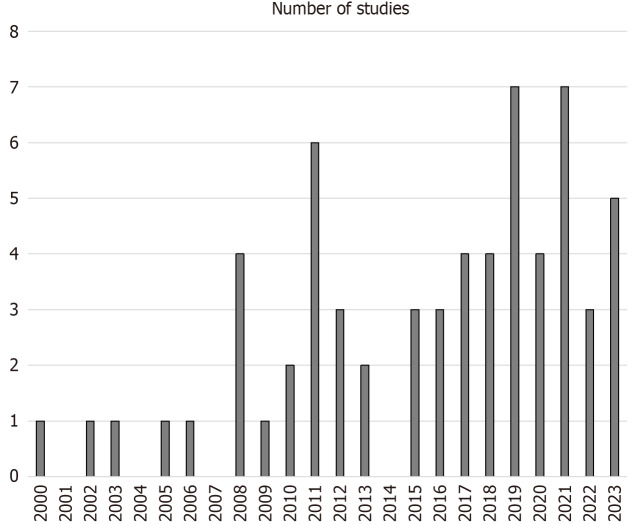
Results: On September 27, 2023, the PubMed search produced 223 articles, CINAHL 62, and the combined PsycLIT/ PsycARTICLES/PsycINFO/Psychology and Behavioral Sciences Collection search 36. Search on ClinicalTrials.gov produced 14 studies, of which none had available data. Eligible were peer-reviewed articles reporting psychiatric/psychological symptoms in patients with IC/BPS, i.e. 63 articles spanning from 2000 to October 2023. These studies identified depression and anxiety problems in the IC/BPS population, along with sleep problems and the tendency to catastrophizing.

Conclusion: Psychotherapies targeting catastrophizing and life stress emotional awareness and expression reduced perceived pain in women with IC/BPS. Such concepts should be considered when implementing treatments aimed at reducing IC/BPS-related pain.

Keywords: Anxiety; Catastrophizing; Depression; Interstitial cystitis/bladder pain syndrome; Psychiatric symptoms; Psychological symptoms.


Conflict of interest statement

Conflict-of-interest statement: All authors declare having no conflicts of interest.

Figures
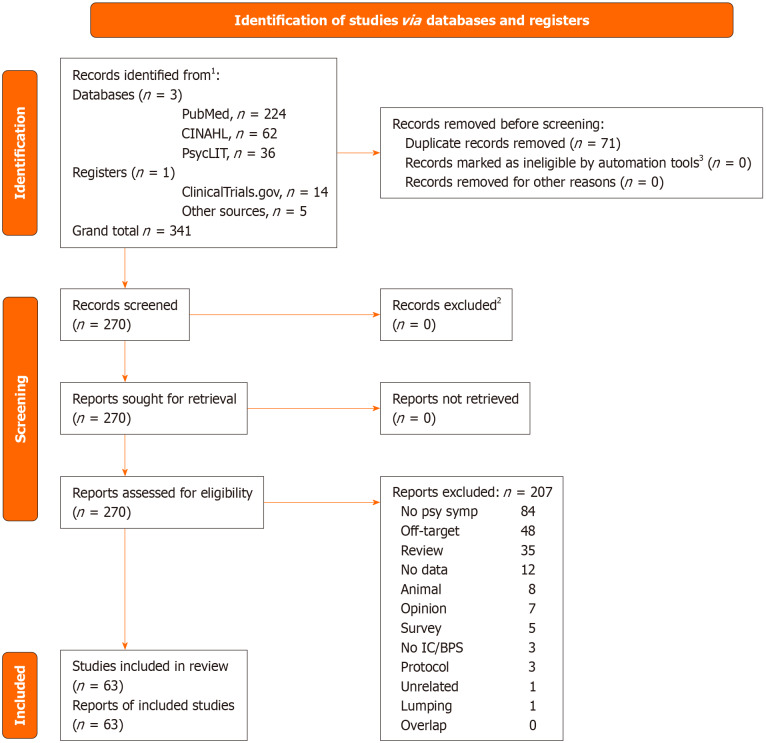
Figure 1
Figure 1
PRISMA flowchart of our search and inclusion procedures. 1Consider, if feasible to do so, reporting the number of records identified from each database or register searched (rather than the total number across all databases/registers); 2If automation tools were used, indicate how many records were excluded by a human and how many were excluded by automation tools; 3No automation tools were used. IC/BPS: Interstitial cystitis/bladder pain syndrome.
Figure 2
Figure 2
Per year distribution of eligible studies.

References

    1. Newsome G. Interstitial cystitis. J Am Acad Nurse Pract. 2003;15:64–71. - PubMed
    1. Osório FL, Carvalho AC, Donadon MF, Moreno AL, Polli-Neto O. Chronic pelvic pain, psychiatric disorders and early emotional traumas: Results of a cross sectional case-control study. World J Psychiatry. 2016;6:339–344. - PMC - PubMed
    1. Hsieh KL, Chin HY, Lo TS, Long CY, Ho CH, Huang SK, Chuang YC, Wu MP. Interstitial cystitis/bladder pain syndrome patient is associated with subsequent increased risks of outpatient visits and hospitalizations: A population-based study. PLoS One. 2021;16:e0256800. - PMC - PubMed
    1. Echols RM, Tosiello RL, Haverstock DC, Tice AD. Demographic, clinical, and treatment parameters influencing the outcome of acute cystitis. Clin Infect Dis. 1999;29:113–119. - PubMed
    1. Grover S, Srivastava A, Lee R, Tewari AK, Te AE. Role of inflammation in bladder function and interstitial cystitis. Ther Adv Urol. 2011;3:19–33. - PMC - PubMed

LinkOut - more resources