Review
. 2024 Nov 25;17(22):e202301827.
doi: 10.1002/cssc.202301827. Epub 2024 Sep 24.

Developing Catalysts for Membrane Electrode Assemblies in High Performance Polymer Electrolyte Membrane Water Electrolyzers

Affiliations
Review

Developing Catalysts for Membrane Electrode Assemblies in High Performance Polymer Electrolyte Membrane Water Electrolyzers

Sun Seo Jeon et al. ChemSusChem. .

Abstract

Extensive research is underway to achieve carbon neutrality through the production of green hydrogen via water electrolysis, powered by renewable energy. Polymer membrane water electrolyzers, such as proton exchange membrane water electrolyzer (PEMWE) and anion exchange membrane water electrolyzer (AEMWE), are at the forefront of this research. Developing highly active and durable electrode catalysts is crucial for commercializing these electrolyzers. However, most research is conducted in half-cell setups, which may not fully represent the catalysts' effectiveness in membrane-electrode-assembly (MEA) devices. This review explores the catalysts developed for high-performance PEMWE and AEMWE MEA systems. Only the catalysts reporting on the MEA performance were discussed in this review. In PEMWE, strategies aim to minimize Ir use for the oxygen evolution reaction (OER) by maximizing activity, employing metal oxide-based supports, integrating secondary elements into IrOx lattices, or exploring non-Ir materials. For AEMWE, the emphasis is on enhancing the performance of NiFe-based and Co-based catalysts by improving electrical conductivity and mass transport. Pt-based and Ni-based catalysts for the hydrogen evolution reaction (HER) in AEMWE are also examined. Additionally, this review discusses the unique considerations for catalysts operating in pure water within AEMWE systems.

Keywords: Catalysts; Hydrogen evolution reaction; Membrane electrode assembly; Oxygen evolution reaction; Water electrolyzer.


Conflict of interest statement

The authors declare no conflict of interest.

Figures
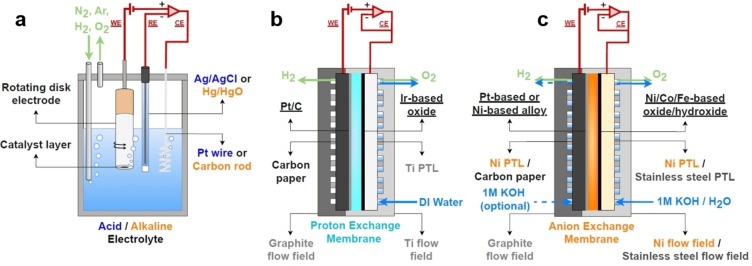
Figure 1
Figure 1
Illustration of (a) three‐electrode (half‐cell) set‐up with rotating disk electrode as working electrode, (b) proton exchange membrane water electrolyzer and (c) anion exchange membrane water electrolyzer.
Figure 2
Figure 2
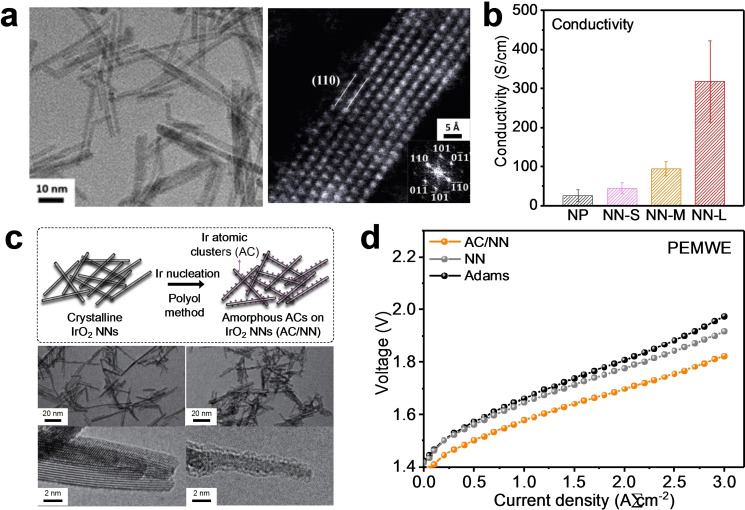
(a) TEM image of IrO2 nanoneedles. (b) The electrical conductivity of IrO2 nanoneedles in PEMWE. Reproduced with permission from ref. [32]. Copyright 2018 Wiley VCH (c) Schematic and TEM image of amorphous Ir cluster anchored IrO2 nanoneedles. (d) Polarization curves of amorphous Ir cluster anchored IrO2 nanoneedles in PEMWE. Reproduced with permission from ref. [33]. Copyright 2022 Elsevier B.V.
Figure 3
Figure 3
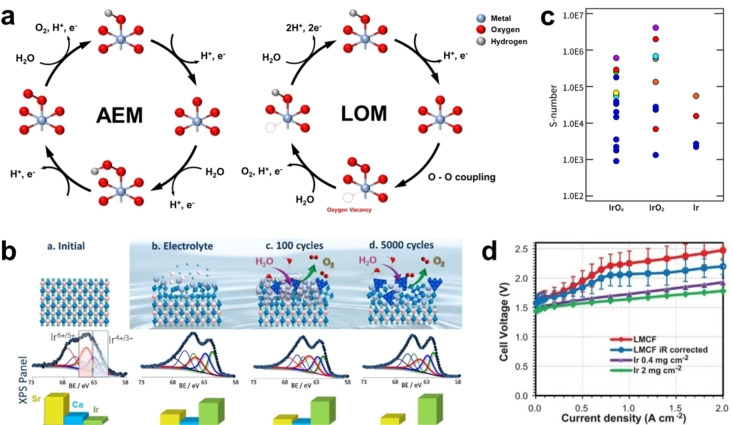
(a) Scheme of AEM and LOM pathway for the OER. (b) Schematic of surface reconstruction and oxidation state change during OER. Reproduced with permission from ref. [55]. Copyright 2022 Nature Research. (c) S–number of Ir catalysts from various references. Reproduced with permission from ref. [56]. Copyright 2023 American Chemical Society. (d) Catalytic activity of nanofibrous cobalt spinel catalyst codoped with La and Mn (LMCF) in PEMWE. Reproduced with permission from ref. [57]. Copyright 2023 AAAS.
Figure 4
Figure 4
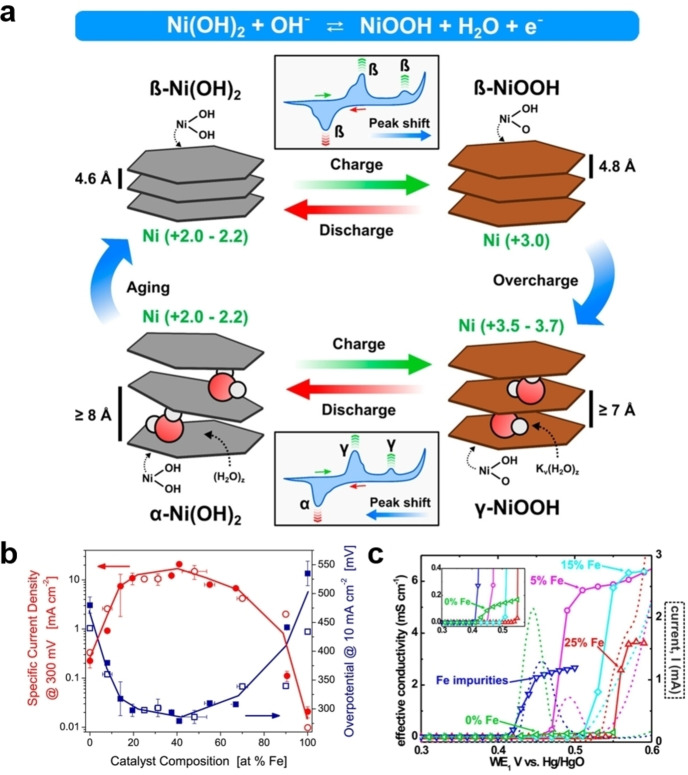
(a) Bode scheme of Ni(OH)2/NiOOH redox transformation. Reproduced with permission from ref. [78]. Copyright 2023 American Chemical Society. (b) OER activity of electrodeposited NiFe catalyst with various Fe contents in 0.1 M KOH. Reproduced with permission from ref. [79]. Copyright 2013 American Chemical Society. (c) Conductivity of NiFe (oxy)hydroxide films with various Fe contents. Reproduced with permission from ref. [80]. Copyright 2015 American Chemical Society.
Figure 5
Figure 5
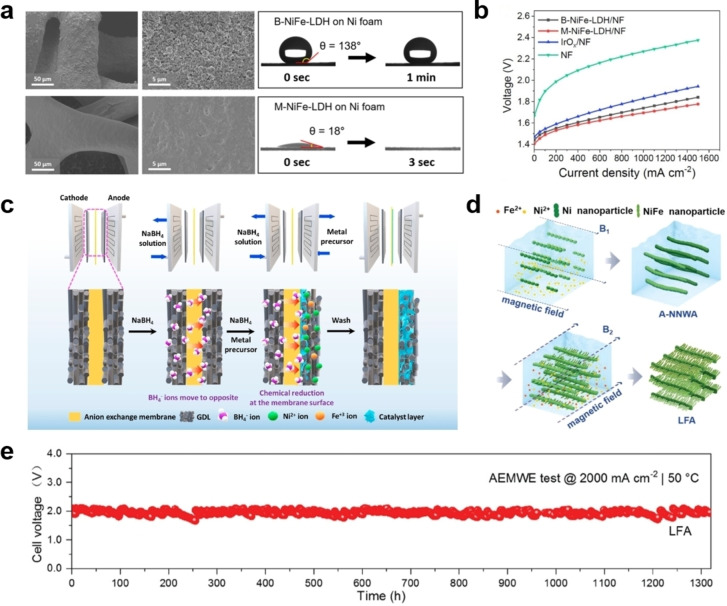
(a) SEM images of Ni foam coated with bulk NiFe LDH (above), monolayer‐like NiFe LDH (below) and photographs of a 1 M KOH droplet on the electrodes, and (b) their AEMWE polarization curves. Reproduced with permission from ref. [83]. Copyright 2021 American Chemical Society. (c) Schematic for NiFe catalyst in‐situ formed within MEA setup. Reproduced with permission from ref. [86]. Copyright 2023 American Chemical Society. (d) Schematic of aligned NiFe nanoparticles on Ni nanowire synthesized by electrodeposition under a magnetic field, and (e) their AEMWE durability test result performed at 2000 mA cm−2 and 50 °C in 1 M KOH. Reproduced with permission from ref. [87]. Copyright 2023 Wiley VCH.
Figure 6
Figure 6
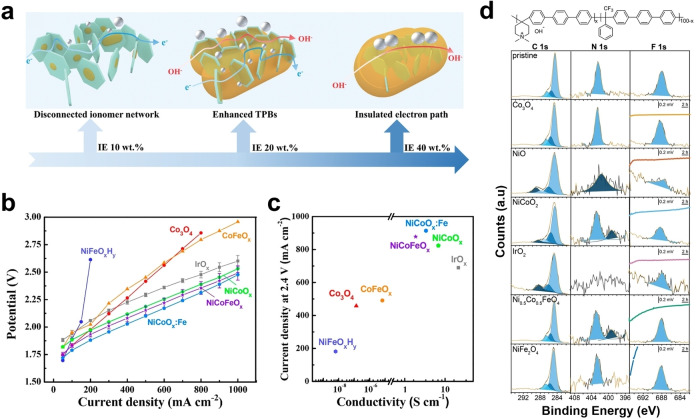
(a) Schematic illustration of vertically aligned NiFe LDH nanosheet arrays with various ionomer contents. Reproduced with permission from ref. [107]. Copyright 2022 Wiley VCH. (b) Polarization curves of pure water AEMWE using various OER catalysts and (c) the current density at 2.4 V correlated with the electrical conductivity of the OER catalysts. Reproduced with permission from ref. [108]. Copyright 2019 American Chemical Society. (d) XPS results of the cathode in pure water AEMWE after 20 hours of operation at 500 mA cm−2. Reproduced with permission from ref. [109]. Copyright 2022 Wiley VCH.
Figure 7
Figure 7
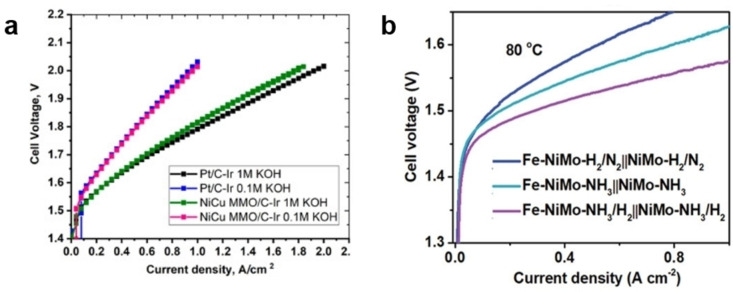
(a) Polarization curves of AEMWE using NiCu mixed metal oxide HER catalyst and Ir black OER catalyst. Reproduced with permission from ref. [123]. Copyright 2021 Elsevier Ltd. (b) Polarization curves of AEMWE using NiMo‐NH3/H2 HER catalyst and Fe‐NiMo‐NH3/H2 OER catalyst. Reproduced with permission from ref. [101] .Copyright 2020 Wiley‐VCH GmbH.
Figure 8
Figure 8
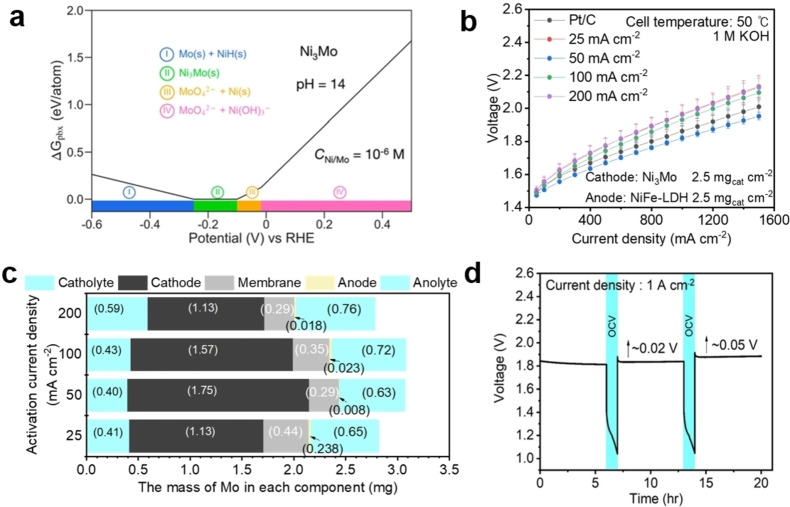
(a) Pourbaix diagram of Ni3Mo catalyst in pH 14. Reproduced with permission from ref. [128]. Copyright 2021 American Chemical Society. (b) Polarization curves of Ni3Mo catalysts when they were activated at various current densities. NiFe LDH was used as OER catalyst. (c) Mo distribution in electrode, membrane, and electrolyte measured by XRF and ICP. (d) Effect of imposing open‐circuit voltage (OCV) for 30 min. Reproduced with permission from ref. [130]. Copyright 2023 American Chemical Society.

References

    1. Igalavithana A. D., You S., Zhang L., Shang J., Lehmann J., Wang X., Zhu Y.-G., Tsang D. C. W., Park Y.-K., Hou D., Ok Y. S., ACS ES&T Eng. 2022, 2, 1987–2001.
    1. Panwar N. L., Kaushik S. C., Kothari S., Renewable Sustainable Energy Rev. 2011, 15, 1513–1524.
    1. Buttler A., Spliethoff H., Renewable Sustainable Energy Rev. 2018, 82, 2440–2454.
    1. Oliveira A. M., Beswick R. R., Yan Y., Curr. Opin. Chem. Eng. 2021, 33, 100701.
    1. Chatenet M., Pollet B. G., Dekel D. R., Dionigi F., Deseure J., Millet P., Braatz R. D., Bazant M. Z., Eikerling M., Staffell I., Balcombe P., Shao-Horn Y., Schäfer H., Chem. Soc. Rev. 2022, 51, 4583–4762. - PMC - PubMed

LinkOut - more resources