


Radiomics incorporating deep features for predicting Parkinson's disease in 123I-Ioflupane SPECT
- PMID: 38985382
- PMCID: PMC11236833
- DOI: 10.1186/s40658-024-00651-1
Radiomics incorporating deep features for predicting Parkinson's disease in 123I-Ioflupane SPECT
Abstract
Purpose: 123I-Ioflupane SPECT is an effective tool for the diagnosis and progression assessment of Parkinson's disease (PD). Radiomics and deep learning (DL) can be used to track and analyze the underlying image texture and features to predict the Hoehn-Yahr stages (HYS) of PD. In this study, we aim to predict HYS at year 0 and year 4 after the first diagnosis with combined imaging, radiomics and DL-based features using 123I-Ioflupane SPECT images at year 0.
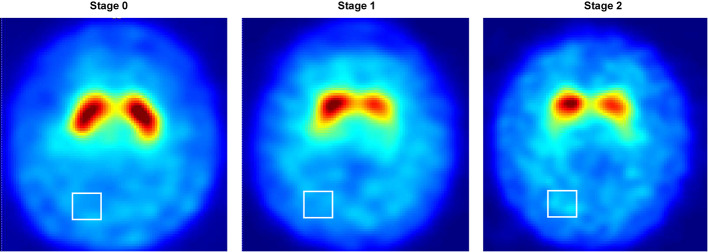
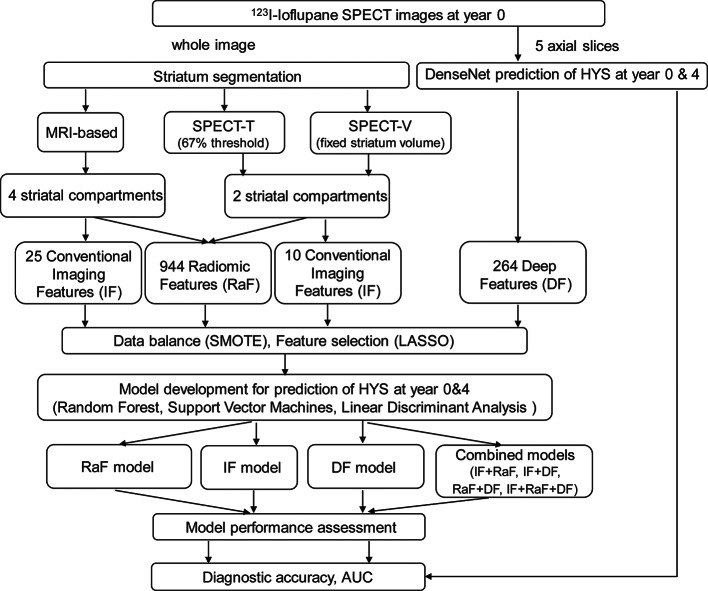
Methods: In this study, 161 subjects from the Parkinson's Progressive Marker Initiative database underwent baseline 3T MRI and 123I-Ioflupane SPECT, with HYS assessment at years 0 and 4 after first diagnosis. Conventional imaging features (IF) and radiomic features (RaF) for striatum uptakes were extracted from SPECT images using MRI- and SPECT-based (SPECT-V and SPECT-T) segmentations respectively. A 2D DenseNet was used to predict HYS of PD, and simultaneously generate deep features (DF). The random forest algorithm was applied to develop models based on DF, RaF, IF and combined features to predict HYS (stage 0, 1 and 2) at year 0 and (stage 0, 1 and ≥ 2) at year 4, respectively. Model predictive accuracy and receiver operating characteristic (ROC) analysis were assessed for various prediction models.
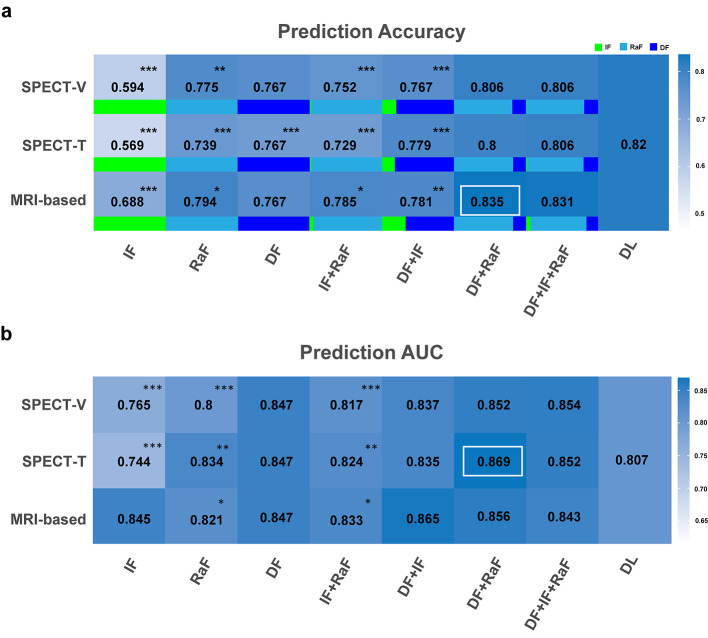
Results: For the diagnostic accuracy at year 0, DL (0.696) outperformed most models, except DF + IF in SPECT-V (0.704), significantly superior based on paired t-test. For year 4, accuracy of DF + RaF model in MRI-based method is the highest (0.835), significantly better than DF + IF, IF + RaF, RaF and IF models. And DL (0.820) surpassed models in both SPECT-based methods. The area under the ROC curve (AUC) highlighted DF + RaF model (0.854) in MRI-based method at year 0 and DF + RaF model (0.869) in SPECT-T method at year 4, outperforming DL models, respectively. And then, there was no significant differences between SPECT-based and MRI-based segmentation methods except for the imaging feature models.
Conclusion: The combination of radiomic and deep features enhances the prediction accuracy of PD HYS compared to only radiomics or DL. This suggests the potential for further advancements in predictive model performance for PD HYS at year 0 and year 4 after first diagnosis using 123I-Ioflupane SPECT images at year 0, thereby facilitating early diagnosis and treatment for PD patients. No significant difference was observed in radiomics results obtained between MRI- and SPECT-based striatum segmentations for radiomic and deep features.
Keywords: 123I-Ioflupane; Deep feature; Deep learning; Parkinson’s disease; Radiomics; SPECT.
© 2024. The Author(s).
Conflict of interest statement
The authors declare that they have no conflict of interest.
Figures


References
-
- Group PDMC, Gray R, Ives N, Rick C, Patel S, Gray A, et al. Long-term effectiveness of dopamine agonists and monoamine oxidase B inhibitors compared with levodopa as initial treatment for Parkinson’s disease (PD MED): a large, open-label, pragmatic randomised trial. Lancet. 2014;384(9949):1196–205. doi: 10.1016/S0140-6736(14)60683-8. - DOI - PubMed
Grants and funding
- 0016/2023/RIB1/Science and Technology Development Fund of Macau
- MYRG-CRG2022-00011-ICMS/Collaborative Research Grant from University of Macau
- EF062/FST/MSP/2023/ZJFCYLKJ/External Industrial Research Collaboration Grant from Zhejiang Fuchuan Medical Technology Co., Ltd.
- 82302263/National Natural Science Foundation of China
- 2023GGA020/Fujian Provincial Health Technology Project
LinkOut - more resources
Full Text Sources
Research Materials
Miscellaneous
