


The black box of the relationship between breast cancer patients and accompanying patients: the accompanied patients' point of view
- PMID: 38987731
- PMCID: PMC11234724
- DOI: 10.1186/s12885-024-12585-z
The black box of the relationship between breast cancer patients and accompanying patients: the accompanied patients' point of view
Abstract
Background: The PAROLE-Onco program was introduced in the province of Quebec, Canada in 2019. It integrates accompanying patients (APs), i.e., people who have been affected by cancer, into the clinical team as full members. These APs use their experiential knowledge with people undergoing treatment and with clinical teams. The aim of this paper is to evaluate, within the framework of two university medical centers, the perceptions of breast cancer patients who receive support from APs, particularly in terms of their active involvement in their care trajectory.
Methods: A qualitative study based on semi-structured interviews with accompanied patients was performed. Fourteen individual interviews were conducted between July and September 2021 with women presenting different profiles in terms of age, education, professional status, type of treatment, family situation, and clinical background. The data were analyzed using thematic analysis, focusing on patients' perceptions of APs' contributions and suggested improvements for accessing AP support.
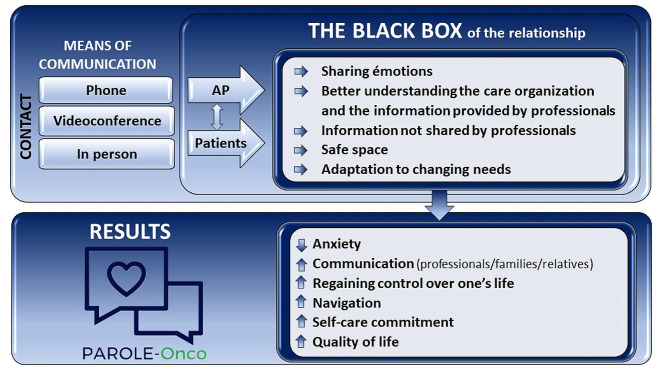
Results: Three themes emerged from the semi-structured interviews: communication modalities used to connect patients with their APs, the characteristics of the support provided by APs, and the perceived effects of this support on the patients. Patients expressed a preference for telephone communication, highlighting its convenience and accessibility. The support provided by APs included emotional and informational support, neutrality, and adaptability. This relationship improved patient communication, reduced anxiety, helped regain control, and enhanced overall quality of life. The results emphasized the added value of APs in complementing the support offered by healthcare professionals. Patients noted the critical role of APs in helping them navigate the healthcare system, better understand their treatment processes, and manage their emotions. The ability of APs to provide practical advice and emotional reassurance was particularly valued. Overall, the findings underscored the significant impact of AP support on patients' experiences and highlighted areas for enhancing this service.
Conclusion: This study highlights, during the care trajectory of people affected by breast cancer, APs' contribution to patients' emotional well-being because they improve, in particular, the management of emotions and communication with health professionals.
Keywords: Accompanied patient; Accompanying patients; Clinical team; Oncology; Patient care experience; Peer support.
Plain language summary
In 2019, we initiated the PAROLE-Onco program in Quebec, Canada, to support cancer patients by integrating Accompanying Patients (APs) into the medical team. These individuals, who have personally experienced cancer, join as full team members, sharing their insights with both patients and medical staff. Our study delved into the perceptions of breast cancer patients at two university hospitals regarding APs’ involvement in their care trajectory. Through interviews with 14 women of diverse backgrounds and cancer experiences, we found that APs were instrumental in enhancing communication with doctors, facilitating the expression of challenging emotions, and aiding in treatment decisions. Patients valued the inclusion of APs in their care team and expressed gratitude for their support. Nonetheless, some encountered difficulties in reaching out to APs due to a lack of awareness or challenges involved in connecting. Overall, our research underscores the positive impact of involving APs in the care of breast cancer patients, and of enhancing emotional well-being and communication throughout the treatment journey.
© 2024. The Author(s).
Conflict of interest statement
The authors declare no competing interests.
Figures
References
-
- Pomey MP, de Guise M, Desforges M, Bouchard K, Vialaron C, Normandin L, et al. The patient advisor, an organizational resource as a lever for an enhanced oncology patient experience (PAROLE-onco): a longitudinal multiple case study protocol. BMC Health Serv Res 4 janv. 2021;21(1):10. doi: 10.1186/s12913-020-06009-4. - DOI - PMC - PubMed
-
- Purssell E, Gould D, Chudleigh J. Impact of isolation on hospitalised patients who are infectious: systematic review with meta-analysis. BMJ Open. févr 2020 [cité 28 mai 2024];10(2):e030371. Disponible sur: https://bmjopen.bmj.com/lookup/doi/10.1136/bmjopen-2019-030371 - DOI - PMC - PubMed
MeSH terms
LinkOut - more resources
Full Text Sources
Medical
Miscellaneous
