


Sodium-Glucose Cotransporter 2 Inhibitors During Cancer Therapy: Benefits, Risks, and Ongoing Clinical Trials
- PMID: 38990501
- PMCID: PMC11480197
- DOI: 10.1007/s11912-024-01577-8
Sodium-Glucose Cotransporter 2 Inhibitors During Cancer Therapy: Benefits, Risks, and Ongoing Clinical Trials
Abstract
Purpose of review: The goal of this paper is to summarize the data pertaining to the use of sodium-glucose cotransporter-2 inhibitors (SGLT-2i) for the prevention of cardiotoxicity in patients receiving anthracyclines for cancer treatment. We discuss the potential efficacy of this class of medications, incorporating insights from existing literature and ongoing studies.
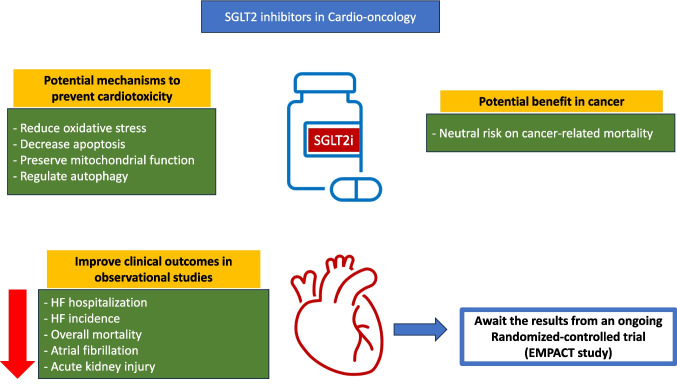
Recent findings: SGLT2i are a class of medications which were initially developed for treatment of Type 2 diabetes and later extended to treat heart failure with reduced and preserved ejection fraction regardless of diabetes status. There remains a need for effective and safe treatments to preventing cardiotoxicity in anthracycline-treated patients. It has been proposed that SGLT2i may provide protection against the cardiotoxic effects of anthracyclines. Some of the proposed mechanisms include beneficial metabolic, neurohormonal, and hemodynamic effects, renal protection, as well as a decrease in inflammation, oxidative stress, apoptosis, mitochondrial dysfunction and ion homeostasis. There is emerging evidence from basic science and observational studies that SGLT2i may play a role in the prevention of chemotherapy-induced cardiotoxicity. Randomized controlled trials are needed to conclusively determine the role of SGLT2 inhibitors as a cardioprotective therapy in patients receiving anthracyclines for the treatment of cancer.
Keywords: CTRCD; Cancer; Cardiooncology; Cardioprotection; Cardiotoxicity; SGLT2i.
© 2024. The Author(s).
Conflict of interest statement
The authors declare that they have no competing interests.
Figures
References
-
- Zinman B WC, Lachin JM, Fitchett D, et al.; EMPA-REG OUTCOME Investigators. Empagliflozin, Cardiovascular Outcomes, and Mortality in Type 2 Diabetes. N Engl J Med 2015 Nov 26;373(22):2117–28 PMID: 26378978. 215. * This RCT showed that empagliflozin added to standard medical care in 4687 diabetic patients compared to placebo in 2333 patients was safe and reduced the risk of death from cardiovascular causes, hospitalization for heart failure and death from any cause. - PubMed
-
- Packer M, Anker SD, Butler J, Filippatos G, Pocock SJ, Carson P, et al. Cardiovascular and Renal Outcomes with Empagliflozin in Heart Failure. New England Journal of Medicine. 2020;383(15):1413–24. * Empagliflozin reduced the risk of cardiovascular death or hospitalization for heart failure in among patients with HFrEF regardless of the presence or absence of diabetes - PubMed
-
- Anker SD, Butler J, Filippatos G, Ferreira JP, Bocchi E, Böhm M, et al. Empagliflozin in Heart Failure with a Preserved Ejection Fraction. New England Journal of Medicine. 2021;385(16):1451–61. ** Empagliflozin reduced the combined risk of cardiovascular death or hospitalization for heart failure in patients with heart failure and a preserved ejection fraction, with or without diabetes. - PubMed
Publication types
MeSH terms
Substances
LinkOut - more resources
Full Text Sources
Medical
Research Materials
