


The positive reinforcing effects of cocaine and opposite-sex social contact: roles of biological sex and estrus
- PMID: 38992255
- PMCID: PMC11742770
- DOI: 10.1007/s00213-024-06648-z
The positive reinforcing effects of cocaine and opposite-sex social contact: roles of biological sex and estrus
Abstract
Rationale: Preclinical studies report that drug use and social contact mutually influence the reinforcing effects of one another. Most of these studies have used same-sex dyads exclusively, and the role of factors related to biological sex and hormonal fluctuations are not well understood.
Objectives: The purpose of this study was to examine the reinforcing effects of cocaine and social contact with an opposite-sex partner in male and female rats, and how these effects are modulated by ovarian hormones.
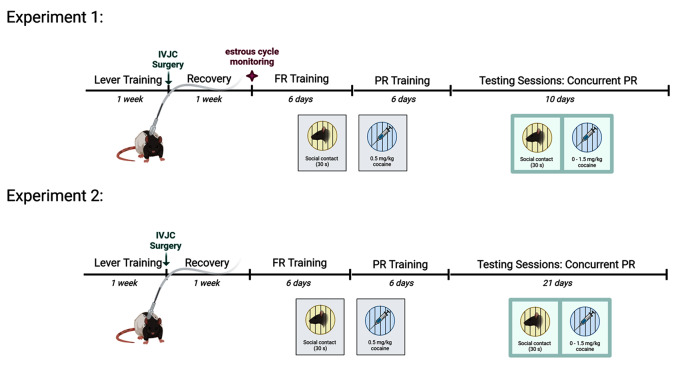
Methods: Male and female rats were trained in a nonexclusive choice procedure in which cocaine and social contact with an opposite-sex partner were simultaneously available on concurrent progressive ratio schedules of reinforcement. To examine the effects of ovarian hormones related to estrous cycling, Experiment 1 used naturally cycling, gonadally intact females, whereas Experiment 2 used ovariectomized females, and estrus was artificially induced with exogenous hormones.
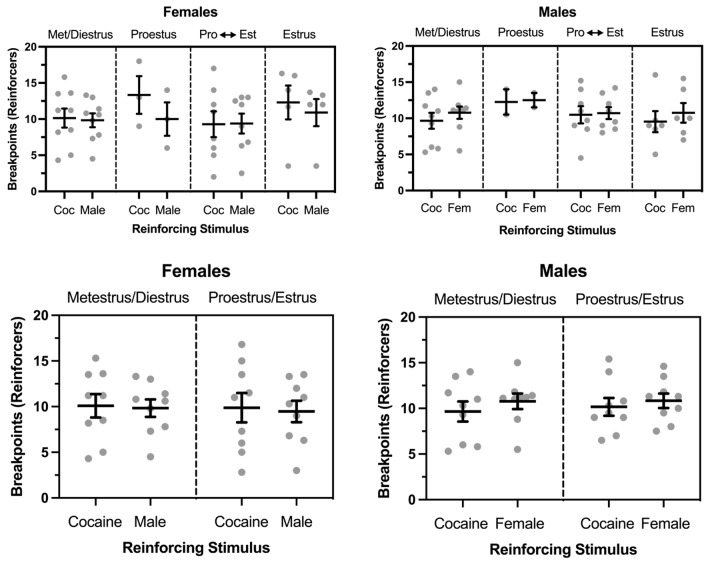
Results: In both experiments, cocaine and social contact functioned as robust reinforcers, and there were no significant effects of biological sex or estrus status of the females. The positive reinforcing effects of both cocaine and social contact increased as a function of cocaine dose, indicating that contingent cocaine administration increases the reinforcing effects of social contact.
Conclusions: These data suggest that cocaine use among opposite-sex partners may enhance factors that contribute to social bonding.
Keywords: Addiction; Animal model; Choice; Concurrent schedule; Estrous cycle; Progressive ratio; Sex differences; Social behavior.
© 2024. The Author(s).
Conflict of interest statement
Declarations. Conflict of interest: The authors have no conflicts of interest to report.
Figures


References
-
- Aragona BJ, Liu Y, Yu YJ et al (2006) Nucleus accumbens dopamine differentially mediates the formation and maintenance of monogamous pair bonds. Nat Neurosci 9:133–139. 10.1038/nn1613 - PubMed
-
- Bahr SJ, Hoffmann JP, Yang X (2005) Parental and peer influences on the risk of adolescent drug use. J Prim Prev 26:529–551. 10.1007/s10935-005-0014-8 - PubMed
MeSH terms
Substances
Grants and funding
LinkOut - more resources
Full Text Sources
