


Potential efficacy of digital polymerase chain reaction for non-invasive prenatal screening of autosomal aneuploidies: a systematic review and meta-analysis
- PMID: 38992581
- PMCID: PMC11238349
- DOI: 10.1186/s12884-024-06655-0
Potential efficacy of digital polymerase chain reaction for non-invasive prenatal screening of autosomal aneuploidies: a systematic review and meta-analysis
Abstract
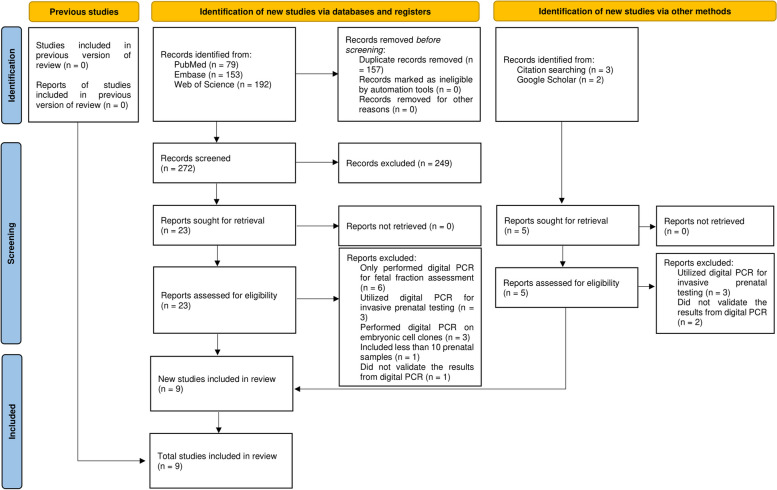
Background: Digital Polymerase Chain Reaction (dPCR) presents a promising approach for quantifying DNA and analyzing copy number variants, particularly in non-invasive prenatal testing. This method offers a streamlined and time-efficient procedure in contrast to the widely used next-generation sequencing for non-invasive prenatal testing. Studies have reported encouraging results for dPCR in detecting fetal autosomal aneuploidies. Consequently, this systematic review aimed to evaluate the effectiveness of dPCR in screening for trisomy 21, 18, and 13.
Methods: A systematic search was conducted in PubMed, Web of Sciences, and Embase for relevant articles published up to December 30, 2023. The Quality Assessment of Diagnostic Accuracy Studies-2 (QUADAS-2) was utilized for the quality assessment of the included articles. Furthermore, a bivariate random-effect regression model was used to conduct a meta-analysis on the utility of dPCR for trisomy 21 screening.
Results: A total of 9 articles were included in this review, with all of them assessing the utility of dPCR in trisomy 21 screening, and 2 and 1 studies conducting additional analysis on the screening abilities of dPCR for trisomy 18 and 13, respectively. A bivariate random-effects model calculated pooled sensitivity and specificity with a 95% confidence interval (CI). Meta-analysis of 6 studies comparing trisomy-21 screening with karyotyping demonstrated dPCR's pooled sensitivity of 98% [95% CI: 94 -100] and specificity of 99% [95% CI: 99 -100]. While conducting a meta-analysis for trisomy 13 and 18 proved impractical, reported values for sensitivity and specificity were favorable.
Conclusions: These findings suggest that dPCR holds promise as an effective tool for non-invasive prenatal testing, presenting a less time-consuming and intricate alternative to next-generation sequencing. However, further research is necessary to evaluate dPCR's applicability in clinical settings and to delineate its specific advantages over next-generation sequencing. This study contributes valuable insights into the potential of dPCR for enhancing prenatal screening methodologies.
Trial registration: The protocol of this study was registered in the International Prospective Register of Systematic Reviews (PROSPERO) on 7/3/2024, with a registration code of CRD42024517523.
Keywords: Down syndrome; Edwards syndrome; Noninvasive prenatal testing; Patau syndrome; Polymerase chain reaction.
© 2024. The Author(s).
Conflict of interest statement
The authors of this study have no financial or non-financial conflicts of interest to disclose.
Figures


References
-
- Ozkan E, Lacerda MP. Genetics, Cytogenetic Testing And Conventional Karyotype. StatPearls. Treasure Island (FL): StatPearls Publishing. Copyright © 2023, StatPearls Publishing LLC.; 2023. - PubMed
Publication types
MeSH terms
LinkOut - more resources
Full Text Sources
Medical
