


Endometrial compaction to predict pregnancy outcomes in patients undergoing assisted reproductive technologies: a systematic review and meta-analysis
- PMID: 38993630
- PMCID: PMC11239225
- DOI: 10.1093/hropen/hoae040
Endometrial compaction to predict pregnancy outcomes in patients undergoing assisted reproductive technologies: a systematic review and meta-analysis
Abstract
Study question: Does endometrial compaction (EC) help predict pregnancy outcomes in those undergoing ART?
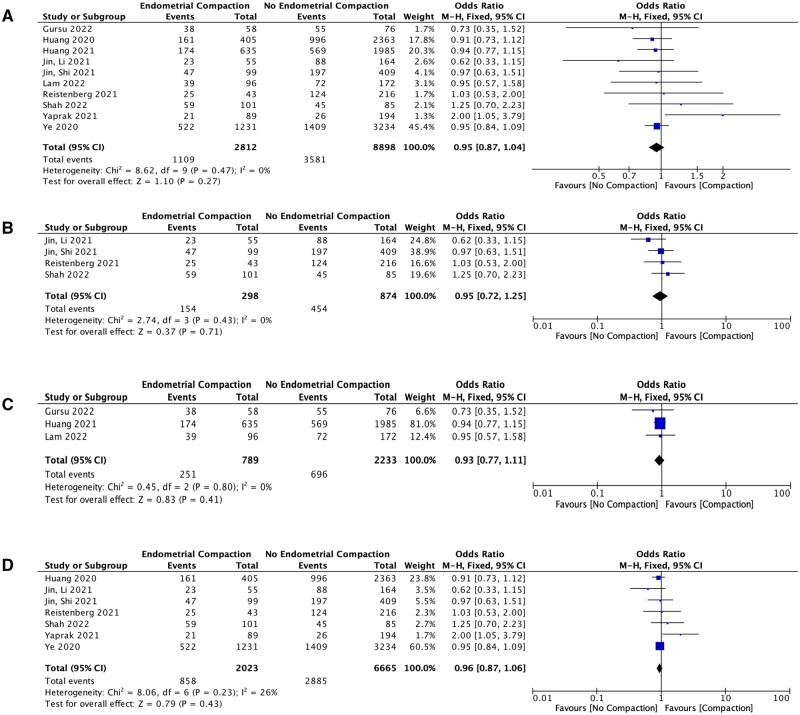
Summary answer: EC is associated with a significantly higher clinical pregnancy rate (CPR) and ongoing pregnancy rate (OPR), but this does not translate to live birth rate (LBR).
What is known already: EC describes the progesterone-induced decrease in endometrial thickness, which may be observed following the end of the proliferative phase, prior to embryo transfer. EC is proposed as a non-invasive tool to help predict pregnancy outcome in those undergoing ART, however, published data is conflicting.
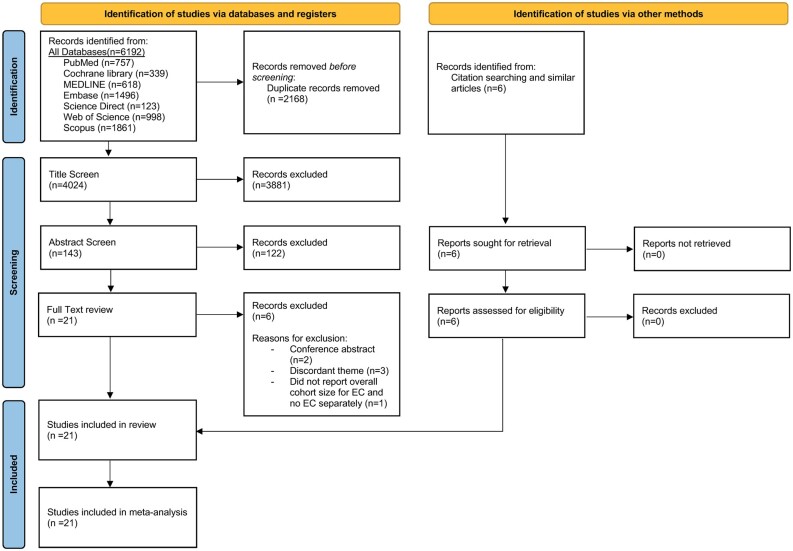
Study design size duration: A literature search was carried out by two independent authors using PubMed, Cochrane Library, MEDLINE, Embase, Science Direct, Scopus, and Web of Science from inception of databases to May 2023. All peer-reviewed studies reporting EC and pregnancy outcomes in patients undergoing IVF/ICSI treatment were included.
Participants/materials setting methods: The primary outcome is LBR. Secondary outcomes included other pregnancy metrics (positive pregnancy test (PPT), CPR, OPR, miscarriage rate (MR)) and rate of EC. Comparative meta-analyses comparing EC and no EC were conducted for each outcome using a random-effects model if I 2 > 50%. The Mantel-Haenszel method was applied for pooling dichotomous data. Results are presented as odds ratios (OR) with 95% CI.
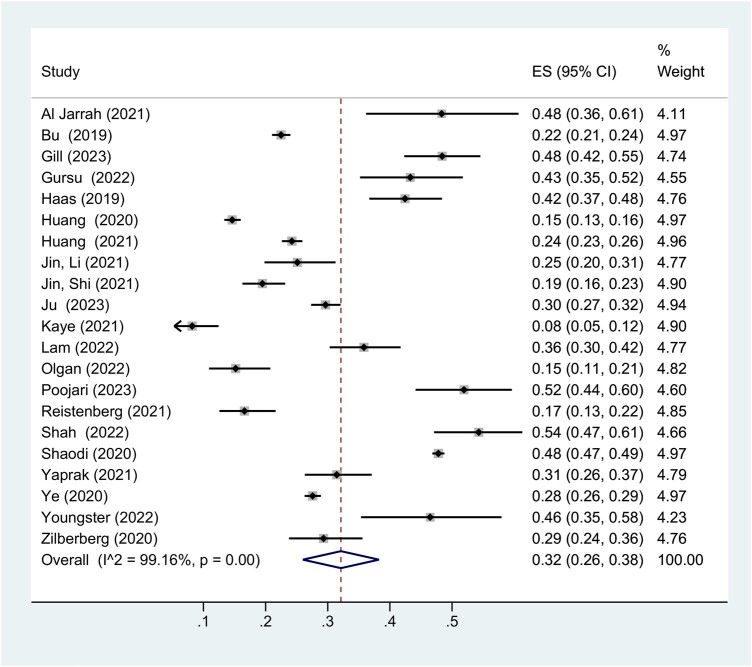
Main results and the role of chance: Out of 4030 screened articles, 21 cohort studies were included in the final analysis (n = 27 857). No significant difference was found between LBR in the EC versus the no EC group (OR 0.95; 95% CI 0.87-1.04). OPR was significantly higher within the EC group (OR 1.61; 95% CI 1.09-2.38), particularly when EC ≥ 15% compared to no EC (OR 3.52; 95% CI 2.36-5.23). CPR was inconsistently defined across the studies, affecting the findings. When defined as a viable intrauterine pregnancy <12 weeks, the EC group had significantly higher CPR than no EC (OR 1.83; 95% CI 1.15-2.92). No significant differences were found between EC and no EC for PPT (OR 1.54; 95% CI 0.97-2.45) or MR (OR 1.06; 95% CI 0.92-1.56). The pooled weighted incidence of EC across all studies was 32% (95% CI 26-38%).
Limitations reasons for caution: Heterogeneity due to differences between reported pregnancy outcomes, definition of EC, method of ultrasound, and cycle protocol may account for the lack of translation between CPR/OPR and LBR findings; thus, all pooled data should be viewed with an element of caution.
Wider implications of the findings: In this dataset, the significantly higher CPR/OPR with EC does not translate to LBR. Although stratification of women according to EC cannot currently be recommended in clinical practice, a large and well-designed clinical trial to rigorously assess EC as a non-invasive predictor of a successful pregnancy is warranted. We urge for consistent outcome reporting to be mandated for ART trials so that data can be pooled, compared, and concluded on.
Study funding/competing interests: H.A. was supported by the Hewitt Fertility Centre. S.G.P. and J.W. were supported by the Liverpool University Hospital NHS Foundation Trust. D.K.H. was supported by a Wellbeing of Women project grant (RG2137) and MRC clinical research training fellowship (MR/V007238/1). N.T. was supported by the National Institute for Health and Care Research. D.K.H. had received honoraria for consultancy for Theramex and has received payment for presentations from Theramex and Gideon Richter. The remaining authors have no conflicts of interest to report.
Registration number: PROSPERO CRD42022378464.
Keywords: ICSI; IVF; assisted reproductive technology; endometrial compaction; endometrial receptivity; endometrial thickness; endometrium; pregnancy outcomes; progesterone; ultrasound.
© The Author(s) 2024. Published by Oxford University Press on behalf of European Society of Human Reproduction and Embryology.
Conflict of interest statement
D.K.H. has received honoraria for consultancy for Theramex and has received payment for presentations from Theramex and Gideon Richter. The remaining authors have no conflicts of interest to report.
Figures
References
-
- Abdallah Y, Naji O, Saso S, Pexsters A, Stalder C, Sur S, Raine-Fenning N, Timmerman D, Brosens JJ, Bourne T.. Ultrasound assessment of the peri-implantation uterus: a review. Ultrasound Obstet Gynecol 2012;39:612–619. - PubMed
-
- Bassil S. Changes in endometrial thickness, width, length and pattern in predicting pregnancy outcome during ovarian stimulation in in vitro fertilization. Ultrasound Obstet Gynecol 2001;18:258–263. - PubMed
-
- Bourne T, Hamberger L, Hahlin M, Granberg S.. Ultrasound in gynecology: endometrium. Int J Gynaecol Obstet 1997;56:115–127. - PubMed
-
- Braakhekke M, Kamphuis EI, Dancet EA, Mol F, F van der V, Mol BW.. Ongoing pregnancy qualifies best as the primary outcome measure of choice in trials in reproductive medicine: an opinion paper. Fertil Steril 2014;101:1203–1204. - PubMed
LinkOut - more resources
Full Text Sources
Research Materials