


Dietary Spirulina effects in Eimeria-challenged broiler chickens: growth performance, nutrient digestibility, intestinal morphology, serum biomarkers, and gene expression
- PMID: 38995102
- PMCID: PMC11306789
- DOI: 10.1093/jas/skae186
Dietary Spirulina effects in Eimeria-challenged broiler chickens: growth performance, nutrient digestibility, intestinal morphology, serum biomarkers, and gene expression
Abstract
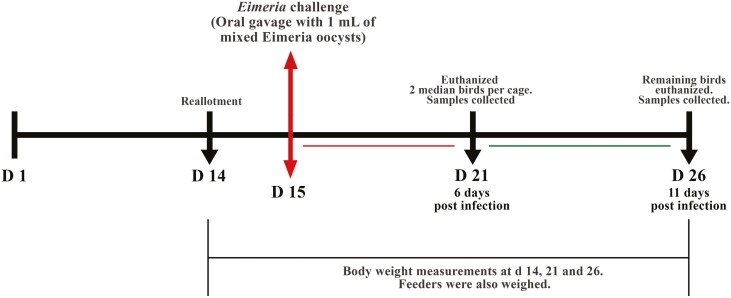
This study investigated the growth performance, nutrient utilization, and intestinal health responses of Eimeria-challenged broiler chickens to dietary Spirulina (Arthrospira platensis). On day 1, birds were assigned to 2 diets supplemented with Spirulina (0 or 5 g/kg) in a randomized complete block design. The birds within each diet were divided into 2 Eimeria-challenge groups (challenge or no-challenge) and that resulted in a 2 × 2 factorial arrangement with 2 levels each of Spirulina and challenge on day 14. On day 15, the birds in the challenge or no-challenge groups were orally gavaged with a solution containing Eimeria oocysts or 1% PBS, respectively. Samples were collected on days 21 and 26 (6- and 11-d post-infection; dpi). Data collected from days 1 to 26 were analyzed using the MIXED procedure of SAS. Birds that were fed Spirulina-supplemented diets had increased (P < 0.05) BW gain, gain-to-feed ratio, and total tract retention nitrogen from days 14 to 21. The ileal villus perimeter and area, serum catalase, HMOX1 and SOD1 jejunal abundance were all increased (P < 0.05) in birds fed Spirulina-supplemented diets on day 21 (6 dpi). However, there was no effect on bone ash or oocyst count. From days 21 to 26, there was a tendency (P = 0.059) for a Spirulina × Challenge interaction on the BW gain of birds. Moreover, dietary Spirulina addition increased (P < 0.05) serum catalase, total antioxidant capacity, ileal villus perimeter, tibia bone ash, and the relative mRNA expression of HMOX1, SOD1, claudin 1, and TNFα in the jejunal mucosa of birds on day 26 (11 dpi). On both 6 and 11 dpi, the Eimeria challenge negatively (P < 0.05) impacted growth performance, gut morphology, and the relative mRNA expression of genes. Overall, assessing the impact of Spirulina in broilers revealed its positive antioxidant, immune-modulating, and health benefits. However, its dietary addition did not completely reverse the Eimeria-induced effects in these birds. Ultimately, this study outlines the positive properties of dietary Spirulina beyond its use in the diet of healthy broiler chickens.
Keywords: antioxidant; coccidiosis; feed additive; intestinal histomorphology; spirulina.
Plain language summary
In recent years, nutritional strategies for managing coccidiosis in broiler chickens have focused on feed additives, amino acids, and minerals. Spirulina, a cyanobacterium, is a feed additive rich in bioactive compounds like phycocyanin, polysaccharides, B vitamins, minerals, polyunsaturated fatty acids, and carotenoids. These compounds confer antioxidant, anti-inflammatory, and immunomodulatory properties to Spirulina. While Spirulina has been extensively explored as a health supplement in humans, its dietary application in broiler chickens and pigs is now gaining attention. Additionally, its potential to combat the Eimeria-induced effects on growth performance, nutrient digestibility, and health in birds has not been adequately addressed. Hence, the aim of this study was to investigate the effect of Spirulina on growth performance, nutrient digestibility, immune response, bone mineral deposition, and serum phosphorus in Eimeria-challenged broiler chickens. Results from this study showed that the positive properties of dietary Spirulina extend beyond its use in the diet of healthy broiler chickens as it reduced some of the negative impact of an Eimeria infection in birds.
© The Author(s) 2024. Published by Oxford University Press on behalf of the American Society of Animal Science.
Conflict of interest statement
This experiment was funded by Livalta, Peterborough, United Kingdom. Dr Hagen Schulze is an employee of Livalta, an AB Agri Company, Peterborough, United Kingdom. The other authors declare that there are no conflicts of interest in the current study.
Figures
References
-
- Abdel-Latif, M. A., Elbestawy A. R., El-Far A. H., Noreldin A. E., Emam M., Baty R. S., Albadrani G. M., Abdel-Daim M. M., and Abd El-Hamid H. S... 2021. Quercetin dietary supplementation advances growth performance, gut microbiota, and intestinal mRNA expression genes in broiler chickens. Animals (Basel). 11:2302. doi: 10.3390/ani11082302 - DOI - PMC - PubMed
-
- Abdel-Moneim, A. -M. E., Shehata A. M., Mohamed N. G., Elbaz A. M., and Ibrahim N. S... 2022. Synergistic effect of Spirulina platensis and selenium nanoparticles on growth performance, serum metabolites, immune responses, and antioxidant capacity of heat-stressed broiler chickens. Biol. Trace Elem. Res. 200:768–779. doi: 10.1007/s12011-021-02662-w - DOI - PubMed
-
- Abdel-Wahab, A. A., Elnesr S. S., Ahmad E. A. M., and Abdel-Kader I. A.. 2023. Effect of dietary supplementation of Spirulina platensis powder on performance, some serum biochemistry, digestive enzymes, microbial content, antioxidant parameters and immune responses of growing Japanese quail. Anim. Biotechnol. 17:1–9. doi: 10.1080/10495398.2023.2200462 - DOI - PubMed
-
- Adedokun, S. A., Helmbrecht A., and Applegate T. J... 2016. Investigation of the effect of coccidial vaccine challenge on apparent and standardized ileal amino acid digestibility in grower and finisher broilers and its evaluation in 21-day-old broilers. Poult. Sci. 95:1825–1835. doi: 10.3382/ps/pew066 - DOI - PubMed
MeSH terms
Substances
LinkOut - more resources
Full Text Sources
Medical
Research Materials
Miscellaneous
