


Dissecting Water, Sanitation, and Hygiene (WaSH) to Assess Risk Factors for Cholera in Shashemene, Oromia Region, Ethiopia
- PMID: 38996037
- PMCID: PMC11244206
- DOI: 10.1093/cid/ciae274
Dissecting Water, Sanitation, and Hygiene (WaSH) to Assess Risk Factors for Cholera in Shashemene, Oromia Region, Ethiopia
Abstract
Background: Cholera outbreaks have afflicted Ethiopia, with nearly 100 000 cases and 1030 deaths reported from 2015 to 2023, emphasizing the critical need to understand water, sanitation, and hygiene (WaSH) risk factors.
Methods: We conducted a cross-sectional household (HH) survey among 870 HHs in Shashemene Town and Shashemene Woreda, alongside extracting retrospective cholera case data from the Ethiopian Public Health Institute database. Relationships between WaSH and sociodemographic/economic-levels of HHs were examined. WaSH status and cholera attack rates (ARs) were described at kebele-level using geospatial mapping, and their association was statistically analyzed.
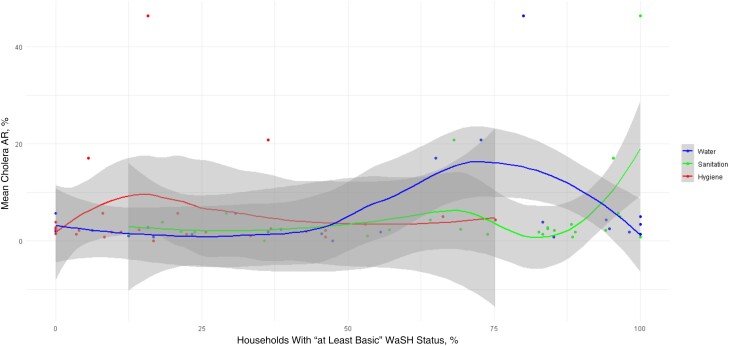
Results: Access to basic drinking water, sanitation, and hygiene facilities was limited, with 67.5% (95% confidence interval, 64.4-70.6), 73.4% (70.3-76.3), and 30.3% (27.3-33.3) of HHs having access, respectively. Better WaSH practices were associated with urban residence (adjusted odds ratio, 1.7, [95% confidence interval, 1.1-2.7]), higher educational levels (2.7 [1.2-5.8]), and wealth (2.5 [1.6-4.0]). The association between cholera ARs and at least basic WaSH status was not statistically significant (multiple R2 = 0.13; P = .36), although localized effects were suggested for sanitation (Moran I = 0.22; P = .024).
Conclusions: Addressing gaps in WaSH access and hygiene practices is crucial for reducing cholera risk. Further analyses with meaningful covariates and increased sample sizes are necessary to understand the association between cholera AR and specific WaSH components.
Keywords: Cholera; Ethiopia; WaSH risk factors; basic WaSH; hygiene practice.
© The Author(s) 2024. Published by Oxford University Press on behalf of Infectious Diseases Society of America.
Conflict of interest statement
Potential conflicts of interest. The authors: No reported conflicts of interest. All authors have submitted the ICMJE Form for Disclosure of Potential Conflicts of Interest. Conflicts that the editors consider relevant to the content of the manuscript have been disclosed.
Figures
References
-
- World Health Organization . WHO global water, sanitation and hygiene annual report 2018. 18 September 2019. Available at: https://www.who.int/publications-detail-redirect/WHO-CED-PHE-WSH-19.147. Accessed 5 December 2023.
-
- Ohwo O, Agusomu TD. Assessment of water, sanitation and hygiene services in sub-Saharan Africa. Eur Sci J ESJ 2018; 14:308.
-
- World Health Organization . Compendium of WHO and other UN guidance on health and environment. 3 September 2021. Available at: https://www.who.int/publications-detail-redirect/WHO-HEP-ECH-EHD-21.02. Accessed 5 December 2023.
Publication types
MeSH terms
Substances
Grants and funding
LinkOut - more resources
Full Text Sources
Medical
Research Materials
