


Increasing Cyetpyrafen Spray Volume and Ozone Spray Improves the Control Effects against Two-Spotted Spider Mite (Tetranychus urticae) in Strawberries
- PMID: 38999632
- PMCID: PMC11244566
- DOI: 10.3390/plants13131792
Increasing Cyetpyrafen Spray Volume and Ozone Spray Improves the Control Effects against Two-Spotted Spider Mite (Tetranychus urticae) in Strawberries
Abstract
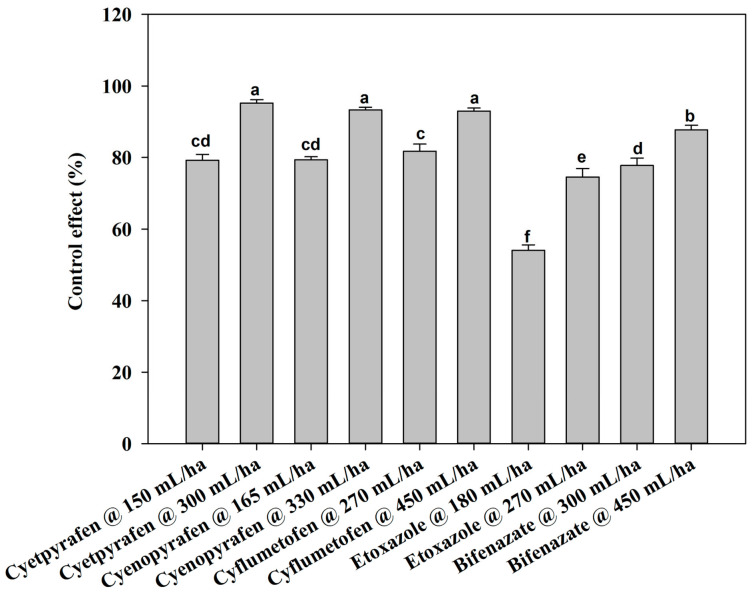
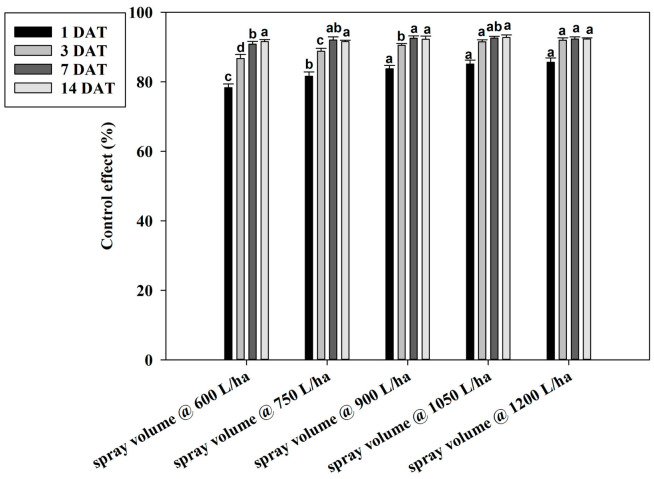
The two-spotted spider mite (Tetranychus urticae) is a constant threat to greenhouse strawberry production. The application of synthetic acaricides is the main method of controlling T. urticae. However, resistance development to traditional acaricides reduces their efficacy and eventually leads to control failure. It is important for strawberry growers to look for new acaricides and application technologies that can limit the harmfulness of T. urticae in environmentally friendly ways. In the current study, laboratory toxicity tests and field trials were performed to screen high-efficiency acaricides, and then application technologies were improved to enhance the management of T. urticae. In the laboratory toxicity tests, the results showed that the LC50 (median lethal concentration) value of cyetpyrafen, cyenopyrafen, cyflumetofen, bifenazate, abamectin, azocyclotin, pyridaben, spirodiclofen, and etoxazole against adult T. urticae was 0.226, 0.240, 0.415, 3.583, 5.531, 25.58, 39.69, 140.3, and 267.7 mg/L, respectively. In addition, the LC50 value of the nine acaricides against eggs of T. urticae was 0.082, 0.097, 0.931, 18.56, 25.52, 45.61, 36.32, 1.954, and 0.040 mg/L, respectively. The field trial results showed that the best control effect was obtained in cyetpyrafen at 300 mL/ha treatment. Cyetpyrafen was chosen for further application technology tests. In the spray volume tests, the results showed that increasing the spray volume from 900 to 1050 L/ha significantly improved the control of T. urticae. In addition, the results from the spray instrument tests demonstrated that the control effects on T. urticae in the ozone spray treatments were significantly higher than those of the conventional and electrostatic sprays 1 and 3 days after treatment (DAT). Therefore, this study suggested that cyetpyrafen effectively controlled T. urticae both in the laboratory tests and in the field trials. Increasing the spray volume and application of ozone spray significantly improved T. urticae management.
Keywords: Tetranychus urticae; cyenopyrafen; ozone spray.
Conflict of interest statement
The authors declare no conflicts of interest.
Figures




References
-
- NBS National Bureau of Statistics of China. [(accessed on 18 June 2024)];2024 Available online: https://data.stats.gov.cn/easyquery.htm?cn=C01.
-
- Jakubowska M., Dobosz R., Zawada D., Kowalska J. A review of crop protection methods against the twospotted spider mite-Tetranychus urticae Koch (Acari: Tetranychidae)-with special reference to alternative methods. Agriculture. 2022;12:898. doi: 10.3390/agriculture12070898. - DOI
Grants and funding
LinkOut - more resources
Full Text Sources
