


The Role of Artificial Intelligence in Nutrition Research: A Scoping Review
- PMID: 38999814
- PMCID: PMC11243505
- DOI: 10.3390/nu16132066
The Role of Artificial Intelligence in Nutrition Research: A Scoping Review
Abstract
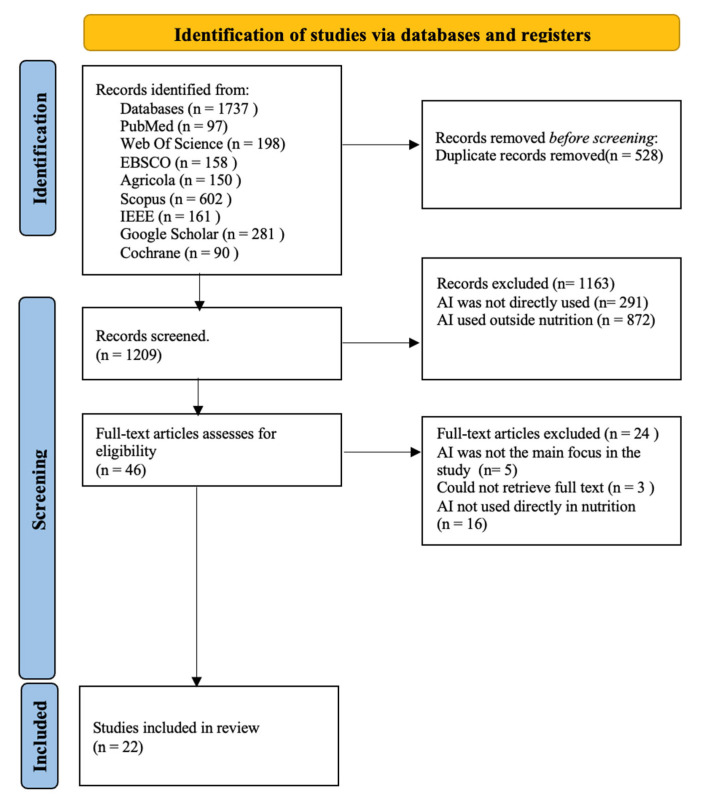
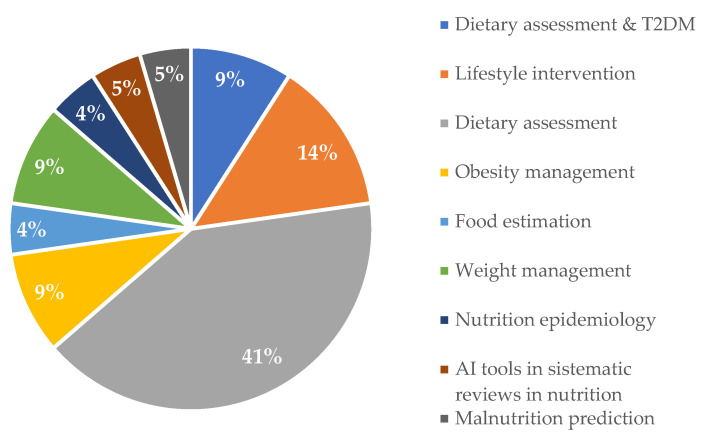
Artificial intelligence (AI) refers to computer systems doing tasks that usually need human intelligence. AI is constantly changing and is revolutionizing the healthcare field, including nutrition. This review's purpose is four-fold: (i) to investigate AI's role in nutrition research; (ii) to identify areas in nutrition using AI; (iii) to understand AI's future potential impact; (iv) to investigate possible concerns about AI's use in nutrition research. Eight databases were searched: PubMed, Web of Science, EBSCO, Agricola, Scopus, IEEE Explore, Google Scholar and Cochrane. A total of 1737 articles were retrieved, of which 22 were included in the review. Article screening phases included duplicates elimination, title-abstract selection, full-text review, and quality assessment. The key findings indicated AI's role in nutrition is at a developmental stage, focusing mainly on dietary assessment and less on malnutrition prediction, lifestyle interventions, and diet-related diseases comprehension. Clinical research is needed to determine AI's intervention efficacy. The ethics of AI use, a main concern, remains unresolved and needs to be considered for collateral damage prevention to certain populations. The studies' heterogeneity in this review limited the focus on specific nutritional areas. Future research should prioritize specialized reviews in nutrition and dieting for a deeper understanding of AI's potential in human nutrition.
Keywords: AI in nutrition; AI-nutritionist; artificial intelligence; artificial intelligence and dietary assessment; chatbot.
Conflict of interest statement
The authors declare no conflicts of interest.
Figures
References
-
- Thomas D.M., Kleinberg S., Brown A.W., Crow M., Bastian N.D., Reisweber N., Lasater R., Kendall T., Shafto P., Blaine R., et al. Machine learning modeling practices to support the principles of AI and ethics in nutrition research. Nutr. Diabetes. 2022;12:48. doi: 10.1038/s41387-022-00226-y. - DOI - PMC - PubMed
-
- American Society for Nutrition. [(accessed on 8 March 2024)]. Available online: https://nutrition.org/public-affairs/nutrition-research-agenda/
Publication types
MeSH terms
LinkOut - more resources
Full Text Sources
