


Biochemical and Anthropometric Outcomes in Paediatric Patients with Heterozygous Familial Hypercholesterolemia after COVID-19 Pandemic Lockdowns: An Exploratory Analysis
- PMID: 38999917
- PMCID: PMC11242984
- DOI: 10.3390/nu16132170
Biochemical and Anthropometric Outcomes in Paediatric Patients with Heterozygous Familial Hypercholesterolemia after COVID-19 Pandemic Lockdowns: An Exploratory Analysis
Abstract
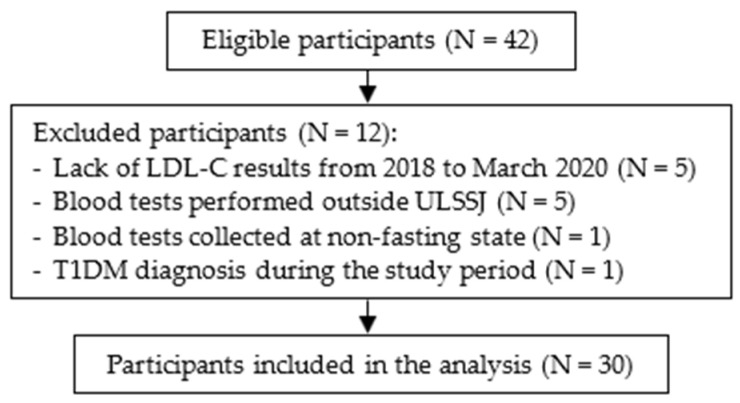
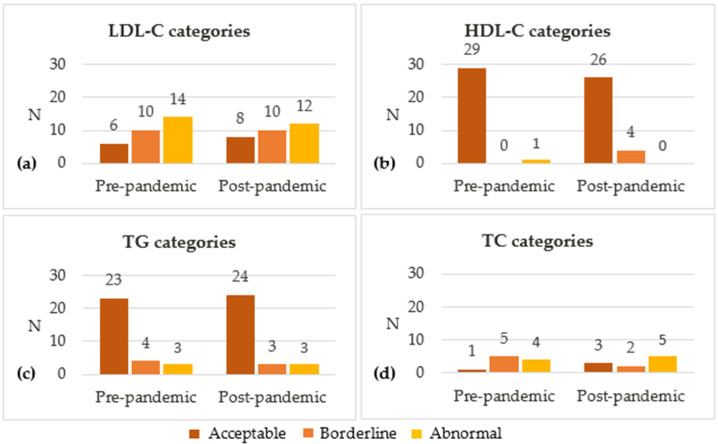
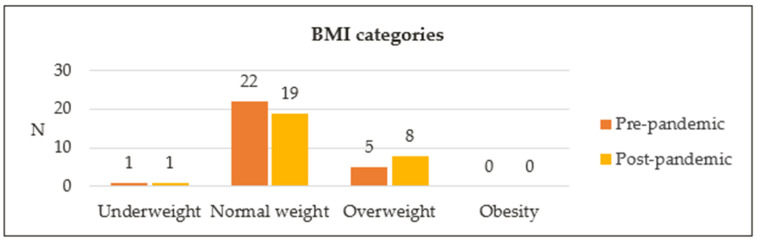
The COVID-19 pandemic lockdowns affected the lifestyles of children and adolescents, leading to an increase in childhood obesity. Paediatric patients with familial hypercholesterolemia (FH) may be more susceptible to lockdown effects due to their increased cardiovascular risk. However, data are lacking. We investigated the effect of lockdowns on the metabolic profile of paediatric patients with FH. Blood lipids and anthropometry measured in September 2021-April 2022 were retrospectively compared with pre-pandemic values. Thirty participants were included (1-16 years; 57% female). From baseline to post-pandemic, median [P25, P75] blood LDL-C concentration was 125 [112, 150] mg/dL vs. 125 [100, 147] mg/dL (p = 0.894); HDL-C was 58 [52, 65] mg/dL vs. 56 [51, 61] mg/dL (p = 0.107); triglycerides were 64 [44, 86] mg/dL vs. 59 [42, 86] mg/dL (p = 0.178). The BMI z-score did not change significantly (0.19 [-0.58, 0.89] vs. 0.30 [-0.48, 1.10], p = 0.524). The lack of deterioration in metabolic profiles during lockdowns is positive, as some deterioration was expected. We speculate that patients and caregivers were successfully educated about healthy lifestyle and dietary habits. Our results should be interpreted with caution since the study sample was small and heterogeneous. Multicentre research is needed to better understand the impact of lockdowns on this population.
Keywords: COVID-19; LDL cholesterol; anthropometry; familial hypercholesterolemia.
Conflict of interest statement
The authors declare no conflicts of interest.
Figures

References
-
- Watts G.F., Gidding S., Wierzbicki A.S., Toth P.P., Alonso R., Brown W.V., Bruckert E., Defesche J., Lin K.K., Livingston M., et al. Integrated guidance on the care of familial hypercholesterolaemia from the International FH Foundation. Eur. J. Prev. Cardiol. 2015;22:849–854. doi: 10.1177/2047487314533218. - DOI - PubMed
-
- Hu P., Dharmayat K.I., Stevens C.A.T., Sharabiani M.T.A., Jones R.S., Watts G.F., Genest J., Ray K.K., Vallejo-Vaz A.J. Prevalence of Familial Hypercholesterolemia Among the General Population and Patients With Atherosclerotic Cardiovascular Disease: A Systematic Review and Meta-Analysis. Circulation. 2020;141:1742–1759. doi: 10.1161/CIRCULATIONAHA.119.044795. - DOI - PubMed
-
- Taylor A., Wang D., Patel K., Whittall R., Wood G., Farrer M., Neely R.D., Fairgrieve S., Nair D., Barbir M., et al. Mutation detection rate and spectrum in familial hypercholesterolaemia patients in the UK pilot cascade project. Clin. Genet. 2010;77:572–580. doi: 10.1111/j.1399-0004.2009.01356.x. - DOI - PubMed
MeSH terms
Substances
LinkOut - more resources
Full Text Sources
Medical
Research Materials
Miscellaneous
