. 2024 Jun 22;25(13):6853.
doi: 10.3390/ijms25136853.

Identification of New Chemoresistance-Associated Genes in Triple-Negative Breast Cancer by Single-Cell Transcriptomic Analysis

Affiliations

Identification of New Chemoresistance-Associated Genes in Triple-Negative Breast Cancer by Single-Cell Transcriptomic Analysis

Spyros Foutadakis et al. Int J Mol Sci. .

Abstract

Triple-negative breast cancer (TNBC) is a particularly aggressive mammary neoplasia with a high fatality rate, mainly because of the development of resistance to administered chemotherapy, the standard treatment for this disease. In this study, we employ both bulk RNA-sequencing and single-cell RNA-sequencing (scRNA-seq) to investigate the transcriptional landscape of TNBC cells cultured in two-dimensional monolayers or three-dimensional spheroids, before and after developing resistance to the chemotherapeutic agents paclitaxel and doxorubicin. Our findings reveal significant transcriptional heterogeneity within the TNBC cell populations, with the scRNA-seq identifying rare subsets of cells that express resistance-associated genes not detected by the bulk RNA-seq. Furthermore, we observe a partial shift towards a highly mesenchymal phenotype in chemoresistant cells, suggesting the epithelial-to-mesenchymal transition (EMT) as a prevalent mechanism of resistance in subgroups of these cells. These insights highlight potential therapeutic targets, such as the PDGF signaling pathway mediating EMT, which could be exploited in this setting. Our study underscores the importance of single-cell approaches in understanding tumor heterogeneity and developing more effective, personalized treatment strategies to overcome chemoresistance in TNBC.

Keywords: 3D spheroids; bulk RNA-sequencing; chemoresistance; single-cell RNA-sequencing; transcriptomics; triple-negative breast cancer.


Conflict of interest statement

The authors declare no conflicts of interest.

Figures
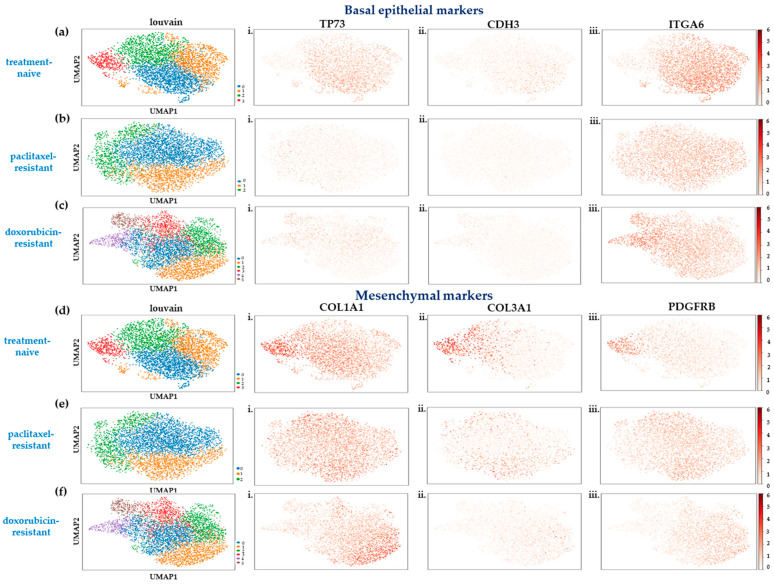
Figure 1
Figure 1
In the upper panel, UMAP plots of the SUM-159 (a) treatment-naïve, (b) paclitaxel-resistant, and (c) doxorubicin-resistant cells grown in monolayer are shown, as well as the individual single-cell expression patterns of the basal epithelial marker genes (i) TP73, (ii) CDH3, and (iii) ITGA6 in these cell states. In the lower panel, (df) the same UMAP plots (df) are shown along with the individual single-cell expression patters of the mesenchymal marker genes (i) COL1A1, (ii) COL3A1, and (iii) PDGFRB.
Figure 2
Figure 2
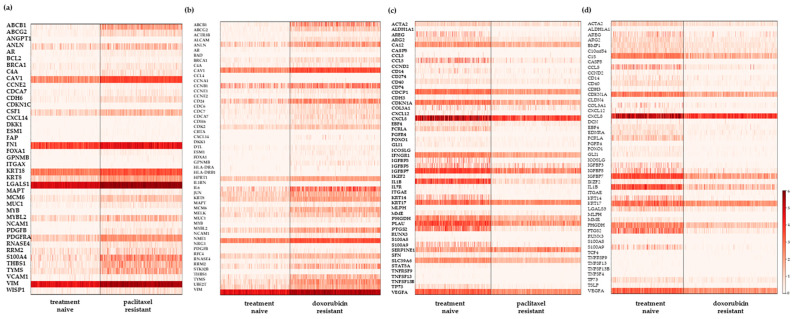
Heatmaps showing the differentially expressed genes in the SUM159 chemoresistant compared to the treatment-naive cells grown in monolayer. (a,b) Show the upregulated genes and (c,d) show the downregulated genes in paclitaxel- and doxorubicin-resistant cells, respectively. The PTPRC gene is missing from (a) and the CD244 and TCL1A genes are missing from (b) due to their very low counts in the treatment-naïve cells that excluded them from the filtered count matrix.
Figure 3
Figure 3
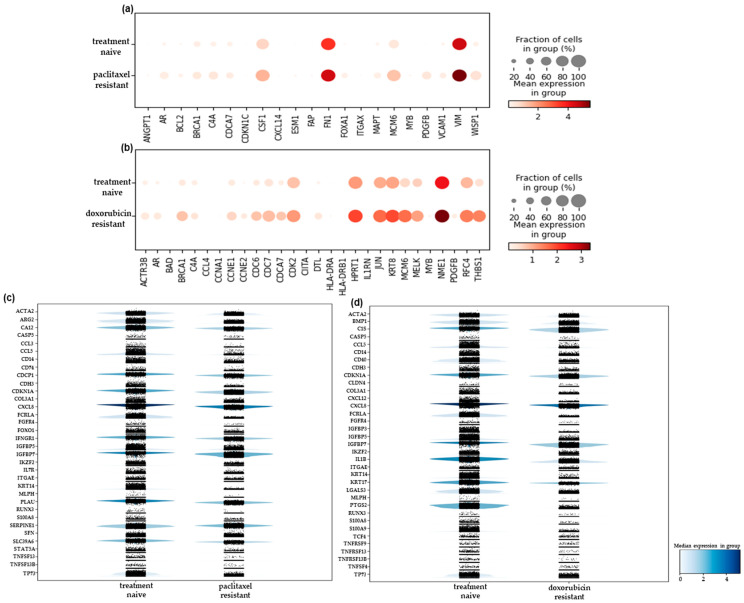
Differentially expressed genes in the 2D-cultured chemoresistant SUM159 cells compared to the treatment-naïve ones that were identified only by single-cell (sc) RNA- and not by bulk RNA-sequencing. Dotplots depicting genes that are upregulated in the (a) paclitaxel- and (b) doxorubicin-resistant cells, respectively. Stacked violin plots depicting genes that are downregulated in the (c) paclitaxel- and (d) doxorubicin- resistant cells, respectively. Each dot represents the normalized gene expression per cell. The PTPRC gene is missing from (a) and the CD244 and TCL1A genes are missing from (b) due to their very low counts in the treatment-naïve cells that excludes them from the filtered count matrix.
Figure 4
Figure 4
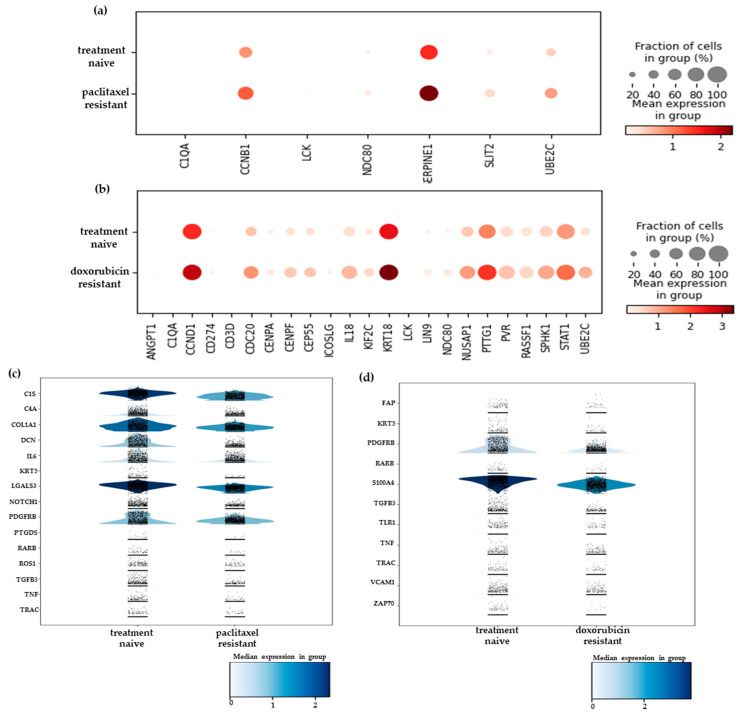
Differentially expressed genes identified by scRNA-seq only in the 3D- and not in the 2D-cultured chemoresistant SUM159 cells compared to the treatment-naïve ones. Dotplots depicting genes that are upregulated in the (a) paclitaxel- and(b) doxorubicin-resistant spheroids, respectively. Stacked violin plots depicting genes that are downregulated in the (c) paclitaxel- and (d) doxorubicin- resistant spheroids, respectively. Each dot represents the normalized gene expression per cell. The ZAP70 gene is missing from (c), and the PTGDS and IL17F genes are missing from (d) due to their very low counts in the chemoresistant cells that excludes them from the filtered count matrix.
Figure 5
Figure 5
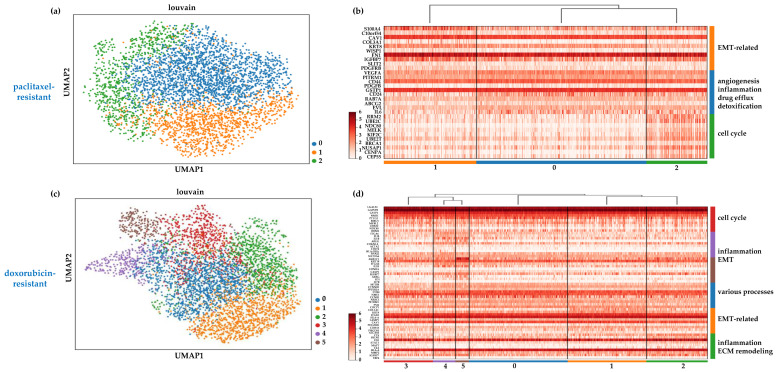
UMAP plots depicting clusters (subpopulations) of SUM159 (a) paclitaxel- and (c) doxorubicin-resistant cells grown in monolayer. The expression levels of the top 10 differentially expressed marker genes in each identified cluster are shown in heatmaps for the paclitaxel- (b) and the doxorubicin-resistant (d) cell states. Representative biological processes possibly mediating chemoresistance in each cell cluster are shown.
Figure 6
Figure 6
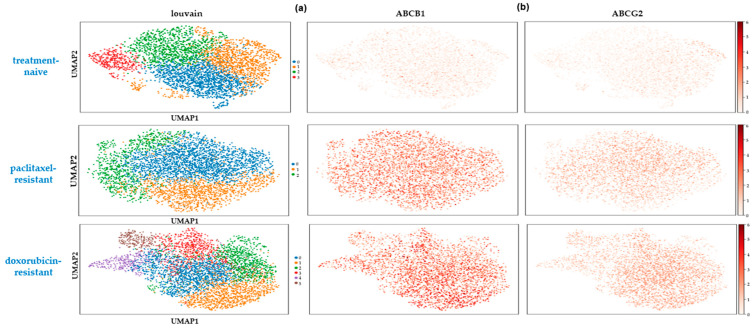
The expression patterns of the 2 ABC transporters ABCB1 (a) and ABCG2 (b) are shown in single cells of the different clusters of SUM159 treatment-naïve (upper panel), paclitaxel- (middle panel) and doxorubicin- (lower panel) resistant cells.

References

    1. Anders C.K., Abramson V., Tan T., Dent R. The Evolution of Triple-Negative Breast Cancer: From Biology to Novel Therapeutics. Am. Soc. Clin. Oncol. Educ. Book. 2016;36:34–42. doi: 10.1200/EDBK_159135. - DOI - PubMed
    1. Derakhshan F., Reis-Filho J.S. Pathogenesis of Triple-Negative Breast Cancer. Annu. Rev. Pathol. Mech. Dis. 2022;17:181–204. doi: 10.1146/annurev-pathol-042420-093238. - DOI - PMC - PubMed
    1. Bianchini G., De Angelis C., Licata L., Gianni L. Treatment Landscape of Triple-Negative Breast Cancer—Expanded Options, Evolving Needs. Nat. Rev. Clin. Oncol. 2021;19:91–113. doi: 10.1038/s41571-021-00565-2. - DOI - PubMed
    1. Asleh K., Riaz N., Nielsen T.O. Heterogeneity of Triple Negative Breast Cancer: Current Advances in Subtyping and Treatment Implications. J. Exp. Clin. Cancer Res. 2022;41:265. doi: 10.1186/s13046-022-02476-1. - DOI - PMC - PubMed
    1. van den Ende N.S., Nguyen A.H., Jager A., Kok M., Debets R., van Deurzen C.H.M. Triple-Negative Breast Cancer and Predictive Markers of Response to Neoadjuvant Chemotherapy: A Systematic Review. Int. J. Mol. Sci. 2023;24:2969. doi: 10.3390/ijms24032969. - DOI - PMC - PubMed

MeSH terms

LinkOut - more resources