


The Molecular Link between Obesity and the Endometrial Environment: A Starting Point for Female Infertility
- PMID: 38999965
- PMCID: PMC11241599
- DOI: 10.3390/ijms25136855
The Molecular Link between Obesity and the Endometrial Environment: A Starting Point for Female Infertility
Abstract
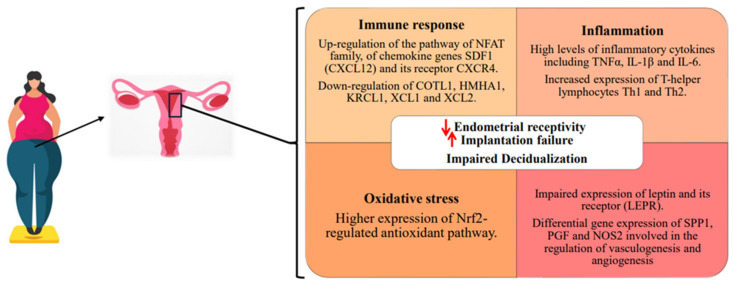
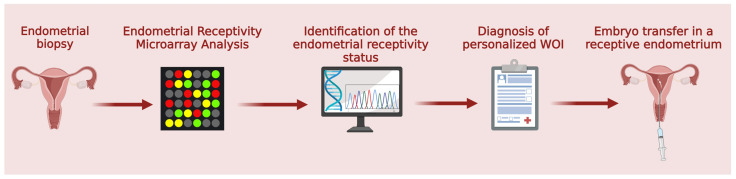
Female infertility constitutes a growing health problem in developing countries and could be associated with several possible causes including reproductive disorders, congenital malformations, infections and hormonal dysfunction. Nonetheless, a series of additional factors can also negatively impact female fertility and are represented by chronic exposure to environmental pollutants, stress, unhealthy lifestyle choices such as cigarette smoking and, among others, obesity. Excess weight is associated with several chronic diseases, and growing evidence demonstrates that it can compromise reproductive physiology due to its influence on endometrial gene expression and receptivity. Thus, the current review of the literature mainly focused on how obesity can impair uterine receptivity, mostly from a molecular point of view throughout the window of implantation (WOI) period at an endometrial level. It was also highlighted that an obesity-related increase in adipose tissue may lead to a modulation in the expression of multiple pathways, which could cause a hostile endometrial environment with a consequent negative impact on the uterine receptivity and the establishment of pregnancy. Thanks to the use of the endometrial receptivity assay (ERA), a specific microarray that studies the expression of a series of genes, it is now possible to evaluate the endometrial status of patients with infertility problems in a more detailed manner. Moreover, female fertility and endometrial receptivity could be affected by endometriosis, a chronic benign gynecological disease, whose cause-and-effect relationship to obesity is still uncertain. Therefore, further investigations would be required to better elucidate these mechanisms that govern embryo implantation and could be potentially useful for the generation of new strategies to overcome implantation failure and improve the pregnancy rates in obese women.
Keywords: endometrial receptivity; endometriosis; endometrium; gene expression; obesity.
Conflict of interest statement
The authors declare no conflicts of interest.
Figures
References
-
- Gonnella F., Konstantinidou F., Di Berardino C., Capacchietti G., Peserico A., Russo V., Barboni B., Stuppia L., Gatta V. A Systematic Review of the Effects of High-Fat Diet Exposure on Oocyte and Follicular Quality: A Molecular Point of View. Int. J. Mol. Sci. 2022;23:8890. doi: 10.3390/ijms23168890. - DOI - PMC - PubMed
Publication types
MeSH terms
LinkOut - more resources
Full Text Sources
Medical
