


First human safety and effectiveness study of defibrillation with a novel patch wearable cardioverter-defibrillator
- PMID: 39001864
- PMCID: PMC11282460
- DOI: 10.1093/europace/euae189
First human safety and effectiveness study of defibrillation with a novel patch wearable cardioverter-defibrillator
Abstract
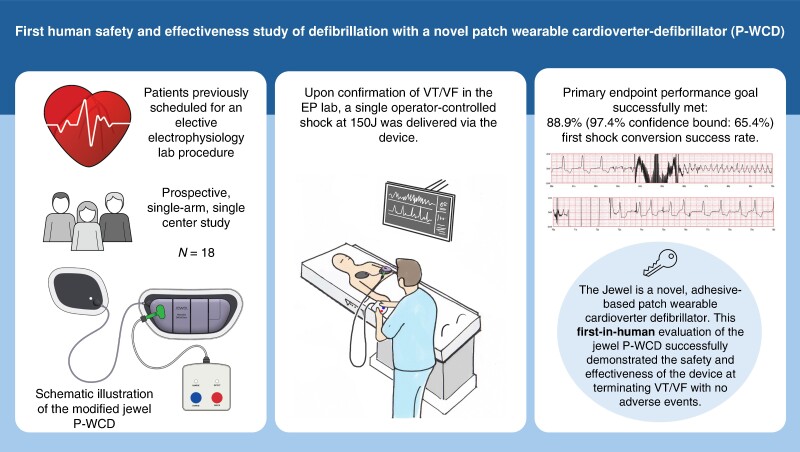
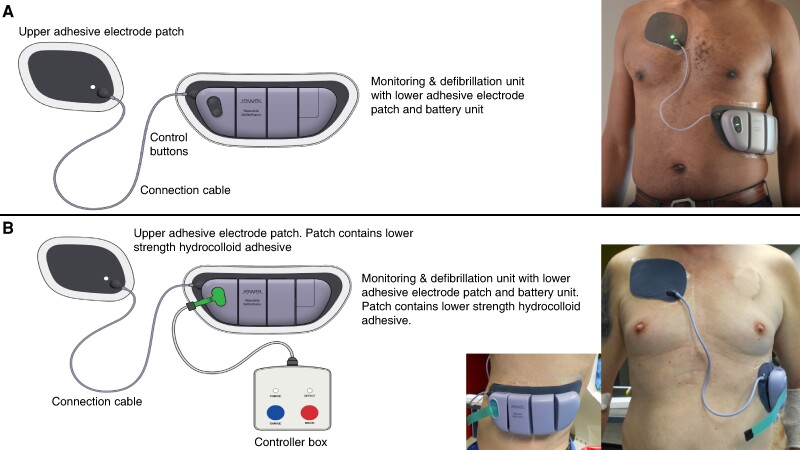
Aims: Wearable cardioverter-defibrillators (WCDs) are indicated in patients at risk of sudden cardiac arrest who are not immediate candidates for implantable defibrillator therapy. Limitations of existing WCDs include poor compliance and high false alarm rates. The Jewel is a novel patch-WCD (P-WCD) that addresses these limitations with an adhesive-based design for near-continuous wear and a machine learning algorithm designed to minimize inappropriate detections. This was a first-in-human study of the Jewel P-WCD conducted in an electrophysiology (EP) lab to determine the safety and effectiveness of the device in terminating ventricular tachycardia/ventricular fibrillation (VT/VF) with a single shock. The aim was to evaluate the safety and effectiveness of terminating VT/VF with a single shock using the Jewel P-WCD.
Methods and results: This was a first-in-human, prospective, single-arm, single-centre study in patients scheduled for an EP procedure in which VT/VF was expected to either spontaneously occur or be induced. The Jewel P-WCD was placed on consented patients; upon confirmation of VT/VF, a single shock (150 J) was delivered via the device. A group sequential design and Pocock alpha spending function was used to measure the observed proportion of successful VT/VF single-shock terminations. The endpoint was achieved if the lower confidence limit exceeded the performance goal of 62%, using a one-sided lower 97.4% exact confidence bound. Of 18 eligible subjects, 16 (88.9%, 97.4% confidence bound: 65.4%) were successfully defibrillated with a single shock, exceeding the primary endpoint performance goal with no adverse events.
Conclusion: This first-in-human evaluation of the Jewel P-WCD demonstrated the safety and effectiveness of terminating VT/VF.
Clinical trial registration: URL: https://clinicaltrials.gov/; Unique identifier: NCT05490459.
Keywords: Sudden cardiac arrest; Ventricular arrhythmia; Wearable cardioverter-defibrillator.
© The Author(s) 2024. Published by Oxford University Press on behalf of the European Society of Cardiology.
Figures
References
-
- Wong CX, Brown A, Lau DH, Chugh SS, Albert CM, Kalman JM et al. Epidemiology of sudden cardiac death: global and regional perspectives. Heart Lung Circ 2019;28:6–14. - PubMed
-
- WHO Scientific Group, WHO . Sudden Cardiac Death: Report of a WHO Scientific Group. https://apps.who.int/iris/handle/10665/39554 (15 March 2024, date last accessed).
-
- Bigger JT. Prophylactic use of implanted cardiac defibrillators in patients at high risk for ventricular arrhythmias after coronary-artery bypass graft surgery. Coronary artery bypass graft (CABG) patch trial investigators. N Engl J Med 1997;337:1569–75. - PubMed
-
- Moss AJ, Hall WJ, Cannom DS, Daubert JP, Higgins SL, Klein H et al. Improved survival with an implanted defibrillator in patients with coronary disease at high risk for ventricular arrhythmia. Multicenter automatic defibrillator implantation trial investigators. N Engl J Med 1996;335:1933–40. - PubMed
-
- Buxton AE, Lee KL, Fisher JD, Josephson ME, Prystowsky EN, Hafley G. A randomized study of the prevention of sudden death in patients with coronary artery disease. Multicenter unsustained tachycardia trial investigators. N Engl J Med 1999;341:1882–90. - PubMed
Publication types
MeSH terms
Associated data
Grants and funding
LinkOut - more resources
Full Text Sources
Medical
Miscellaneous
