


Bloodstream infections due to multi-drug resistant bacteria in the emergency department: prevalence, risk factors and outcomes-a retrospective observational study
- PMID: 39001978
- PMCID: PMC11950129
- DOI: 10.1007/s11739-024-03692-7
Bloodstream infections due to multi-drug resistant bacteria in the emergency department: prevalence, risk factors and outcomes-a retrospective observational study
Abstract
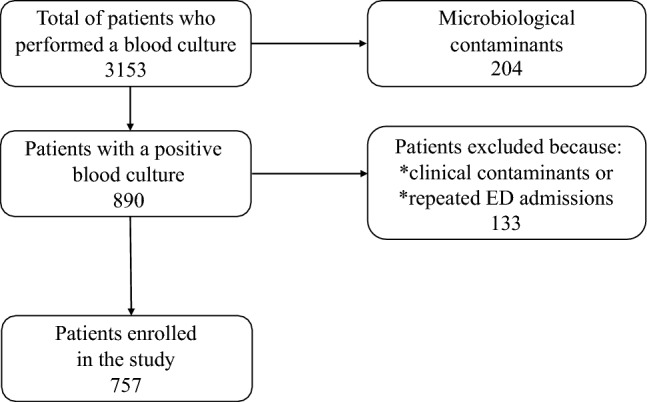
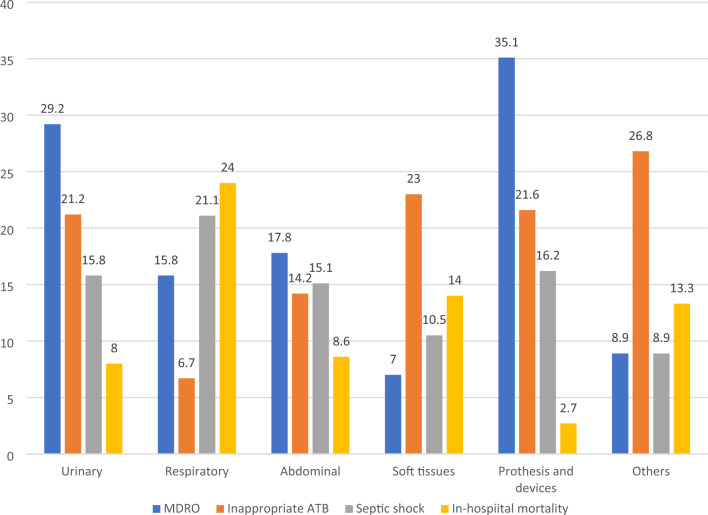
Multidrug-resistant organisms (MDROs) are prevalent in patients admitted to the Emergency Department (ED) and increase the risk of inappropriate empirical antibiotic therapy. Risk stratification for MDRO infection is essential to early identify patients requiring empirical broad-spectrum antibiotic therapy, but it remains challenging for emergency physicians. This study aimed to evaluate prevalence, risk factors, and outcomes of patients admitted to the ED with a bloodstream infection (BSI) caused by MDROs. A retrospective observational study enrolling all consecutive adult patients admitted with a BSI to the ED of Niguarda Hospital, Italy, from January 2019 to December 2021 was performed. 757 patients were enrolled, 14.1% with septic shock. 156 (20%) patients had a BSI caused by MDRO: extended-spectrum beta-lactamase (ESBL) producing Enterobacterales were the most prevalent followed by methicillin-resistant Staphylococcus aureus (MRSA). Risk factors for BSI due to MDRO and specifically for ESBL were chronic renal failure (OR 2.2; 95%CI 1.4-3.6), nursing home residency (OR 4.4; 95%CI 1.9-10.2) and antibiotic therapy in the last 90-days (OR 2.6; 95%CI 1.7-4), whereas for MRSA were dialysis (OR 12.3; 95%CI 1.8-83), antibiotic therapy and/or hospital admission in the past 90-days (OR 3.6; 95%CI 1.2-10.6) and ureteral stent or nephrostomy (OR 7.8; 95%CI 1.5-40.9). Patients with BSI due to MDRO had a higher rate of inappropriate empirical antibiotic therapy (50%) and longer length of stay, but no higher in-hospital mortality. Among patients admitted to the ED with a BSI, MDROs are frequent and often associated with inappropriate empirical antibiotic therapy. Specific updated risk factors for MDRO may help clinicians to better identify patients requiring a broader antibiotic therapy in the ED, while awaiting microbiological results.
Keywords: Enterobacteriaceae; Anti-bacterial agents; Beta-lactamases; MRSA; Sepsis; Septic shock.
© 2024. The Author(s).
Conflict of interest statement
Declarations. Conflict of interest: The authors declare that they have no conflict interest. Statement of human and animal rights: The study was approved by the local ethical committee of Milano Area 3 (ethical approval number 338-18052022). Informed consent: Owing to retrospective and de-identified data collection, the need for informed consent was waived.
Figures
References
-
- European Centre for Disease Prevention and Control. Antimicrobial resistance surveillance in Europe 2023. Annual Report of the European Antimicrobial Resistance Surveillance Network (EARS-Net). Stockholm, Sweden: European Centre for Disease Prevention and 2023. 2020–2021
-
- Pfaller MA, Carvalhaes CG, Smith CJ, Diekema DJ, Castanheira M (2020) Bacterial and fungal pathogens isolated from patients with bloodstream infection: frequency of occurrence and antimicrobial susceptibility patterns from the SENTRY Antimicrobial Surveillance Program (2012–2017). Diagn Microbiol Infect Dis 97(2):115016 - PubMed
-
- McDanel J, Schweizer M, Crabb V, Nelson R, Samore M, Khader K et al (2017) Incidence of extended-spectrum β-Lactamase (ESBL)-producing Escherichia coli and klebsiella infections in the United States: A systematic literature review. Infect Control Hosp Epidemiol 38(10):1209–1215 - PubMed
-
- González del Castillo J, Julián-Jiménez A, Gamazo-Del Rio JJ, García-Lamberechts EJ, Llopis-Roca F, Guardiola Tey JM, et al. (2020) A multidrug-resistant microorganism infection risk prediction model: development and validation in an emergency medicine population. Eur J Clin Microbiol Infect Dis 39(2):309–323 - PubMed
-
- Picot-Guéraud R, Batailler P, Caspar Y, Hennebique A, Mallaret MR (2015) Bacteremia caused by multidrug-resistant bacteria in a French university hospital center: 3 Years of collection. Am J Infect Control 43(9):960–964 - PubMed
Publication types
MeSH terms
Substances
LinkOut - more resources
Full Text Sources
Miscellaneous
