. 2024 Jul 15;23(1):75.
doi: 10.1186/s12937-024-00980-y.

Lower energy intake associated with higher risk of cardiovascular mortality in chronic kidney disease patients on a low-protein diets

Affiliations

Lower energy intake associated with higher risk of cardiovascular mortality in chronic kidney disease patients on a low-protein diets

Yao Liu et al. Nutr J. .

Abstract

Objective: An increasing number of studies shown that inadequate energy intake causes an increase in adverse incidents in chronic kidney disease (CKD) patients on low-protein diets (LPD). The study aimed to investigate the relationship between energy intake and cardiovascular mortality in CKD patients on a LPD.

Methods: This was a cross-sectional study, a total of 4264 CKD patients were enrolled from the NHANES database between 2009 and 2018. Restricted cubic spline plots and Cox regression analysis were used to analyze the association between energy intake and cardiovascular mortality in CKD patients on a LPD. Additionally, a nomogram was constructed to estimate cardiovascular survival in CKD patients on a LPD.

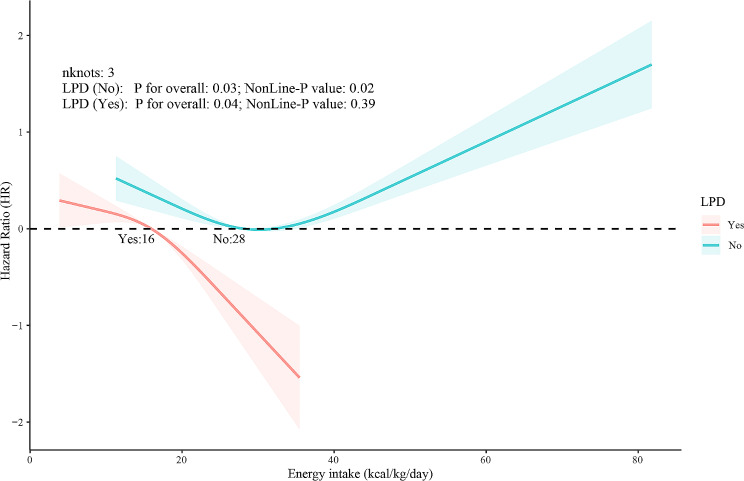
Results: Among CKD patients on a LPD in the United States, 90.05% had an energy intake of less than 25 kcal/kg/day, compared to 36.94% in CKD patients on a non-LPD. Energy intake and cardiovascular mortality showed a linear relationship in CKD patients on a LPD, while a 'U-shaped' relationship was observed in CKD patients on a non-LPD. Multifactorial Cox regression models revealed that for Per-standard deviation (Per-SD) decrement in energy intake, the risk of cardiovascular mortality increased by 41% (HR: 1.41, 95% CI: 1.12, 1.77; P = 0.004) in CKD patients on a LPD. The concordance index of the nomogram was 0.79 (95% CI, 0.75, 0.83).

Conclusion: CKD patients, especially those on a LPD, have significantly inadequate energy intake. Lower energy intake is associated with higher cardiovascular mortality in CKD patients on a LPD.

Keywords: Chronic kidney disease; Epidemiology and outcomes; Malnutrition; Mortality risk; Risk factors.


Conflict of interest statement

The authors declare no competing interests.

Figures
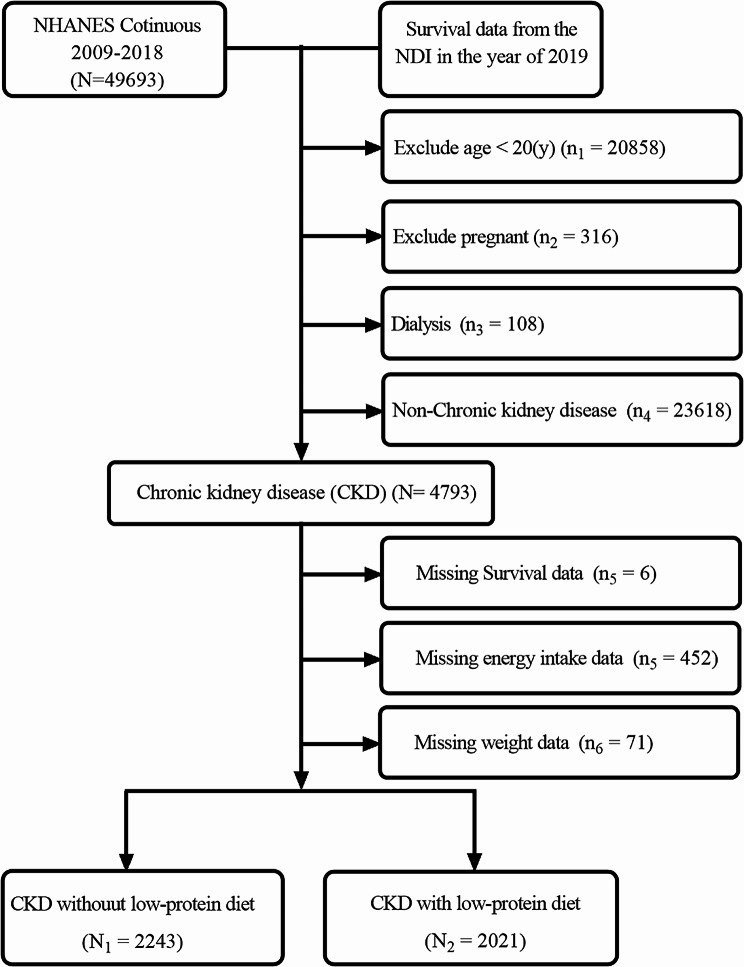
Fig. 1
Fig. 1
Flowchart of included individuals in this study
Fig. 2
Fig. 2
Status of nutritional intake in CKD patients with changes over the years: (A) energy intake, (B) the proportion of patients with different levels of energy intake, (C) protein, carbohydrate, and fat intake, (D) the proportion of patients with LPD, VLPD, low carbohydrate diet, low fat diet. LPD, low protein diet; VLPD, very low protein diet; CKD, chronic kidney disease
Fig. 3
Fig. 3
Association between energy intake and the risk of cardiovascular mortality in individuals with CKD by different protein intake based on restricted cubic spline plot
Fig. 4
Fig. 4
Associations between energy intake and the risk of cardiovascular mortality in individuals with CKD on a LPD. Model 1 adjusted for baseline age, sex (‘Male’, ‘Female’), ethnicity, BMI (‘<30’, ‘≥30’), alcohol use (‘No’, ‘Yes’), smoking (‘No’, ‘Yes’); Model 2 adjusted for covariates in model 1 plus e-GFR, ACR (‘<30’, ‘30–300’, ‘≥30’); Model 3 adjusted for covariates in model 2 plus serum albumin (‘<35’, ‘≥35’), hypertension (‘Yes’ or ‘No’), anemia (‘Yes’ or ‘No’), diabetes (‘Yes’ or ‘No’), hyperlipidemia (‘Yes’ or ‘No’), RAASi use (‘Yes’ or ‘No’); HR, hazard ratio; CI, confidence interval; BMI, body mass index; ACR, albumin-creatinine ratio; e-GFR, estimated glomerular filtration rate; RAASi, renin-angiotensin-aldosterone system inhibitor; CKD, chronic kidney disease
Fig. 5
Fig. 5
Stratified analysis of the effect of energy intake and the cardiovascular mortality in patients with CKD on a LPD. Adjusted for baseline age, sex, ethnicity, BMI, e-GFR, ACR, e-GFR; HR, hazard ratio; CI, confidence interval; ACR, albumin-creatinine ratio; e-GFR, estimated glomerular filtration rate; CKD, chronic kidney disease; CVD, Cardiovascular Disease
Fig. 6
Fig. 6
Nomograms predicted cardiovascular mortality. Prognostic nomogram to predict individual renal survival probability at 3, and 5 years in patients with CKD on a LPD. BMI, body mass index; e-GFR, estimated glomerular fltration rate

Similar articles

References

    1. Kovesdy CP. Epidemiology of chronic kidney disease: an update 2022. Kidney Int Supplements. 2022;12(1):7–11. doi: 10.1016/j.kisu.2021.11.003. - DOI - PMC - PubMed
    1. Global regional, national burden of chronic kidney disease 1990–2017: a systematic analysis for the global burden of Disease Study 2017. Lancet (London England) 2020;395(10225):709–33. doi: 10.1016/S0140-6736(20)30045-3. - DOI - PMC - PubMed
    1. Curtis S, Komenda P. Screening for chronic kidney disease: moving toward more sustainable health care. Curr Opin Nephrol Hypertens. 2020;29(3):333–8. doi: 10.1097/MNH.0000000000000597. - DOI - PubMed
    1. Hanafusa N, Lodebo BT, Kopple JD. Current uses of Dietary Therapy for patients with Far-Advanced CKD. Clin J Am Soc Nephrology: CJASN. 2017;12(7):1190–5. doi: 10.2215/CJN.09340916. - DOI - PMC - PubMed
    1. Kasiske BL, Lakatua JD, Ma JZ, et al. A meta-analysis of the effects of dietary protein restriction on the rate of decline in renal function. Am J Kidney Diseases: Official J Natl Kidney Foundation. 1998;31(6):954–61. doi: 10.1053/ajkd.1998.v31.pm9631839. - DOI - PubMed

LinkOut - more resources