


This is a preprint.
Motor adaptation is reduced by symbolic compared to sensory feedback
- PMID: 39005305
- PMCID: PMC11244888
- DOI: 10.1101/2024.06.28.601293
Motor adaptation is reduced by symbolic compared to sensory feedback
Abstract
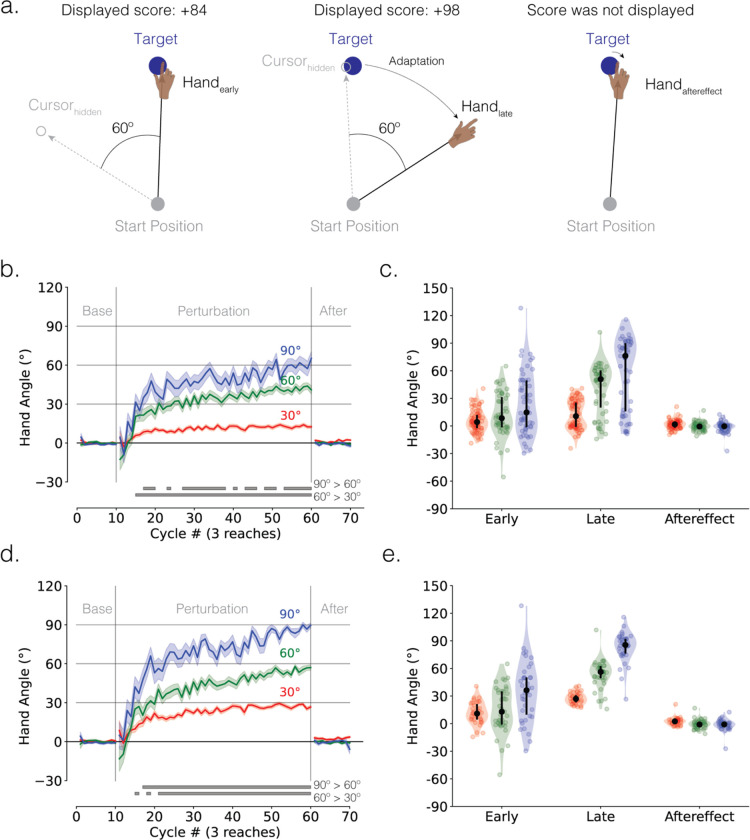
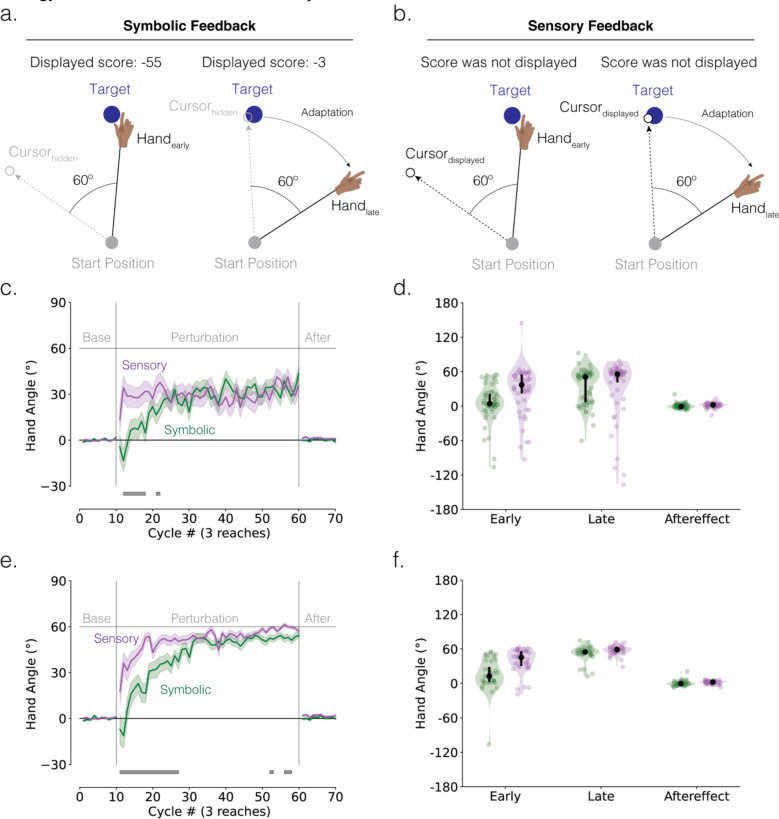
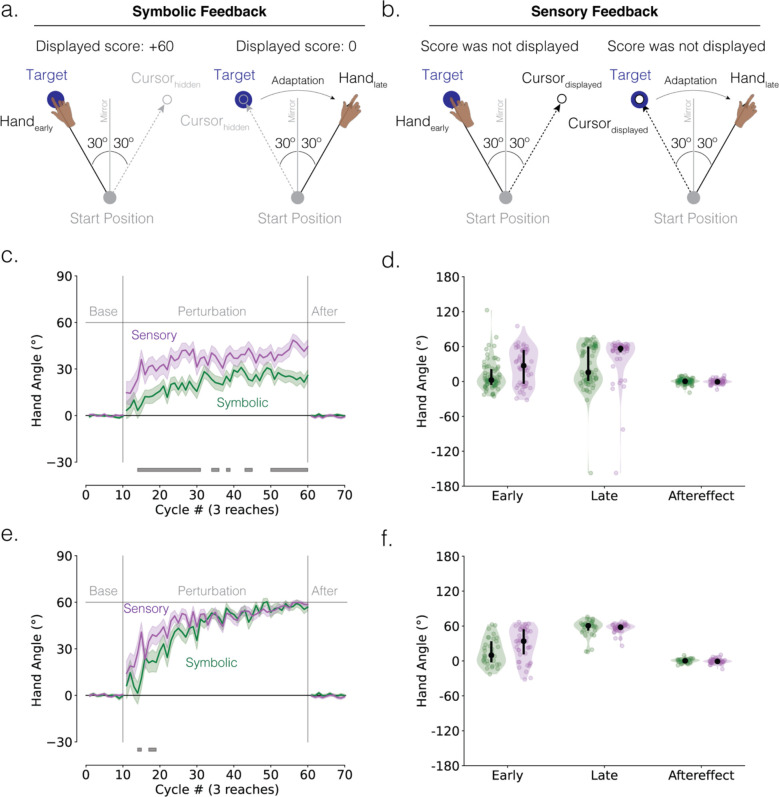
Motor adaptation - the process of reducing motor errors through feedback and practice - is an essential feature of human competence, allowing us to move accurately in dynamic and novel environments. Adaptation typically results from sensory feedback, with most learning driven by visual and proprioceptive feedback that arises with the movement. In humans, motor adaptation can also be driven by symbolic feedback. In the present study, we examine how implicit and explicit components of motor adaptation are modulated by symbolic feedback. We conducted three reaching experiments involving over 400 human participants to compare sensory and symbolic feedback using a task in which both types of learning processes could be operative (Experiment 1) or tasks in which learning was expected to be limited to only an explicit process (Experiments 2 and 3). Adaptation with symbolic feedback was dominated by explicit strategy use, with minimal evidence of implicit recalibration. Even when matched in terms of information content, adaptation to rotational and mirror reversal perturbations was slower in response to symbolic feedback compared to sensory feedback. Our results suggest that the abstract and indirect nature of symbolic feedback disrupts strategic reasoning and/or refinement, deepening our understanding of how feedback type influences the mechanisms of sensorimotor learning.
Conflict of interest statement
Competing interests RI is a co-founder with equity in Magnetic Tides, Inc., a biotechnology company created to develop a novel method of non-invasive brain stimulation. The other authors declare no competing interests.
Figures
References
Publication types
Grants and funding
LinkOut - more resources
Full Text Sources
