[Preprint]. 2024 Oct 3:2024.06.27.601086.
doi: 10.1101/2024.06.27.601086.

The Amphibian Genomics Consortium: advancing genomic and genetic resources for amphibian research and conservation

Affiliations

The Amphibian Genomics Consortium: advancing genomic and genetic resources for amphibian research and conservation

Tiffany A Kosch et al. bioRxiv. .

Update in

  • The Amphibian Genomics Consortium: advancing genomic and genetic resources for amphibian research and conservation.
    Kosch TA, Torres-Sánchez M, Liedtke HC, Summers K, Yun MH, Crawford AJ, Maddock ST, Ahammed MS, Araújo VLN, Bertola LV, Bucciarelli GM, Carné A, Carneiro CM, Chan KO, Chen Y, Crottini A, da Silva JM, Denton RD, Dittrich C, Espregueira Themudo G, Farquharson KA, Forsdick NJ, Gilbert E, Che J, Katzenback BA, Kotharambath R, Levis NA, Márquez R, Mazepa G, Mulder KP, Müller H, O'Connell MJ, Orozco-terWengel P, Palomar G, Petzold A, Pfennig DW, Pfennig KS, Reichert MS, Robert J, Scherz MD, Siu-Ting K, Snead AA, Stöck M, Stuckert AMM, Stynoski JL, Tarvin RD, Wollenberg Valero KC; Amphibian Genomics Consortium. Kosch TA, et al. BMC Genomics. 2024 Nov 1;25(1):1025. doi: 10.1186/s12864-024-10899-7. BMC Genomics. 2024. PMID: 39487448 Free PMC article. Review.

Abstract

Amphibians represent a diverse group of tetrapods, marked by deep divergence times between their three systematic orders and families. Studying amphibian biology through the genomics lens increases our understanding of the features of this animal class and that of other terrestrial vertebrates. The need for amphibian genomic resources is more urgent than ever due to the increasing threats to this group. Amphibians are one of the most imperiled taxonomic groups, with approximately 41% of species threatened with extinction due to habitat loss, changes in land use patterns, disease, climate change, and their synergistic effects. Amphibian genomic resources have provided a better understanding of ontogenetic diversity, tissue regeneration, diverse life history and reproductive modes, antipredator strategies, and resilience and adaptive responses. They also serve as essential models for studying broad genomic traits, such as evolutionary genome expansions and contractions, as they exhibit the widest range of genome sizes among all animal taxa and possess multiple mechanisms of genetic sex determination. Despite these features, genome sequencing of amphibians has significantly lagged behind that of other vertebrates, primarily due to the challenges of assembling their large, repeat-rich genomes and the relative lack of societal support. The emergence of long-read sequencing technologies, combined with advanced molecular and computational techniques that improve scaffolding and reduce computational workloads, is now making it possible to address some of these challenges. To promote and accelerate the production and use of amphibian genomics research through international coordination and collaboration, we launched the Amphibian Genomics Consortium (AGC, https://mvs.unimelb.edu.au/amphibian-genomics-consortium) in early 2023. This burgeoning community already has more than 282 members from 41 countries. The AGC aims to leverage the diverse capabilities of its members to advance genomic resources for amphibians and bridge the implementation gap between biologists, bioinformaticians, and conservation practitioners. Here we evaluate the state of the field of amphibian genomics, highlight previous studies, present challenges to overcome, and call on the research and conservation communities to unite as part of the AGC to enable amphibian genomics research to "leap" to the next level.

Keywords: Amphibians; Biodiversity conservation; Comparative genomics; Genomics; Lissamphibia; Metagenomics; Phylogenomics; Population genomics; Taxonomy; Transcriptomics.


Conflict of interest statement

Competing interests The authors declare no competing interests.

Figures
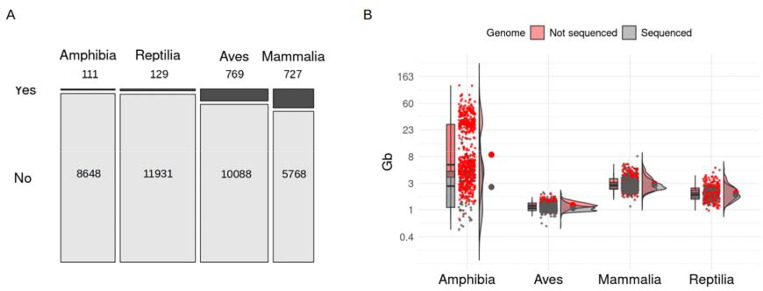
Figure 1.
Figure 1.. Estimated genome size across tetrapod classes in relation to sequenced genomes.
(A) Mosaic plot representing the percentage of species with sequenced genomes as a proportion of the number of described species for each tetrapod class (Yes: % species with sequenced genome; No: % species without sequenced genome). (B) Combined box and density plot with raw data as points comparing genome size of species with sequenced genome (gray; genome sizes from NCBI genome assemblies) versus a subset of species without a sequenced genome (red; genome sizes from the Animal Genome Size Database) for each tetrapod class. The y-axis is log-transformed to facilitate visualization. Information about sequenced genomes and genome sizes was obtained from the NCBI Genome Browser, the Animal Genome Size database, and amphibian records from [12, 20].
Figure 2.
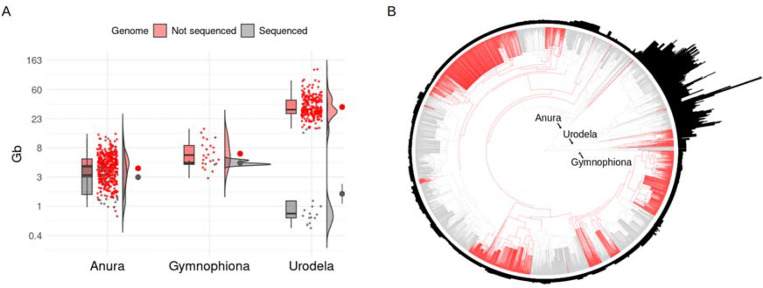
Figure 2.. Estimated genome size across amphibian orders in relation to sequenced genomes.
(A) Combined box and density plot with raw data as points showing genome size of species with sequenced genome (gray color; genome sizes from NCBI genome assemblies) versus a subset of species without available genome assembly (red color; genome sizes from the Animal Genome Size Database) for each amphibian order. The y-axis is logarithmic transformed to facilitate visualization. Information about sequenced genomes and genome sizes was obtained from the NCBI Genome Browser, the Animal Genome Size database [20], and amphibian records from [12]. (B) Amphibian phylogenetic tree was adapted from [71], which includes species with genome size estimates from Genomes on a Tree (GoaT) [19]. Branches are color coded to represent families without any genomic record (in red) and families with at least a representative genome sequenced (in gray). Bar plots around the phylogeny indicate relative genome sizes.
Figure 3.
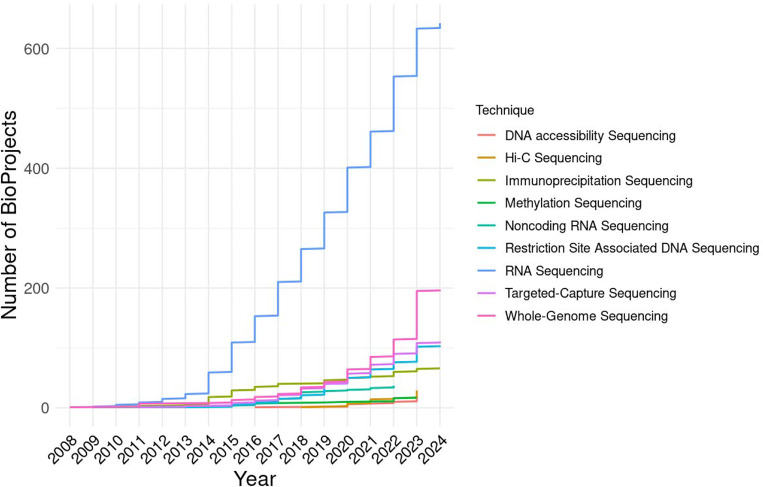
Figure 3.. Main sequencing techniques applied to amphibian genomics studies.
Yearly cumulative number of amphibian BioProjects split and color-coded by sequencing technique (DNA accessibility Sequencing includes ATAC-Seq and Mnase-Seq; Immunoprecipitation Sequencing includes: ChIP-Seq and RIP-Seq; Amplicon sequencing was included with Targeted-Capture Sequencing; Noncoding RNA Sequencing includes: miRNA-Seq and ncRNA-Seq). BioProject information was obtained from the NCBI Sequence Read Archive (SRA, accessed 1 March 2024).
Figure 4.
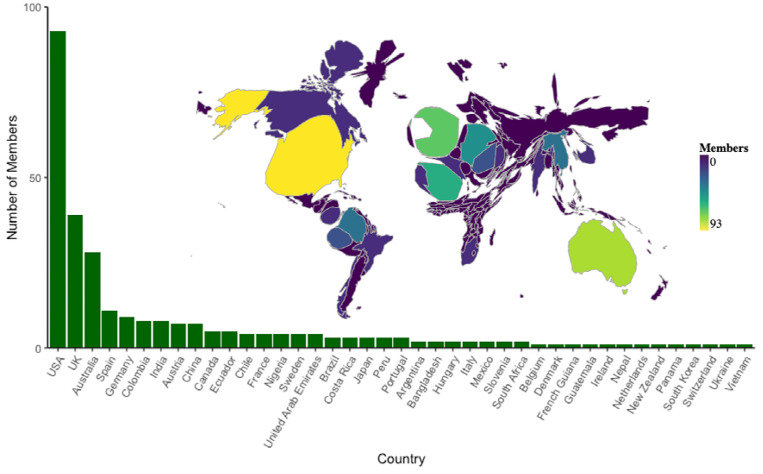
Figure 4.. Amphibian Genomics Consortium (AGC) membership by country.
Inset map showing the size of each country scaled by number of members in the AGC.
Figure 5.
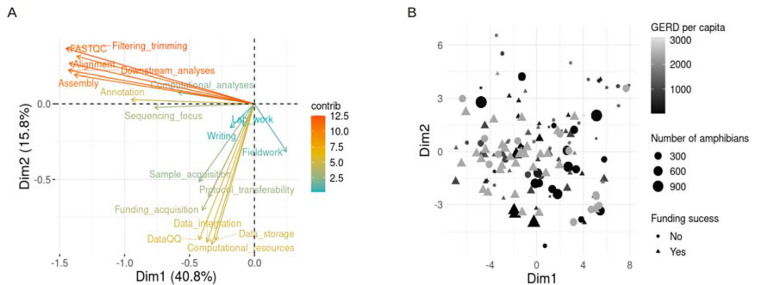
Figure 5.. Sequencing competencies and identified challenges of the members of the Amphibian Genomics Consortium (AGC).
(A) Representation of the contribution of the AGC survey quantitative questions to the first dimensions after computing a principal component analysis (PCA). Bioinformatic competencies and perceived challenges were grouped into dimensions one and two, respectively. (B) Scatter plot showing PCA scores for each AGC survey respondent. Respondent answers are coded by the qualitative question about funding success for amphibian genomics projects using shape; number of amphibian species of the respondent main affiliation country by size, and gross domestic expenditure on R&D (GERD) per capita of the respondent main affiliation country by gray-scale color coded. Information about the number of amphibian species per country was obtained from AmphibiaWeb. GERD per capita was calculated using information from the UNESCO and World Bank websites from the information about the most recent year for each country.

References

    1. Hellsten U, Harland RM, Gilchrist MJ, Hendrix D, Jurka J, Kapitonov V, Ovcharenko I, Putnam NH, Shu S, Taher L et al. : The Genome of the Western Clawed Frog Xenopus tropicalis. Science 2010, 328(5978):633–636. - PMC - PubMed
    1. Band MR, Larson JH, Rebeiz M, Green CA, Heyen DW, Donovan J, Windish R, Steining C, Mahyuddin P, Womack JE et al. : An ordered comparative map of the cattle and human genomes. Genome Res 2000, 10(9):1359–1368. - PMC - PubMed
    1. Aparicio S, Chapman J, Stupka E, Putnam N, Chia JM, Dehal P, Christoffels A, Rash S, Hoon S, Smit A et al. : Whole-genome shotgun assembly and analysis of the genome of Fugu rubripes. Science 2002, 297(5585):1301–1310. - PubMed
    1. Collins FS, Green ED, Guttmacher AE, Guyer MS, on behalf of the USNHGRI: A vision for the future of genomics research. Nature 2003, 422(6934):835–847. - PubMed
    1. Hillier LW, Miller W, Birney E, Warren W, Hardison RC, Ponting CP, Bork P, Burt DW, Groenen MAM, Delany ME et al. : Sequence and comparative analysis of the chicken genome provide unique perspectives on vertebrate evolution. Nature 2004, 432(7018):695–716. - PubMed

Publication types

LinkOut - more resources