


Perioperative management and neuraxial analgesia in women with factor XI deficiency (<60 IU/dL): a French multicenter observational study of 314 pregnancies
- PMID: 39006229
- PMCID: PMC11245963
- DOI: 10.1016/j.rpth.2024.102462
Perioperative management and neuraxial analgesia in women with factor XI deficiency (<60 IU/dL): a French multicenter observational study of 314 pregnancies
Abstract
Background: Factor (F)XI deficiency is a rare bleeding disorder with a poor correlation between bleeding tendency and FXI level. Management of pregnant women with FXI deficiency is not clearly established, especially regarding neuraxial analgesia (NA).
Objectives: A retrospective multicenter observational study was conducted in French hemostasis centers on pregnant women with FXI of <60 IU/dL.
Methods: Data to report were (i) FXI levels before pregnancy and at time of delivery, (ii) type of NA and delivery management modalities, and (iii) possible complications related to NA and bleeding complications.
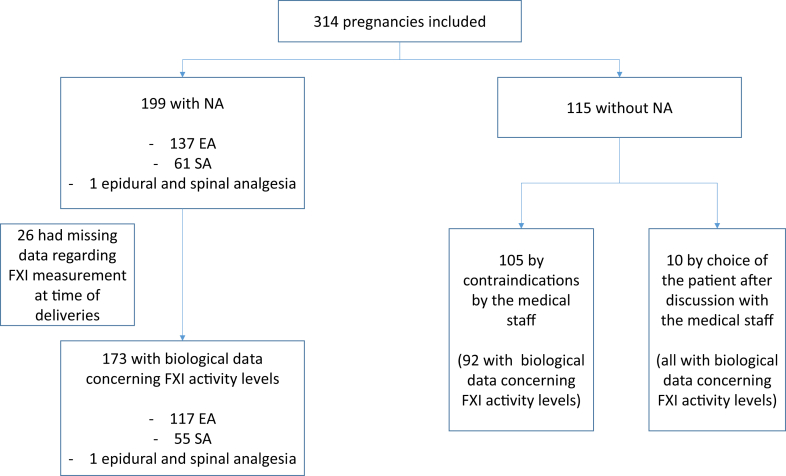
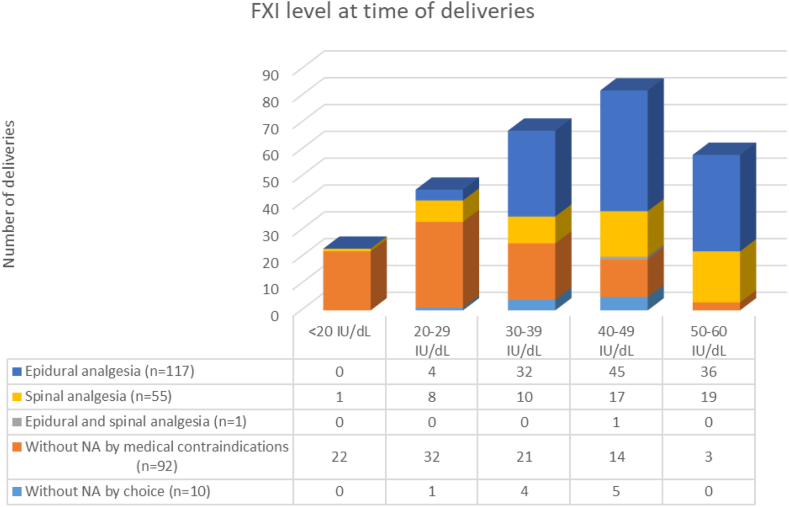
Results: Three hundred fourteen pregnancies in patients with FXI deficiency of <60 IU/dL were reported (from 20 centers); among them, 199 NA procedures have been completed (137 epidurals and 61 spinals, 1 had both). The period of childbirth was mostly from 2014 to 2020 (281/314; 89.5%). Congenital FXI deficiency was established with certainty by investigators in 32.8% patients (n = 103). Previous bleedings were described in 20.4% of the patients (64/314; 45.3% cutaneous, 31.3% gynecologic, and 15.6% postsurgical). Thirteen deliveries had an NA procedure with FXI of <30 IU/dL, 42 with FXI of 30-40 IU/dL, and 118 with FXI of 40-60 IU/dL. Median FXI levels at delivery in the epidural and spinal groups were not significantly different but were significantly lower in the group without NA by medical staff contraindications. There were no complications related to NA. A 17.5% postpartum hemorrhage or excessive postpartum bleeding incidence was reported, which is consistent with previous data.
Conclusion: Our data support the use of a 30 IU/dL FXI threshold for NA, as suggested by the French proposals published in August 2023.
Keywords: bleeding; epidural anesthesia; factor XI; observational study; spinal anesthesia.
© 2024 The Authors.
Figures
References
-
- Asakai R., Davie E.W., Chung D.W. Organization of the gene for human factor XI. Biochemistry. 1987;26:7221–7228. - PubMed
-
- Rosenthal R.L., Dreskin O.H., Rosenthal N. New hemophilia-like disease caused by deficiency of a third plasma thromboplastin factor. Proc Soc Exp Biol Med Soc Exp Biol Med. 1953;82:171–174. - PubMed
-
- Bolton-Maggs P.H.B. Factor XI deficiency—resolving the enigma? Hematology Am Soc Hematol Educ Program. 2009:97–105. - PubMed
-
- Mumford A.D., Ackroyd S., Alikhan R., Bowles L., Chowdary P., Grainger J., et al. Guideline for the diagnosis and management of the rare coagulation disorders: a United Kingdom Haemophilia Centre Doctors’ Organization guideline on behalf of the British Committee for Standards in Haematology. Br J Haematol. 2014;167:304–326. - PubMed
LinkOut - more resources
Full Text Sources
