


Imiglucerase, cholecalciferol, and bone-diet in skeletal health management of type I Gaucher disease patients: a pilot study and systematic review
- PMID: 39006867
- PMCID: PMC11245647
- DOI: 10.1093/jbmrpl/ziae071
Imiglucerase, cholecalciferol, and bone-diet in skeletal health management of type I Gaucher disease patients: a pilot study and systematic review
Abstract
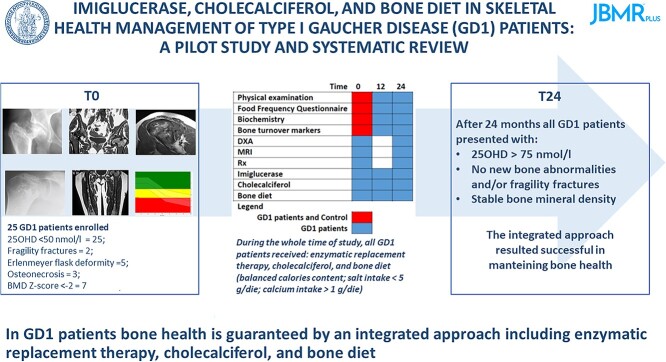
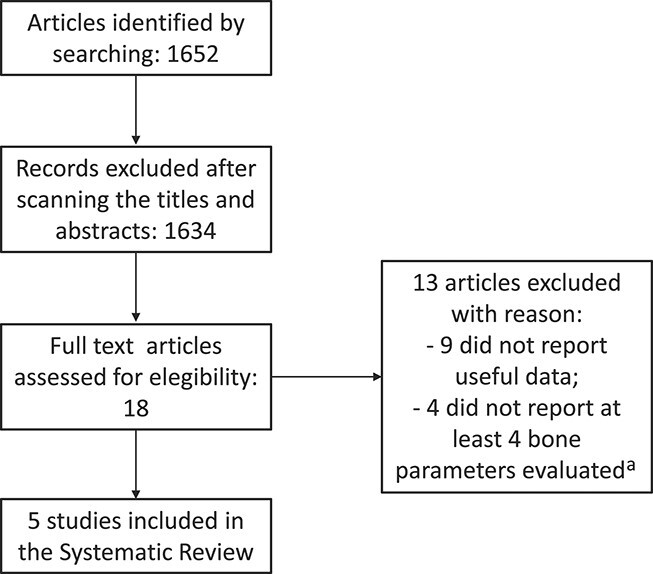
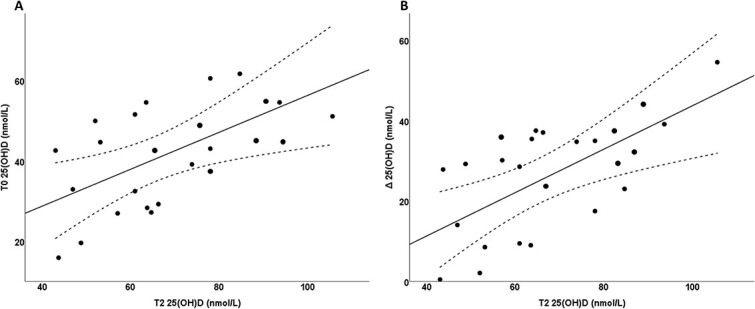
Skeletal anomalies represent a characteristic feature of type 1 Gaucher disease (GD1). Here we evaluated the impact of an integrated therapy comprising enzyme-replacement therapy (ERT), cholecalciferol, and a normocalcemic-normocaloric-hyposodic diet (bone diet) on bone health in GD1 patients. We also performed a systematic review to compare our results with available data. From January 1, 2015 to February 28, 2019, all GD1 patients referred to Federico II University were enrolled and treated with the integrated therapy. Bone turnover markers and bone mineral density (BMD) were evaluated at baseline (T0) and after 24 months (T24). We enrolled 25 GD1 patients, all showing 25-hydroxy vitamin D (25OHD) levels < 50 nmol/l (hypovitaminosis D) at T0. Response to cholecalciferol treatment was effective, showing a direct relationship between 25OHD levels before and after treatment. At T0, 2 GD1 patients showed fragility fractures, 5 the Erlenmeyer flask deformity, 3 osteonecrosis, and 7 a BMD Z-score ≤ -2. Overall, GD1 patients with bone anomalies showed higher C-terminal telopeptide levels compared with those without bone anomalies. No new bone anomalies occurred during 2 years of follow-up. At T24, BMD remained stable across the entire study cohort, including in patients with bone anomalies. The systematic review showed that our study is the first that evaluated all bone health parameters. Hypovitaminosis D is prevalent in GD1 patients. The response to cholecalciferol treatment was effective but different to healthy subjects and in patients with metabolic bone disorders. Integrated therapy including ERT, cholecalciferol, and bone diet guarantees bone health.
Keywords: Gaucher disease; bone markers; enzyme-replacement therapy; vitamin D.
© The Author(s) 2024. Published by Oxford University Press on behalf of the American Society for Bone and Mineral Research.
Conflict of interest statement
The study was realized with a partial unconditional support of Sanofi.
Figures
References
-
- Pastores GM, Hughes DA. Gaucher disease. In: Adam MP, Mirzaa GM, Pagon RA, et al., eds. GeneReviews® [Internet]. University of Washington; 1993–2023. https://www.ncbi.nlm.nih.gov/books/NBK1269/ - PubMed
LinkOut - more resources
Full Text Sources
