


Oral Health and Its Associated Factors Among the Elderly in the Emergency Department: A Latent Class Analysis
- PMID: 39006876
- PMCID: PMC11244057
- DOI: 10.2147/JMDH.S469086
Oral Health and Its Associated Factors Among the Elderly in the Emergency Department: A Latent Class Analysis
Abstract
Purpose: The objective of this study was to investigate latent classes of oral health and the factors associated with them in acutely admitted elderly inpatients.
Patients and methods: A cross-sectional study was conducted using purposive sampling to survey Chinese older-adult acutely inpatients. Data was collected utilizing several instruments, including a general information questionnaire, Brief Oral Health Status Examination (BOHSE), Oral Frailty Index-8 (OFI-8), Mini-Nutritional Assessment Short Form (MNA-SF), and Frailty Screening Questionnaire (FSQ). Latent class analysis was applied to identify distinct categories of oral health among elderly inpatients, and multinomial logistic regression was employed to analyze the factors associated with different oral health categories.
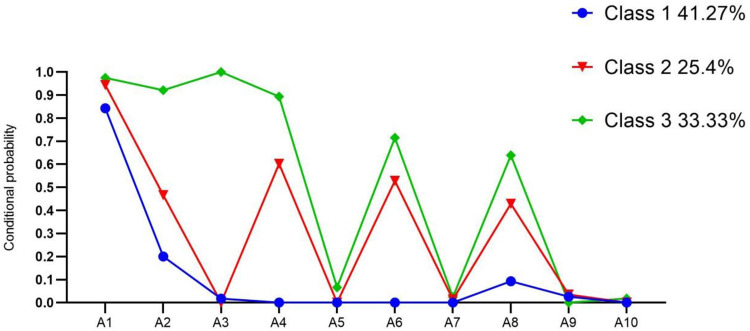
Results: In this study, a total of 504 elderly patients were ultimately included, leading to the identification of three latent classes of oral health: "oral health-low level group (41.27%)", "oral health-moderate level group (25.4%)", and "oral health-high level group (33.33%)". The findings revealed that patients with advanced age, elevated neutrophil percentage, and higher C-reactive protein (CRP) values were more likely to be classified in the low oral health group. Additionally, individuals experiencing malnutrition and frailty had a higher risk of falling into the low oral health category. Those with comorbidities and oral frailty were more prevalent in the moderate oral health group. At the same time, elderly patients with higher BMI (22.95±3.043) ratios were more likely to be categorized in the high oral health group.
Conclusion: This study sheds light on three distinct latent classes of oral health among acutely admitted elderly inpatients. These findings underscore the importance of healthcare professionals focusing on the assessment and health education of elderly patients' oral health. Furthermore, personalized interventions should be developed to promote healthy aging, with particularly attention to enhancing oral health outcomes in this population.
Keywords: emergency department; factors; frailty; latent class analysis; older people; oral health.
© 2024 Yang et al.
Conflict of interest statement
The authors declare that the research was conducted in the absence of any commercial or financial relationships that could be construed as a potential conflict of interest.
Figures
References
-
- World Health Organization. Ageing and health. Available from: http://www.who.int/zh/health-topics/ageing#tab=tab_1. Accessed September 11, 2023.
-
- Ministry of Civil Affairs. 2021 statistical bulletin on development of civil affairs. Available from: https://www.mca.gov.cn/images3/www2017/file/202208/2021mzsyfztjgb.pdf. Accessed December 3, 2023.
-
- World Health Organization. Global oral health status report: towards universal health coverage for oral health by 2030. Available from: https://www.who.int/publications/i/item/9789240061484. Accessed December 5, 2023.
LinkOut - more resources
Full Text Sources
Research Materials
Miscellaneous
