


Nijmegen breakage syndrome: 25-year experience of diagnosis and treatment in Ukraine
- PMID: 39007137
- PMCID: PMC11239363
- DOI: 10.3389/fimmu.2024.1428724
Nijmegen breakage syndrome: 25-year experience of diagnosis and treatment in Ukraine
Abstract
Introduction: Nijmegen breakage syndrome (NBS) is an autosomal recessive disorder, characterized by microcephaly, immunodeficiency, and impaired DNA repair. NBS is most prevalent among Slavic populations, including Ukraine. Our study aimed to comprehensively assess the prevalence, diagnosis, clinical data, immunological parameters, and treatment of NBS patients in Ukraine.
Methods: We conducted a retrospective review that included 84 NBS patients from different regions of Ukraine who were diagnosed in 1999-2023. Data from the Ukrainian Registry of NBS and information from treating physicians, obtained using a developed questionnaire, were utilized for analysis.
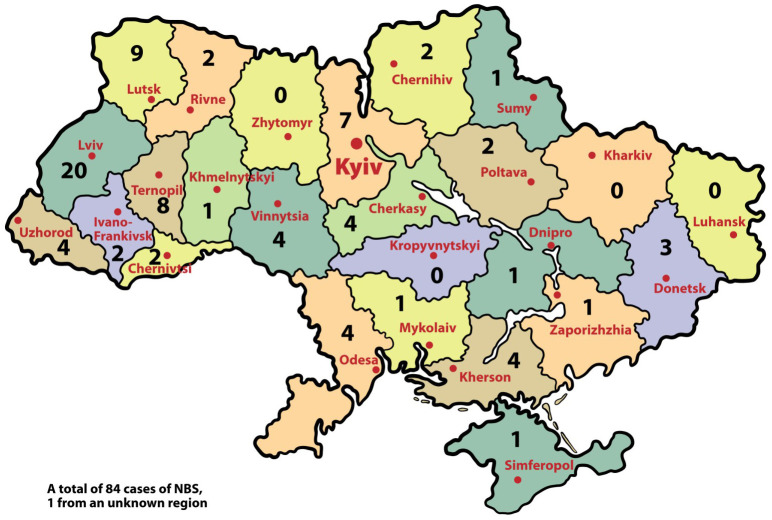
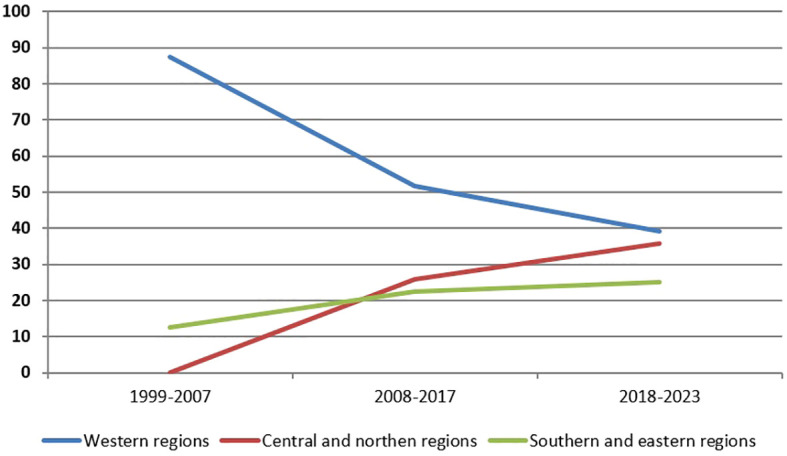
Results: Among 84 NBS patients, 55 (65.5%) were alive, 25 (29.8%) deceased, and 4 were lost to follow-up. The median age of patients was 11 years, ranging from 1 to 34 years. Most patients originate from western regions of Ukraine (57.8%), although in recent years, there has been an increase in diagnoses from central and southeastern regions, expanding our knowledge of NBS prevalence. The number of diagnosed patients per year averaged 3.4 and increased from 2.7 to 4.8 in recent years. The median age of NBS diagnosis was 4.0 years (range 0.1-16) in 1999-2007 and decreased to 2.7 in the past 6 years. Delayed physical development was observed in the majority of children up to the age of ten years. All children experienced infections, and 41.3% of them had recurrent infections. Severe infections were the cause of death in 12%. The second most common clinical manifestation of NBS was malignancies (37.5%), with the prevalence of lymphomas (63.3%). Malignancies have been the most common cause of death in NBS patients (72% of cases). Decreased levels of CD4+ and CD19+ were observed in 89.6%, followed by a reduction of CD3+ (81.8%) and CD8+ (62.5%). The level of NK cells was elevated at 62.5%. IgG concentration was decreased in 72.9%, and IgA - in 56.3%. Immunoglobulin replacement therapy was administered to 58.7% of patients. Regular immunoglobulin replacement therapy has helped reduce the frequency and severity of severe respiratory tract infections.
Conclusion: Improvements in diagnosis, including prenatal screening, newborn screening, monitoring, and expanding treatment options, will lead to better outcomes for NBS patients.
Keywords: NBN gene; Nijmegen breakage syndrome; c.657_661del5 variant; clinical analysis; diagnosis; immunological characterization; incidence; malignancies.
Copyright © 2024 Boyarchuk, Kostyuchenko, Akopyan, Bondarenko, Volokha, Hilfanova, Savchak, Nazarenko, Yarema, Urbas, Hrabovska, Lysytsia, Budzyn, Tykholaz, Ivanchuk, Bastanohova, Patskun, Vasylenko, Stepanovskyy, Chernyshova and Makukh.
Conflict of interest statement
Author HM is employed by Scientific Medical Genetic Center LeoGENE, LTD. The remaining authors declare that the research was conducted in the absence of any commercial or financial relationships that could be construed as a potential conflict of interest.
Figures
References
-
- Varon R, Seemanova E, Chrzanowska K, Hnateyko O, Piekutowska-Abramczuk D, Krajewska-Walasek M, et al. . Clinical ascertainment of Nijmegen breakage syndrome (NBS) and prevalence of the major mutation, 657del5, in three Slav populations. Eur J Hum Genet. (2000) 8:900–2. doi: 10.1038/sj.ejhg.5200554 - DOI - PubMed
-
- Sharapova SO, Pashchenko OE, Bondarenko AV, Vakhlyarskaya SS, Prokofjeva T, Fedorova AS, et al. . Geographical distribution, incidence, Malignancies, and outcome of 136 eastern slavic patients with nijmegen breakage syndrome and NBN founder variant c.657_661del5. Front Immunol. (2021) 11:602482. doi: 10.3389/fimmu.2020.602482 - DOI - PMC - PubMed
MeSH terms
LinkOut - more resources
Full Text Sources
Research Materials
Miscellaneous
