


Adverse Events of COVID-19 Vaccines in the United States: Temporal and Spatial Analysis
- PMID: 39008362
- PMCID: PMC11287098
- DOI: 10.2196/51007
Adverse Events of COVID-19 Vaccines in the United States: Temporal and Spatial Analysis
Abstract
Background: The COVID-19 pandemic, caused by SARS-CoV-2, has had a profound impact worldwide, leading to widespread morbidity and mortality. Vaccination against COVID-19 is a critical tool in controlling the spread of the virus and reducing the severity of the disease. However, the rapid development and deployment of COVID-19 vaccines have raised concerns about potential adverse events following immunization (AEFIs). Understanding the temporal and spatial patterns of these AEFIs is crucial for an effective public health response and vaccine safety monitoring.
Objective: This study aimed to analyze the temporal and spatial characteristics of AEFIs associated with COVID-19 vaccines in the United States reported to the Vaccine Adverse Event Reporting System (VAERS), thereby providing insights into the patterns and distributions of the AEFIs, the safety profile of COVID-19 vaccines, and potential risk factors associated with the AEFIs.
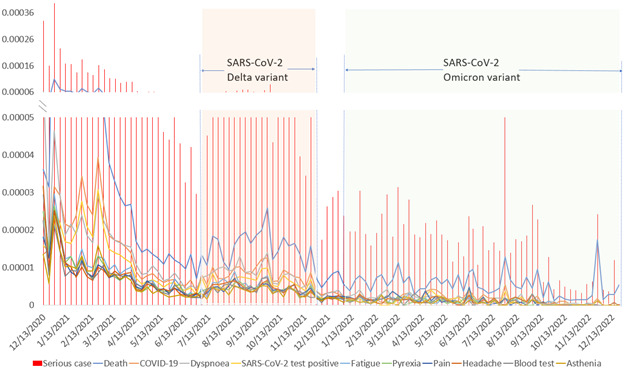
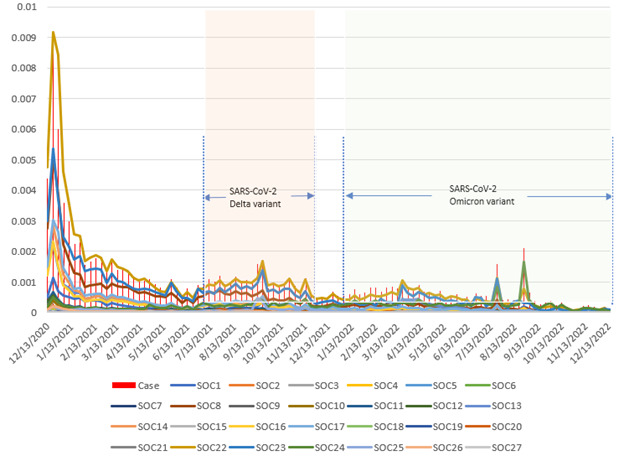
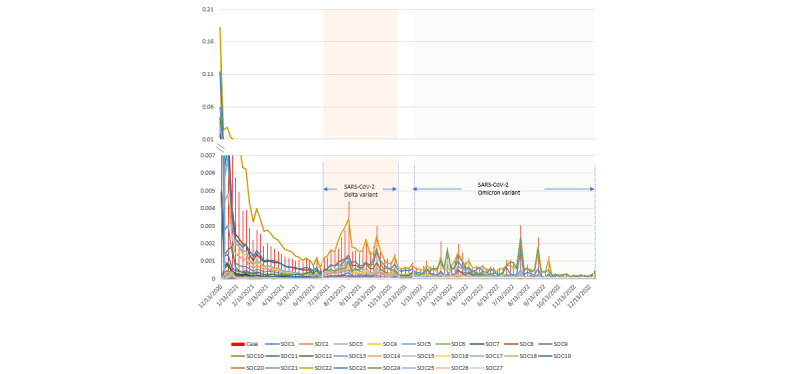
Methods: We conducted a retrospective analysis of administration data from the Centers for Disease Control and Prevention (n=663,822,575) and reports from the surveillance system VAERS (n=900,522) between 2020 and 2022. To gain a broader understanding of postvaccination AEFIs reported, we categorized them into system organ classes (SOCs) according to the Medical Dictionary for Regulatory Activities. Additionally, we performed temporal analysis to examine the trends of AEFIs in all VAERS reports, those related to Pfizer-BioNTech and Moderna, and the top 10 AEFI trends in serious reports. We also compared the similarity of symptoms across various regions within the United States.
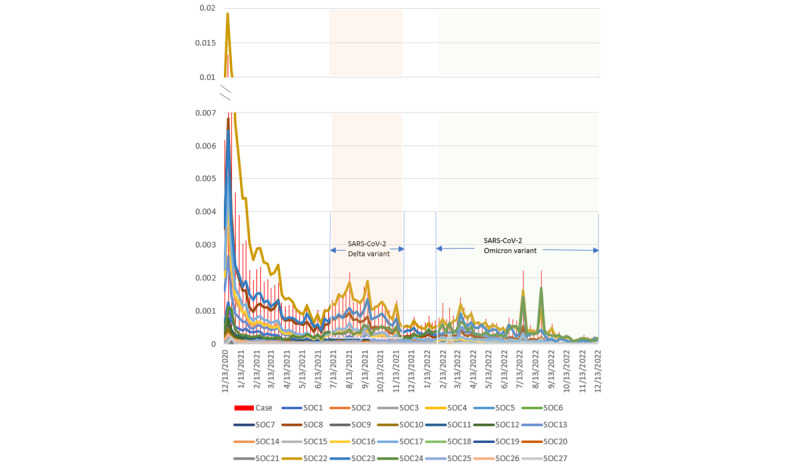
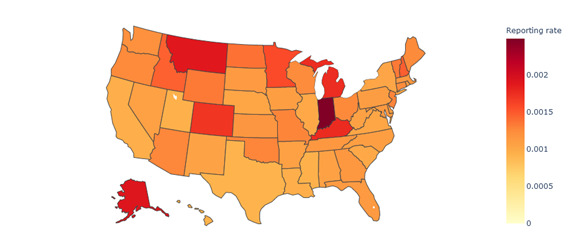
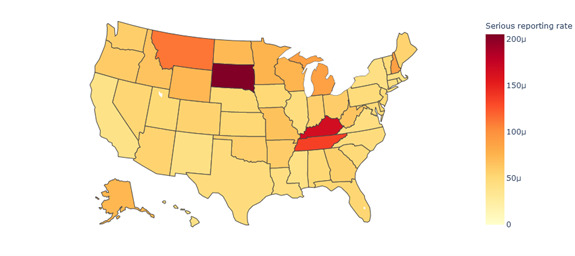
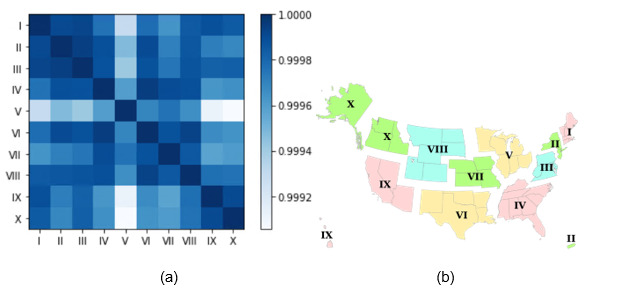
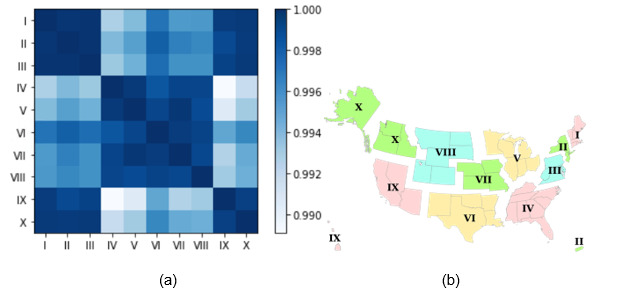
Results: Our findings revealed that the most frequently reported symptoms following COVID-19 vaccination were headache (n=141,186, 15.68%), pyrexia (n=122,120, 13.56%), and fatigue (n=121,910, 13.54%). The most common symptom combination was chills and pyrexia (n=56,954, 6.32%). Initially, general disorders and administration site conditions (SOC 22) were the most prevalent class reported. Moderna exhibited a higher reporting rate of AEFIs compared to Pfizer-BioNTech. Over time, we observed a decreasing reporting rate of AEFIs associated with COVID-19 vaccines. In addition, the overall rates of AEFIs between the Pfizer-BioNTech and Moderna vaccines were comparable. In terms of spatial analysis, the middle and north regions of the United States displayed a higher reporting rate of AEFIs associated with COVID-19 vaccines, while the southeast and south-central regions showed notable similarity in symptoms reported.
Conclusions: This study provides valuable insights into the temporal and spatial patterns of AEFIs associated with COVID-19 vaccines in the United States. The findings underscore the critical need for increasing vaccination coverage, as well as ongoing surveillance and monitoring of AEFIs. Implementing targeted monitoring programs can facilitate the effective and efficient management of AEFIs, enhancing public confidence in future COVID-19 vaccine campaigns.
Keywords: ADE; AEFI; COVID-19; COVID-19 vaccine; VAERS; Vaccine Adverse Event Reporting System; adverse drug event; adverse event following immunization; vaccine.
©Yiming Li, Jianfu Li, Yifang Dang, Yong Chen, Cui Tao. Originally published in JMIR Public Health and Surveillance (https://publichealth.jmir.org), 15.07.2024.
Conflict of interest statement
Conflicts of Interest: None declared.
Figures
References
-
- Fernandes Q, Inchakalody VP, Merhi M, Mestiri S, Taib N, Moustafa Abo El-Ella D, Bedhiafi T, Raza A, Al-Zaidan L, Mohsen MO, Yousuf Al-Nesf MA, Hssain AA, Yassine HM, Bachmann MF, Uddin S, Dermime S. Emerging COVID-19 variants and their impact on SARS-CoV-2 diagnosis, therapeutics and vaccines. Ann Med. 2022 Dec 08;54(1):524–540. doi: 10.1080/07853890.2022.2031274. https://boris.unibe.ch/id/eprint/176178 - DOI - PMC - PubMed
-
- Chaimayo C, Kaewnaphan B, Tanlieng N, Athipanyasilp N, Sirijatuphat R, Chayakulkeeree M, Angkasekwinai N, Sutthent R, Puangpunngam N, Tharmviboonsri T, Pongraweewan O, Chuthapisith S, Sirivatanauksorn Y, Kantakamalakul W, Horthongkham N. Rapid SARS-CoV-2 antigen detection assay in comparison with real-time RT-PCR assay for laboratory diagnosis of COVID-19 in Thailand. Virol J. 2020 Nov 13;17(1):177. doi: 10.1186/s12985-020-01452-5. https://virologyj.biomedcentral.com/articles/10.1186/s12985-020-01452-5 10.1186/s12985-020-01452-5 - DOI - PMC - PubMed
-
- Yamayoshi S, Sakai-Tagawa Y, Koga M, Akasaka O, Nakachi I, Koh H, Maeda K, Adachi E, Saito M, Nagai H, Ikeuchi K, Ogura T, Baba R, Fujita K, Fukui T, Ito F, Hattori S, Yamamoto K, Nakamoto T, Furusawa Y, Yasuhara A, Ujie M, Yamada S, Ito M, Mitsuya H, Omagari N, Yotsuyanagi H, Iwatsuki-Horimoto K, Imai M, Kawaoka Y. Comparison of rapid antigen tests for COVID-19. Viruses. 2020 Dec 10;12(12):1420. doi: 10.3390/v12121420. https://www.mdpi.com/resolver?pii=v12121420 v12121420 - DOI - PMC - PubMed
-
- Safiabadi Tali SH, LeBlanc JJ, Sadiq Z, Oyewunmi OD, Camargo C, Nikpour B, Armanfard N, Sagan SM, Jahanshahi-Anbuhi S. Tools and techniques for severe acute respiratory syndrome coronavirus 2 (SARS-CoV-2)/COVID-19 detection. Clin Microbiol Rev. 2021 Jun 16;34(3):e00228-20. doi: 10.1128/CMR.00228-20. https://journals.asm.org/doi/abs/10.1128/CMR.00228-20?url_ver=Z39.88-200... 34/3/e00228-20 - DOI - PMC - PubMed
-
- WHO coronavirus (COVID-19) dashboard. World Health Organization. [2024-06-16]. https://covid19.who.int/
MeSH terms
Substances
Grants and funding
LinkOut - more resources
Full Text Sources
Medical
Miscellaneous
