


Association of cord blood Ang-1 and sCD105 levels with bronchopulmonary dysplasia in preterm infants
- PMID: 39010003
- PMCID: PMC11247901
- DOI: 10.1186/s12887-024-04932-7
Association of cord blood Ang-1 and sCD105 levels with bronchopulmonary dysplasia in preterm infants
Abstract
Background: To investigate the relationship between cord blood levels of Angiopoietin-1 (Ang-1) and S-endoglin (sCD105) and bronchopulmonary dysplasia (BPD) in preterm infants.
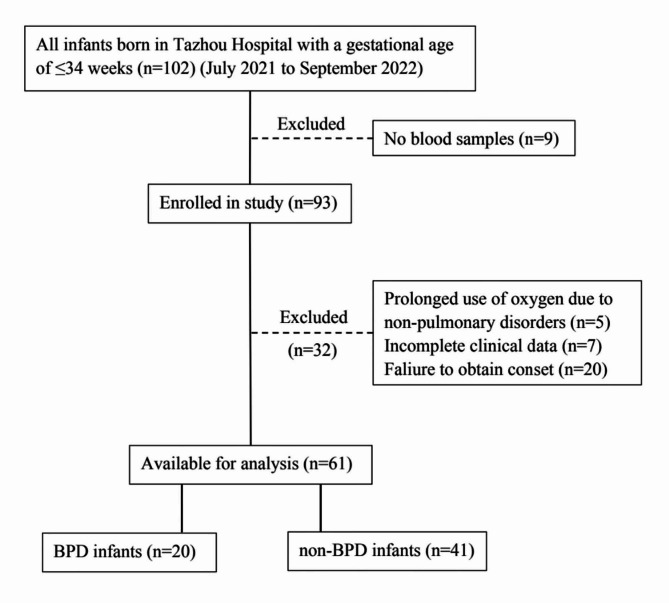
Methods: Sixty-one preterm infants admitted to the neonatal intensive care unit of the study hospital between July 2021 and September 2022 were included. Cord blood was collected after the birth of premature infants. Ang-1 and sCD105 levels were quantified using the vascular endothelial growth factor enzyme-linked immunosorbent assay. Preterm infants were divided into BPD and non-BPD groups, and differences in Ang-1 and sCD105 levels between the two groups were compared. A binary logistic model was used to assess the association between low and high levels Ang-1 and BPD in preterm infants.
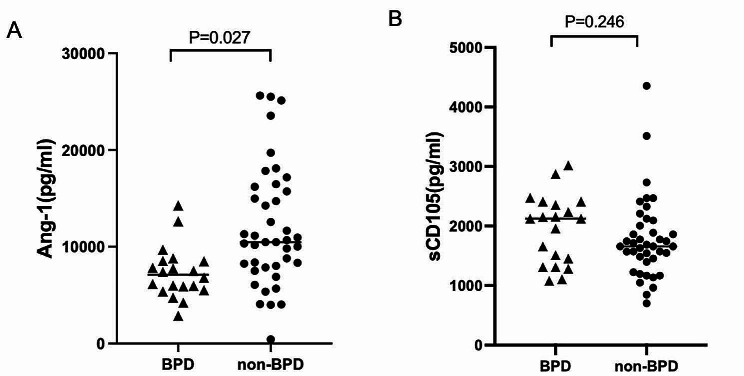
Results: In the study, there were 20 preterm infants with BPD (32.8%) and 41 preterm infants with non-BPD (67.2%). Ang-1 concentration levels were lower in the BPD group than in the non-BPD group (7105.43 (5617.01-8523.00) pg/ml vs. 10488.03 (7946.19-15962.77) pg/ml, P = 0.027). However, the sCD105 concentration levels were not significantly different between the BPD and non-BPD groups (P = 0.246). A median Ang-1 concentration of 8800.40 pg/ml was calculated. Logistic regression analysis showed that after adjusting for gestational age, birth weight, and maternal prenatal steroid hormone application, the odds ratio (OR) was 8.577 for the risk of BPD in preterm infants with Ang-1 concentrations of ≤ 8800.40 pg/ml compared to those with Ang-1 concentrations of > 8800.40 pg/ml (OR: 8.577, 95% confidence interval: 1.265-58.155, P = 0.028).
Conclusion: Our study indicated that Ang-1 levels in the cord blood of preterm infants may be associated the risk of BPD. In the future, we will continue to conduct study with large samples.
Keywords: Ang-1; Bronchopulmonary dysplasia; Early prediction; Preterm infants; sCD105.
© 2024. The Author(s).
Conflict of interest statement
The authors declare no competing interests.
Figures
References
-
- Research Collaborative Group on Ultra-immature and Ultra-low Birth Weight Infants Analysis of clinical treatment of ultra-immature and ultra-low birth weight infants in Guangdong Province[J] Chin J Pediatr. 2019;57(12):934–42. - PubMed
MeSH terms
Substances
LinkOut - more resources
Full Text Sources
Medical
Miscellaneous
