Review
. 2024 Jul 11:19:7049-7069.
doi: 10.2147/IJN.S468695. eCollection 2024.

Application and Method of Surface Plasmon Resonance Technology in the Preparation and Characterization of Biomedical Nanoparticle Materials

Affiliations
Review

Application and Method of Surface Plasmon Resonance Technology in the Preparation and Characterization of Biomedical Nanoparticle Materials

Jingyao Zhang et al. Int J Nanomedicine. .

Abstract

Surface Plasmon Resonance (SPR) technology, as a powerful analytical tool, plays a crucial role in the preparation, performance evaluation, and biomedical applications of nanoparticles due to its real-time, label-free, and highly sensitive detection capabilities. In the nanoparticle preparation process, SPR technology can monitor synthesis reactions and surface modifications in real-time, optimizing preparation techniques and conditions. SPR enables precise measurement of interactions between nanoparticles and biomolecules, including binding affinities and kinetic parameters, thereby assessing nanoparticle performance. In biomedical applications, SPR technology is extensively used in the study of drug delivery systems, biomarker detection for disease diagnosis, and nanoparticle-biomolecule interactions. This paper reviews the latest advancements in SPR technology for nanoparticle preparation, performance evaluation, and biomedical applications, discussing its advantages and challenges in biomedical applications, and forecasting future development directions.

Keywords: SPR; biomedical applications; characterization; nanomaterials; nanoparticles.


Conflict of interest statement

The authors report no conflicts of interest in this work.

Figures
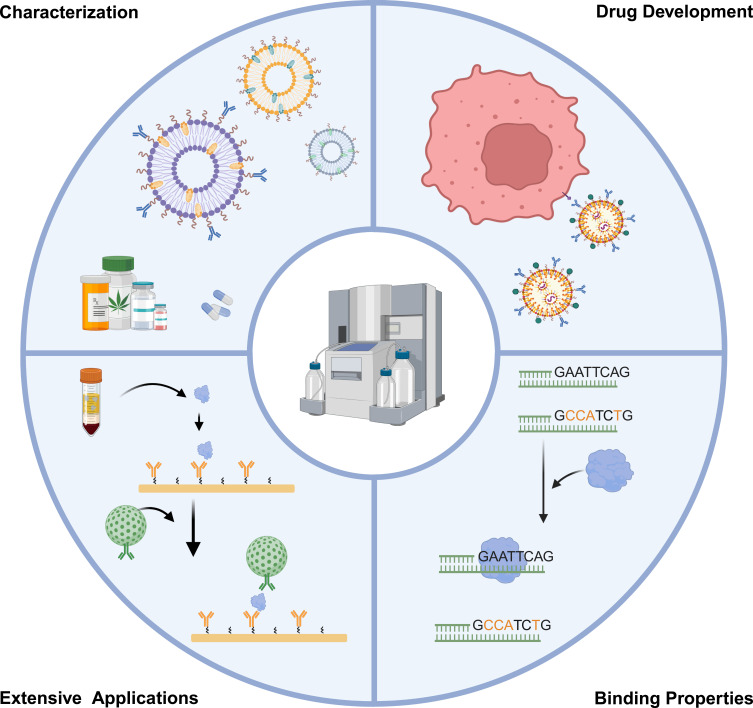
Figure 1
Figure 1
SPR technology applied in the biomedical field, including nanoparticle characterization, drug development, binding properties and extensive application.
Figure 2
Figure 2
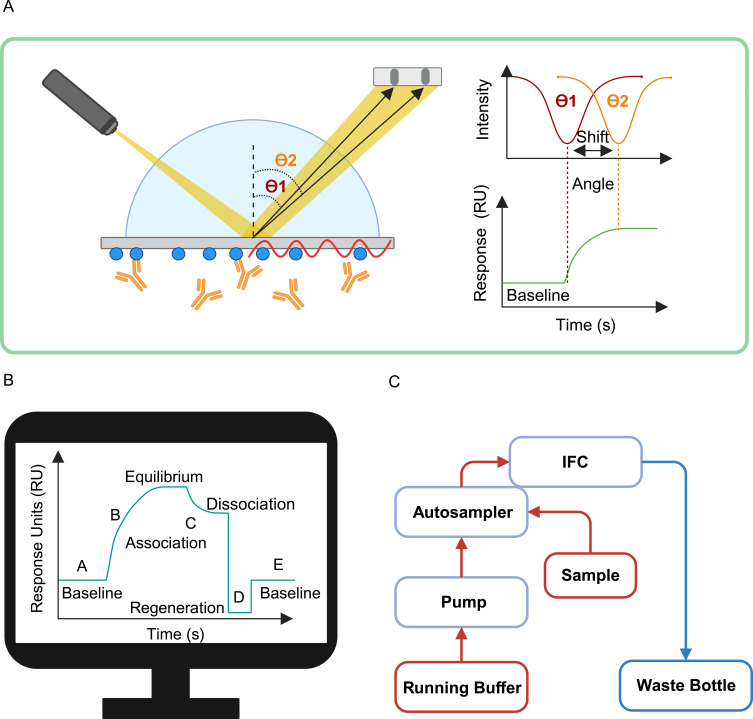
The main components of SPR instrument. (A) Optical module of SPR: The change of refractive index causes the angle shift from θ1 to θ2. (B) Signal collection system: signals collected at different binding stages. (C) Schematic of microfluidic system, arrows indicate the direction of fluid flow through the system.
Figure 3
Figure 3
Real-time Sensorgram obtained from a proteinase K protection assay with Sample (red) and BSA (green). The injection of proteinase K into individual membrane-associated proteins is indicated by arrows. Horizontal arrows show the resonance unit (RU) values at the start and end of the proteinase K injection phase.
Figure 4
Figure 4
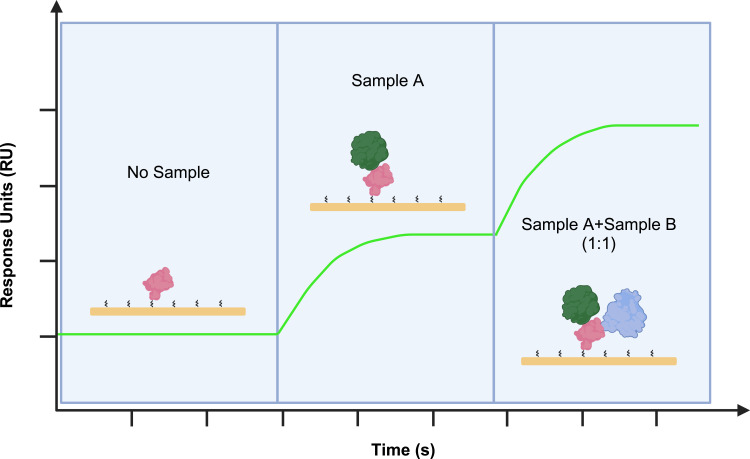
Fixation of target protein on a CM5 chip via SPR to observe the binding of Sample A and Sample B to target protein. Initially, Sample A is injected for 120 seconds, followed by the injection of a 1:1 mixture of Sample A and Sample B for 120 seconds to observe to different binding epitopes.
Figure 5
Figure 5
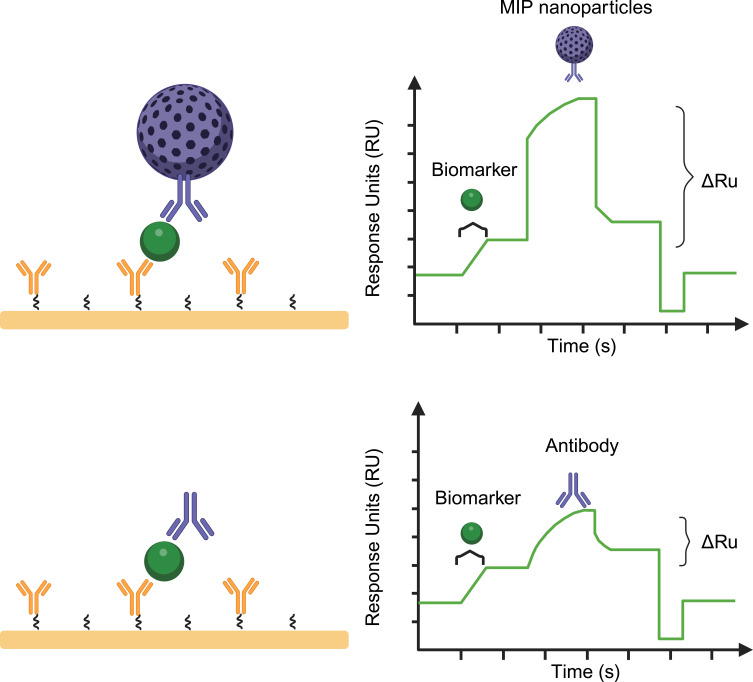
Schematic illustration of molecularly imprinted nanoparticles enhanced biomarker detection using an SPR biosensor. Injection of biomarker, followed by injection of molecularly imprinted nanoparticles.

References

    1. Petros RA, DeSimone JM. Strategies in the design of nanoparticles for therapeutic applications. Nat Rev Drug Discov. 2010;9(8):615–627. doi: 10.1038/nrd2591 - DOI - PubMed
    1. Desfrancois C, Auzely R, Texier I. Lipid nanoparticles and their hydrogel composites for drug delivery: a review. Pharmaceuticals. 2018;11(4):118. doi: 10.3390/ph11040118 - DOI - PMC - PubMed
    1. Rohovie MJ, Nagasawa M, Swartz JR. Virus-like particles: next-generation nanoparticles for targeted therapeutic delivery. Bioeng Transl Med. 2017;2(1):43–57. doi: 10.1002/btm2.10049 - DOI - PMC - PubMed
    1. Padmanabhan P, Kumar A, Kumar S, Chaudhary RK, Gulyas B. Nanoparticles in practice for molecular-imaging applications: an overview. Acta Biomater. 2016;41:1–16. doi: 10.1016/j.actbio.2016.06.003 - DOI - PubMed
    1. Xu H, Cui Y, Tian Y, et al. Nanoparticle-based drug delivery systems for enhancing bone regeneration. ACS Biomater Sci Eng. 2024;10(3):1302–1322. doi: 10.1021/acsbiomaterials.3c01643 - DOI - PubMed

MeSH terms

LinkOut - more resources