Clinical Trial
. 2024 Dec 1;210(11):1358-1369.
doi: 10.1164/rccm.202401-0165OC.

Pyrazinamide Safety, Efficacy, and Dosing for Treating Drug-Susceptible Pulmonary Tuberculosis: A Phase 3, Randomized Controlled Clinical Trial

Affiliations
Clinical Trial

Pyrazinamide Safety, Efficacy, and Dosing for Treating Drug-Susceptible Pulmonary Tuberculosis: A Phase 3, Randomized Controlled Clinical Trial

Ava Y Xu et al. Am J Respir Crit Care Med. .

Abstract

Rationale: Optimizing pyrazinamide dosing is critical to improve treatment efficacy while minimizing toxicity during tuberculosis treatment. Study 31/AIDS Clinical Trials Group A5349 represents the largest phase 3 randomized controlled therapeutic trial to date for such an investigation. Objectives: We sought to report pyrazinamide pharmacokinetic parameters, risk factors for lower pyrazinamide exposure, and relationships between pyrazinamide exposure and efficacy and safety outcomes. We aimed to determine pyrazinamide dosing strategies that optimize risks and benefits. Methods: We analyzed pyrazinamide steady-state pharmacokinetic data using population nonlinear mixed-effects models. We evaluated the contribution of pyrazinamide exposure to long-term efficacy using parametric time-to-event models and safety outcomes using logistic regression. We evaluated optimal dosing with therapeutic windows targeting ≥95% durable cure and safety within the observed proportion of the primary safety outcome. Measurements and Main Results: Among 2,255 participants with 6,978 plasma samples, pyrazinamide displayed sevenfold exposure variability (151-1,053 mg·h/L). Body weight was not a clinically relevant predictor of drug clearance and thus did not justify the need for weight-banded dosing. Both clinical and safety outcomes were associated with pyrazinamide exposure, resulting in therapeutic windows of 231-355 mg · h/L for the control and 226-349 mg·h/L for the rifapentine-moxifloxacin regimen. Flat dosing of pyrazinamide at 1,000 mg would have permitted an additional 13.1% (n = 96) of participants allocated to the control and 9.2% (n = 70) to the rifapentine-moxifloxacin regimen dosed within the therapeutic window, compared with the current weight-banded dosing. Conclusions: Flat dosing of pyrazinamide at 1,000 mg/d would be readily implementable and could optimize treatment outcomes in drug-susceptible tuberculosis. Clinical trial registered with www.clinicaltrials.gov (NCT02410772).

Keywords: dose–response; exposure–response; population pharmacokinetics; pyrazinamide; tuberculosis.


Figures
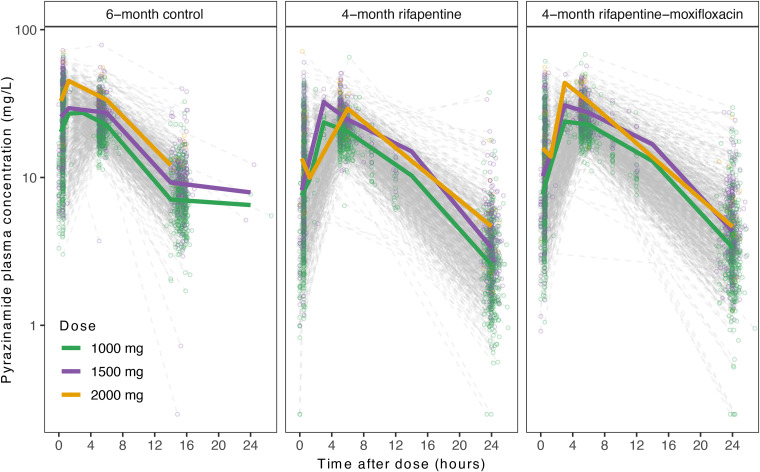
Figure 1.
Figure 1.
Observed pyrazinamide plasma concentration with respect to time after dose. Circles represent individual samples, and solid lines represent medians. Data are stratified by treatment regimens (left, 6-month control; middle, 4-month rifapentine-containing regimen; right, 4-month rifapentine–moxifloxacin–containing regimen) and by dose (green, 1,000 mg; purple, 1,500 mg; yellow, 2,000 mg).
Figure 2.
Figure 2.
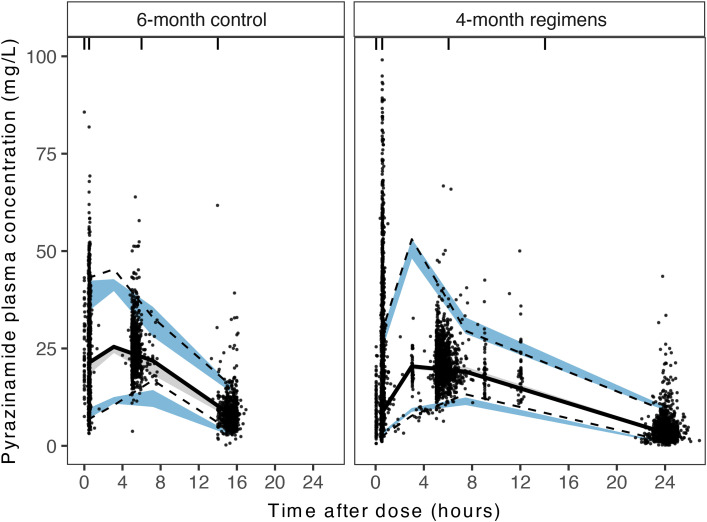
Prediction-corrected visual predictive checks for the full cohort. Visual predictive checks for data are stratified by 6-month control and 4-month investigational regimens. Dots show observed pyrazinamide plasma concentration, solid lines show the median of the observed data, dashed lines show the 5th and 95th percentiles of the observed data, and shaded areas show 95% confidence intervals of the 5th percentile (blue), median (gray), and 95th percentile (blue) of model predicted simulations.
Figure 3.
Figure 3.
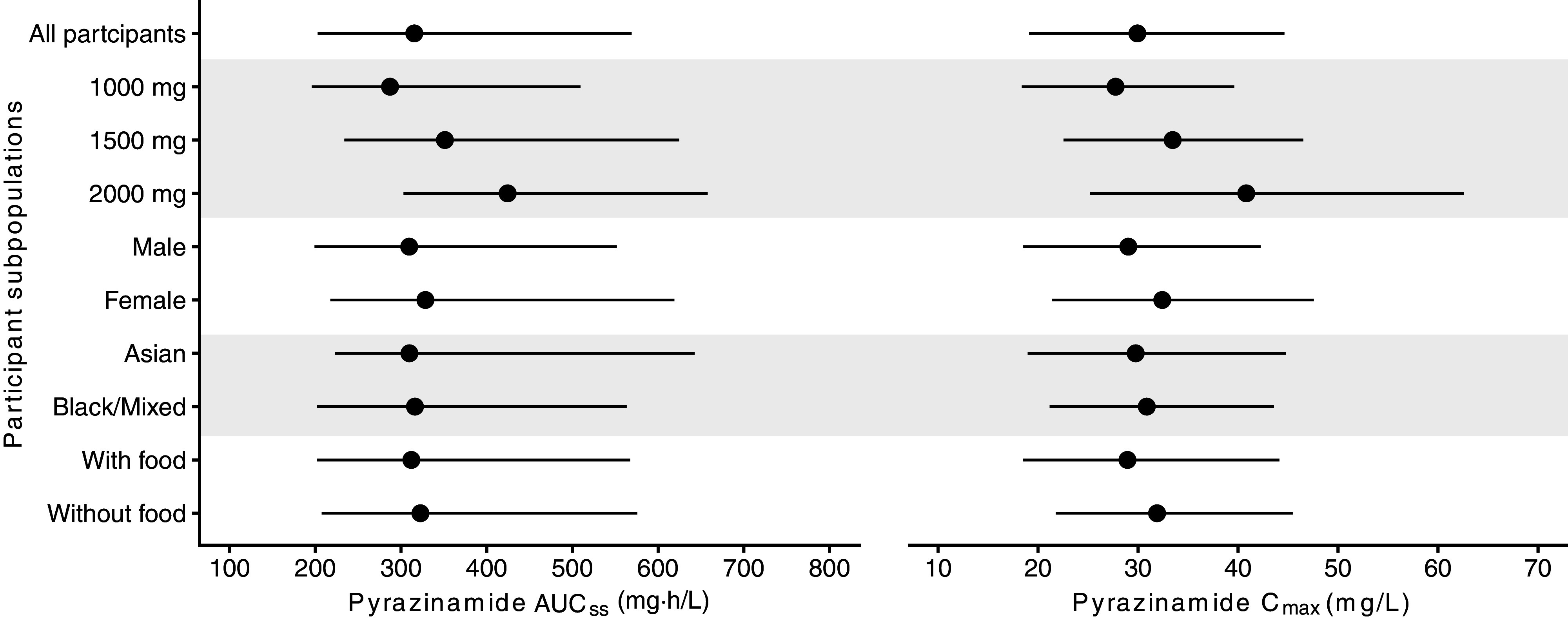
Dose stratification with respect to PK metrics. Model-derived PK metrics are depicted, stratified by covariates associated with interindividual PK variability of pyrazinamide (dose, sex, race, and food effects). Black lines show the 2.5th percentile to 97.5th percentile range of pyrazinamide AUCss and Cmax distributions. Dots show stratified median values for each respective group with alternating shades. AUCss = steady-state area under the concentration–time curve; Cmax = peak concentration; PK = pharmacokinetic.
Figure 4.
Figure 4.
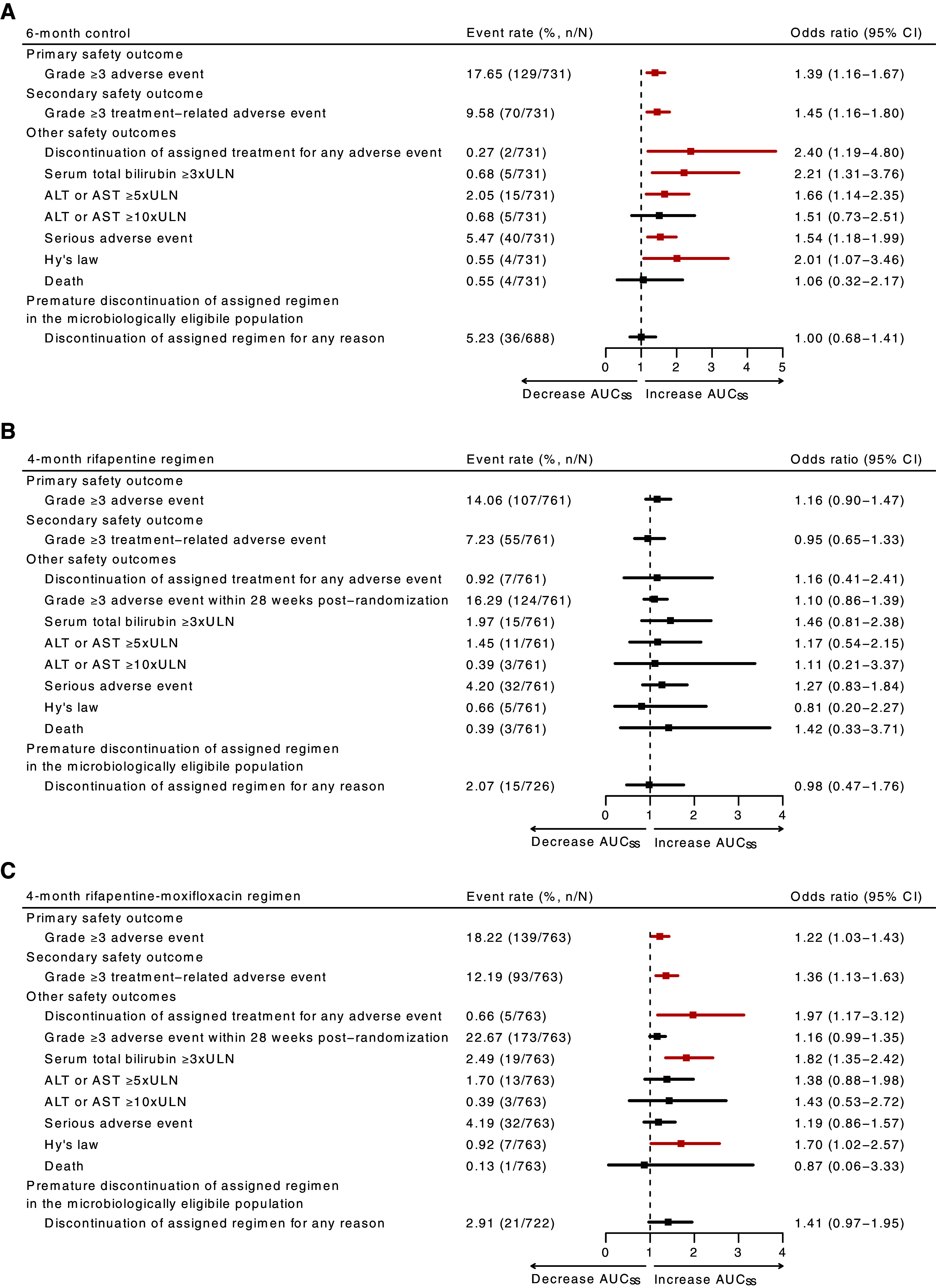
(A–C) Adjusted odds ratios of safety outcomes for increase with pyrazinamide steady-state area under the concentration–time curve (AUCss) in the 6-month control (A), 4-month rifapentine (B), and 4-month rifapentine–moxifloxacin (C) regimens in the primary analysis cohort with safety and tolerability outcomes during treatment and up to 14 days after treatment discontinuation. As regimens B and C had a treatment duration of 4 months, grade 3 or higher adverse event within 28 weeks after randomization was used to compare with the 6-month control. Odds ratios were adjusted by age and calculated per 100 mg·h/L increase in pyrazinamide AUCss. Outcome is highlighted in red if it was found to be statistically significant at P < 0.05. ALT = alanine aminotransferase; AST = aspartate aminotransferase; CI = confidence interval; n/N = number of participants reported for each safety outcome out of the total number of participants in the safety cohort; ULN = upper limit of the normal range.
Figure 5.
Figure 5.
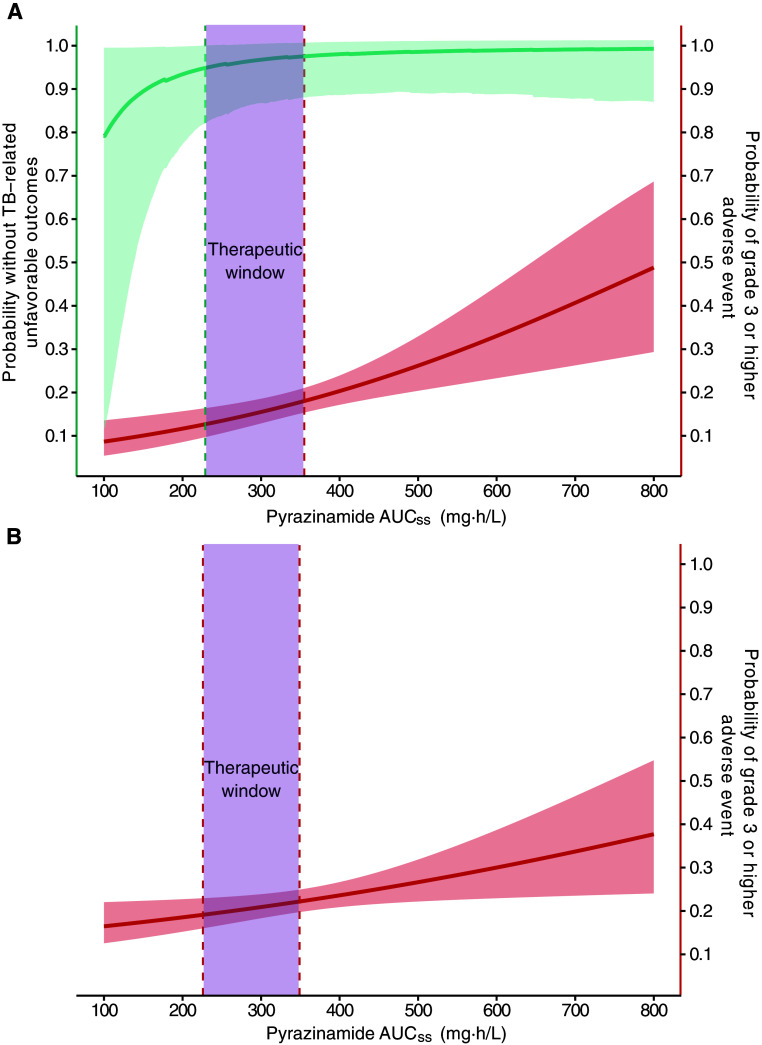
Pyrazinamide steady-state area under the concentration–time curve (AUCss) associated with primary efficacy and safety outcomes. (A) In the 6-month standard regimen, the therapeutic window of pyrazinamide AUCss between 231 and 355 mg·h/L was associated with ≤18% observed grade 3 or higher adverse event while maintaining 95% durable cure at 12 months after treatment initiation. (B) In the 4-month rifapentine–moxifloxacin regimen, therapeutic window of pyrazinamide AUCss between 226 and 349 was associated with ≤18% observed grade 3 or higher adverse event. The solid teal line indicates the median probability without tuberculosis (TB)–related unfavorable outcomes at given pyrazinamide AUCss, and teal-shaded areas indicate the 95% CI. The solid red lines indicate the median probability of grade 3 or higher adverse event at given pyrazinamide AUCss, and red-shaded areas indicate the 95% CI. A solid teal line with shaded areas is not pictured in B, because pyrazinamide AUCss was not associated with TB-related unfavorable outcomes for the 4-month rifapentine–moxifloxacin regimen. The teal dotted line shows the pyrazinamide AUCss predicted to achieve the targeted primary efficacy outcome threshold. The red dotted line at the upper boundary of the therapeutic window shows the pyrazinamide AUCss predicted to achieve the observed primary safety outcome. The red dotted line at the lower boundary of the therapeutic window in B shows the fifth percentile of the pyrazinamide AUCss used to predict the primary safety outcome. The purple shade shows the therapeutic window constructed on the basis of the exposure and response relationship described above.
Figure 6.
Figure 6.
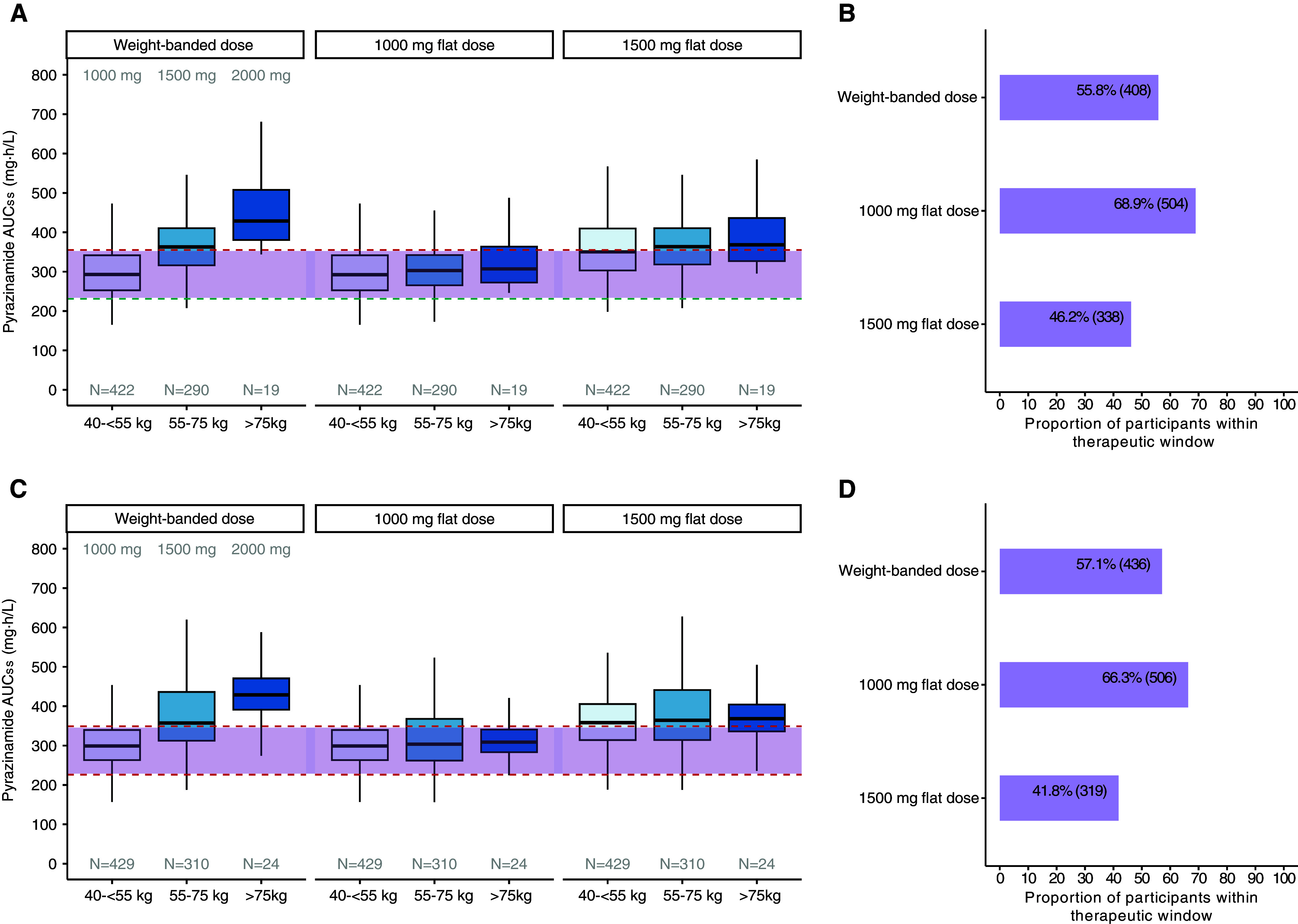
Optimizing regimens with proposed 1,000-mg flat dose. (A–D) We simulated pyrazinamide exposures in Tuberculosis Trials Consortium Study 31/AIDS Clinical Trials Group A5349 participants using currently endorsed weight-banded dosing at 1,000, 1,500, or 2,000 mg/d, in comparison with daily 1,000- or 1,500-mg flat doses for (A and B) 6-month control and (C and D) 4-month rifapentine–moxifloxacin regimens. Therapeutic window in purple shade for 6-month control were below 355 mg·h/L (red dotted line) and above 231 mg·h/L (teal dotted line) and for 4-month rifapentine–moxifloxacin regimen were below 349 mg·h/L and above 226 mg·h/L (red dotted lines). The teal dotted line shows the pyrazinamide steady-state area under the concentration–time curve (AUCss) predicted to achieve the target efficacy outcome of 95% durable cure at 12 months after treatment initiation. The top red dotted line shows the pyrazinamide AUCss predicted to achieve the observed primary safety outcome, an 18% probability of grade 3 or higher adverse event. The bottom red dotted line in C shows the fifth percentile of the pyrazinamide AUCss used to predict the primary safety outcome.

Comment in

References

    1. World Health Organization. Global tuberculosis report 2023. Geneva, Switzerland: World Health Organization; 2023.
    1. Hu Y, Coates AR, Mitchison DA. Sterilising action of pyrazinamide in models of dormant and rifampicin-tolerant Mycobacterium tuberculosis. Int J Tuberc Lung Dis . 2006;10:317–322. - PubMed
    1. Mccune RM, Feldmann FM, Lambert HP, Mcdermott W. Microbial persistence: I. The capacity of tubercle bacilli to survive sterilization in mouse tissues. J Exp Med . 1966;123:445–468. - PMC - PubMed
    1. McCune RM, Jr, Tompsett R. Fate of Mycobacterium tuberculosis in mouse tissues as determined by the microbial enumeration technique: I. The persistence of drug-susceptible tubercle bacilli in the tissues despite prolonged antimicrobial therapy. J Exp Med . 1956;104:737–762. - PMC - PubMed
    1. Phillips S, Larkin JC, Jr, Litzenberger WL, Horton GE, Haimsohn JS. Observations on pyrazinamide (Aldinamide) in pulmonary tuberculosis. Am Rev Tuberc . 1954;69:443–450. - PubMed

Publication types

Associated data