. 2024 Nov;71(5):577-588.
doi: 10.1165/rcmb.2023-0398OC.

Investigation of CFTR Function in Human Nasal Epithelial Cells Informs Personalized Medicine

Affiliations

Investigation of CFTR Function in Human Nasal Epithelial Cells Informs Personalized Medicine

Audrey Pion et al. Am J Respir Cell Mol Biol. 2024 Nov.

Abstract

We broaden the clinical versatility of human nasal epithelial (HNE) cells. HNEs were isolated from 10 participants harboring cystic fibrosis transmembrane conductance regulator (CFTR) variants: 9 with rare variants (Q359R [n = 2], G480S, R334W [n = 5], and R560T) and 1 harboring R117H;7T;TG10/5T;TG12. Cultures were differentiated at the air-liquid interface. CFTR function was measured in Ussing chambers at three conditions: baseline, ivacaftor, and elexacaftor + tezacaftor + ivacaftor (ETI). Four participants initiated modulators. Q359R HNEs had 5.4% (% wild-type) baseline CFTR function and 25.5% with ivacaftor. With therapy, sweat [Cl-] decreased and symptoms resolved. G480S HNEs had 4.1% baseline and 32.1% CFTR function with ETI. Clinically, forced expiratory volume in 1 second increased and sweat [Cl-] decreased (119 to 46 mmol/L) with ETI. In vitro cultures derived from 5 participants harboring R334W showed a moderate increase in CFTR function with exposure to modulators. For one of these participants, ETI was begun in vivo; symptoms and forced expiratory volume in 1 second improved. The c.1679G>C (R560T) HNEs had less than 4% baseline CFTR function and no modulator response. RNA analysis confirmed that c.1679G>C completely missplices. A symptomatic patient harboring R117H;7T;TG10/5T;TG12 exhibited reduced CFTR function (17.5%) in HNEs, facilitating a diagnosis of mild CF. HNEs responded to modulators (ivacaftor: 32.8%, ETI: 55.5%), and, since beginning therapy, lung function improved. We reaffirm HNE use for guiding therapeutic approaches, inform predictions on modulator response (e.g., R334W), and closely assess variants that affect splicing (e.g., c.1679G>C). Notably, functional studies in HNEs harboring R117H;7T;TG10/5T;TG12 facilitated a diagnosis of mild CF, suggesting the use for HNE functional studies as a clinical diagnostic test.

Keywords: 5T; air–liquid interface; cystic fibrosis; modulators; nasal epithelial.


Figures

Figure 1.
Figure 1.
Cystic fibrosis transmembrane conductance regulator (CFTR) function in healthy control participants. (A) A representative short circuit current (Isc) tracing from human nasal epithelial cell (HNE) culture of a healthy individual. R1 and R2 denote technical replicates. Amil = amiloride; Fsk = forskolin; IBMX = 3-isobutyl-1-methylxanthine; Inh-172 = inhibitor 172. (B) Air–liquid interface culturing conditions were utilized at the Johns Hopkins University (JHU) laboratory to differentiate HNEs from 4 healthy control participants (mean ± SD; two technical replicates per individual). CFTR function is represented as ΔIsc-CFTRinh172. (C) Air–liquid interface culturing conditions were utilized at the collaborating laboratory in Gaslini, Italy, to differentiate HNEs from 4 healthy control participants (mean ± SD; four technical replicates per individual).
Figure 2.
Figure 2.
In two siblings with Q359R-CFTR, ivacaftor (Iva) alone is sufficient for the substantial CFTR functional recovery. Air–liquid interface culturing conditions were utilized to differentiate human nasal epithelial cells. Ussing chambers were utilized to assess CFTR function. (A–F) Figures for (A–C) the older sibling and (D–F) the younger sibling include (A and D) representative tracings, (B and E) graphs with individual data points and ΔIsc-CFTRinh172 means, and (C and F) graphs representing percent wild-type (% WT) CFTR function. In the tracings, black text/arrows indicate drug addition time points for both conditions, green text/arrows indicate timepoints for ivacaftor-treated samples, and blue text/arrows indicate timepoints for baseline samples. Unpaired t tests were utilized to ascertain significance. **P ≤ 0.01. ***P ≤ 0.001. Amil = amiloride; CFTR = cystic fibrosis transmembrane conductance regulator; CFTRInh-172 = inhibitor 172; Fsk = forskolin; IBMX = 3-isobutyl-1-methylxanthine; Isc = short circuit current.
Figure 3.
Figure 3.
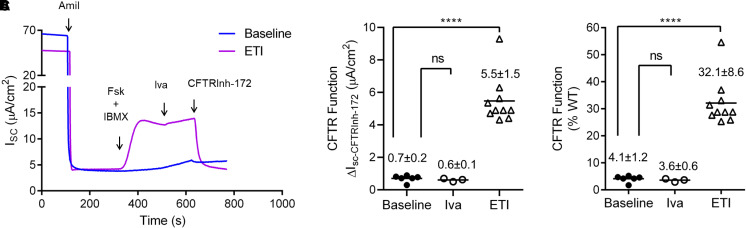
The elexacaftor + tezacaftor + ivacaftor (ETI) combination leads to substantial recovery of G480S-CFTR function, even though ivacaftor (Iva) alone provides no benefit. Air–liquid interface culturing conditions were utilized to differentiate human nasal epithelial cells. Ussing chambers were utilized to assess CFTR function. (A) Representative tracing. (B) Graph with individual data points and ΔIsc-CFTRinh172 mean. (C) Graph representing percent wild-type (%WT) CFTR function. One-way ANOVA Dunnett’s multiple comparisons test was utilized to ascertain significance. ****P ≤ 0.0001. Amil = amiloride; CFTR = cystic fibrosis transmembrane conductance regulator; CFTRInh-172 = inhibitor 172; Fsk = forskolin; IBMX = 3-isobutyl-1-methylxanthine; Isc = short circuit current; Iva = ivacaftor; ns = not significant.
Figure 4.
Figure 4.
R334W: ivacaftor (Iva) and the elexacaftor + tezacaftor + ivacaftor (ETI) combination recovers modest levels of cystic fibrosis transmembrane conductance regulator (CFTR) function. Air–liquid interface culturing conditions were utilized to differentiate human nasal epithelial cells. Ussing chambers were utilized to assess CFTR function. (A) Representative tracing. (B–E) Graph with individual data points and ΔIsc-CFTRinh172 mean for (B) pwCF4, (C) pwCF5, (D) pwCF6, and (E) pwCF7 and pwCF8, with genotypes as indicated on the labels. pwCF = person with cystic fibrosis. (F) Dot plots representing percent wild-type (%WT) CFTR function for pwCF4–pwCF8. In the blue tracing representing baseline, inhibitor 172 (CFTRInh-172) was added, as indicated by the blue arrow, and no ivacaftor was given. Unpaired t tests were utilized to ascertain significance. ***P ≤ 0.001 and ****P ≤ 0.0001. Amil = amiloride, Fsk = forskolin, IBMX = 3-isobutyl-1-methylxanthine; Isc = short circuit current.
Figure 5.
Figure 5.
Complete missplicing prevents functional recovery with modulators for a participant with R560T-CFTR. Air–liquid interface culturing conditions were utilized to differentiate human nasal epithelial cells. Ussing chambers were utilized to assess cystic fibrosis transmembrane conductance regulator (CFTR) function. (A) Representative tracing. (B) Graph with individual data points and ΔIsc-CFTRinh172 mean. (C) Graph representing percent wild-type (% WT) CFTR function. (D) Gel electrophoresis and Sanger sequencing chromatogram showing two products, one correctly spliced and one aberrantly spliced. (E) Sanger sequencing chromatogram from 361-bp product shows only a G peak at the end of exon 12. (F) Diagram depicting aberrant splicing because of the variant c.1679G>C (R560T). One-way ANOVA Dunnett’s multiple comparisons test was utilized to ascertain significance. Amil = amiloride; CFTRInh-172 = inhibitor 172; Fsk = forskolin; IBMX = 3-isobutyl-1-methylxanthine; Isc = short circuit current; Iva = ivacaftor; ns = not significant (P > 0.05); TBP = Tata binding protein.
Figure 6.
Figure 6.
Human nasal epithelial cells help diagnosis of mild cystic fibrosis (CF) and selection of a patient treatment plan. (A) Pedigree of proband and immediate family. R117H and intron 9 variant status is indicated below each symbol. (B) Representative tracings. Air–liquid interface culturing conditions were utilized to differentiate human nasal epithelial cells. Ussing chambers were utilized to assess cystic fibrosis transmembrane conductance regulator (CFTR) function. In the blue tracing representing baseline, DMSO was added instead of ivacaftor, followed by inhibitor 172 (CFTRInh-172). (C) Graph with individual data points and ΔIsc-CFTRinh172 mean. (D) Graph representing percent wild-type (% WT) CFTR function. (E) Diagram representing the fraction of misspliced CFTR mRNA because of the intron 9 variant. One-way ANOVA Dunnett’s multiple comparisons test was utilized to ascertain significance. *P ≤ 0.05 and **P ≤ 0.01. Amil = amiloride; elexacaftor + tezacaftor + ivacaftor (ETI); Fsk = forskolin; IBMX = 3-isobutyl-1-methylxanthine; Isc = short circuit current; Iva = ivacaftor.

References

    1. Lopes-Pacheco M. CFTR Modulators: the changing face of cystic fibrosis in the era of precision medicine. Front Pharmacol . 2019;10:1662. - PMC - PubMed
    1. Noel S, Servel N, Hatton A, Golec A, Rodrat M, Ng DRS, et al. Correlating genotype with phenotype using CFTR-mediated whole-cell Cl(−) currents in human nasal epithelial cells. J Physiol . 2022;600:1515–1531. - PubMed
    1. Brewington JJ, Filbrandt ET, LaRosa FJ, 3rd, Moncivaiz JD, Ostmann AJ, Strecker LM, et al. Brushed nasal epithelial cells are a surrogate for bronchial epithelial CFTR studies. JCI Insight . 2018;3:e99385. - PMC - PubMed
    1. Amaral MD, de Boeck K, CF ESPTFoSuatndf Theranostics by testing CFTR modulators in patient-derived materials: the current status and a proposal for subjects with rare CFTR mutations. J Cyst Fibros . 2019;18:685–692. - PubMed
    1. Keegan DE, Brewington JJ. Nasal epithelial cell-based models for individualized study in cystic fibrosis. Int J Mol Sci . 2021;22:4448. - PMC - PubMed

MeSH terms