. 2024 Jul 16;15(1):5947.
doi: 10.1038/s41467-024-49585-3.

Introducing carbon assimilation in yeasts using photosynthetic directed endosymbiosis

Affiliations

Introducing carbon assimilation in yeasts using photosynthetic directed endosymbiosis

Yang-le Gao et al. Nat Commun. .

Abstract

Conversion of heterotrophic organisms into partially or completely autotrophic organisms is primarily accomplished by extensive metabolic engineering and laboratory evolution efforts that channel CO2 into central carbon metabolism. Here, we develop a directed endosymbiosis approach to introduce carbon assimilation in budding yeasts. Particularly, we engineer carbon assimilating and sugar-secreting photosynthetic cyanobacterial endosymbionts within the yeast cells, which results in the generation of yeast/cyanobacteria chimeras that propagate under photosynthetic conditions in the presence of CO2 and in the absence of feedstock carbon sources like glucose or glycerol. We demonstrate that the yeast/cyanobacteria chimera can be engineered to biosynthesize natural products under the photosynthetic conditions. Additionally, we expand our directed endosymbiosis approach to standard laboratory strains of yeasts, which transforms them into photosynthetic yeast/cyanobacteria chimeras. We anticipate that our studies will have significant implications for sustainable biotechnology, synthetic biology, and experimentally studying the evolutionary adaptation of an additional organelle in yeast.


Conflict of interest statement

The authors declare that they have no competing interests.

Figures
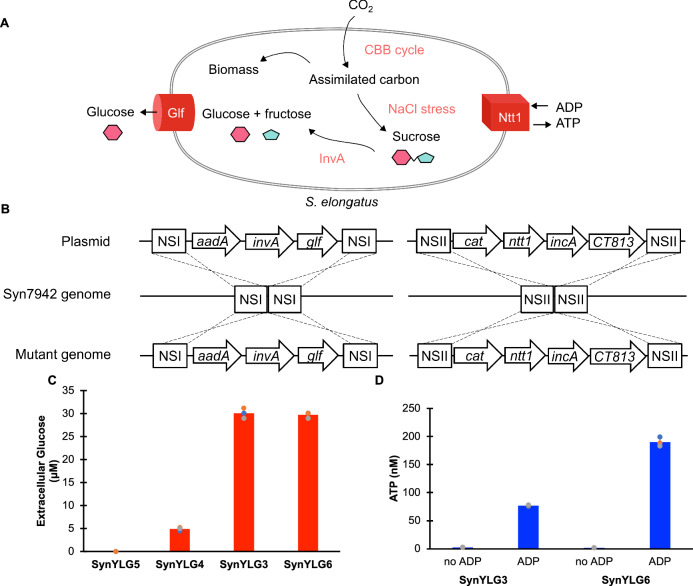
Fig. 1
Fig. 1. Engineering Syn7942 to secrete glucose assimilated from photosynthesis.
A Engineering Syn7942 to secrete glucose assimilated from CO2. B Suicide plasmid-based strategy used in this manuscript to engineer cyanobacterial mutants, SynYLG strains. C Secretion of extracellular glucose by SynYLG6 and SynYLG3 cells expressing the glf and invA genes in comparison to SynYLG4 cells only expressing the glf gene and SynYLG5 cells (no glf and invA). D Release of ATP by SynYLG6 cells expressing the UWE25 ADP/ATP translocase in the presence of 80 μM ADP in comparison to SynYLG3 cells. As compared to SynYLG3 cells (no ATP/ADP translocase), higher levels of ATP was released when SynYLG6 (expressing the ATP/ADP translocase) were challenged with extracellular ADP (80 μM). But no ATP was released when the cells were challenged with a blank solution lacking ADP (n  =  3 biological replicates; data are presented as mean values  +  /− SEM). Source data are provided as a Source Data file.
Fig. 2
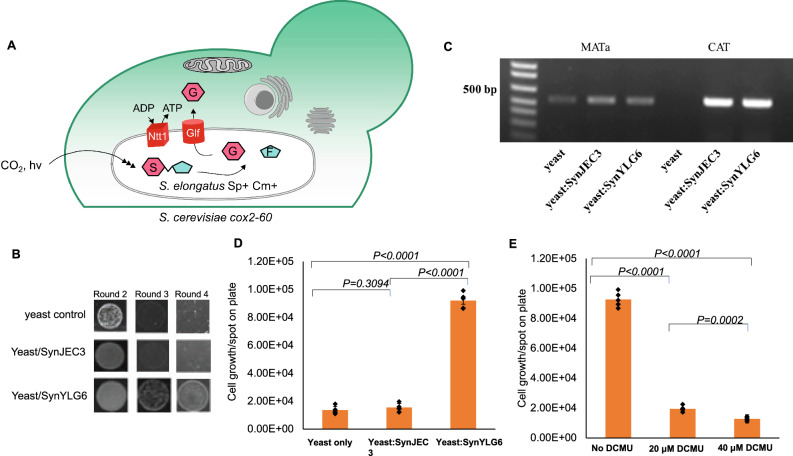
Fig. 2. S. cerevisiaeSynYLG6 chimeras have a partially rescued respiration-competent phenotype.
A Our platform: We use suicide plasmid-based strategy to engineer cyanobacterial endosymbionts, SynYLG6 strains, such that they can secrete glucose as well as ATP. S. cerevisiae mutants, deficient in ATP synthesis by oxidative phosphorylation under defined photosynthetic selection conditions, are used as the host strains. Engineered cyanobacteria strains, SynYLG, are then introduced into the yeast cells by a cell fusion process that is developed and optimized (see “Methods”). The yeast/cyanobacterial chimera are selected under defined photosynthetic selection conditions where the cyanobacterial endosymbionts provide glucose and ATP to the mutant S. cerevisiae host cells. Figure was prepared using BioRender. B Growth of S. cerevisiae cox2-60–SynYLG6 chimeras on medium without extra carbon source. Additionally, no growth was observed in round 4 for yeast lacking intracellular SynYLG6. The experiment was repeated independently six times with similar results. C Total DNA isolated from spots grown on selection medium III contain the yeast-encoded MATa gene and SynYLG6/SynJEC3-encoded chloramphenicol acetyltransferase (CAT) gene. The experiment was repeated independently six times with similar results. Complete data set is shown in Supplementary Fig. 4. D Growth trends of yeast-SynYLG6 chimeras on Selection Medium III. Cells (3.00 × 103) from round 3 were spotted on Selection Medium III and counted after 72 h growth. (n  =  5 technical replicates; data are presented as mean values + /− SEM.) P-values were calculated by two-tailed t-test comparing the two means. As listed the P-values for yeast and yeast:SynJEC3 are 0.3094, for yeast:SynJEC3 and yeast:SynYLG6 are <0.0001 and for yeast and yeast:SynYL6 are <0.0001. E Cell count analysis to demonstrate the effect of (3-(3,4-dichlorophenyl) −1,1-dimethylurea), DCMU, on S. cerevisiae cox2-60-SynYLG6 chimeras (n  =  5 technical replicates; data are presented as mean values + /− SEM). As listed the P-values for No DCMU and 20 µM DCMU treatment was <0.0001, for No DCMU and 40 µM DCMU was <0.0001 and 20 µM DCMU and 40 µM DCMU was 0.0002. Source data are provided as a Source Data file.
Fig. 3
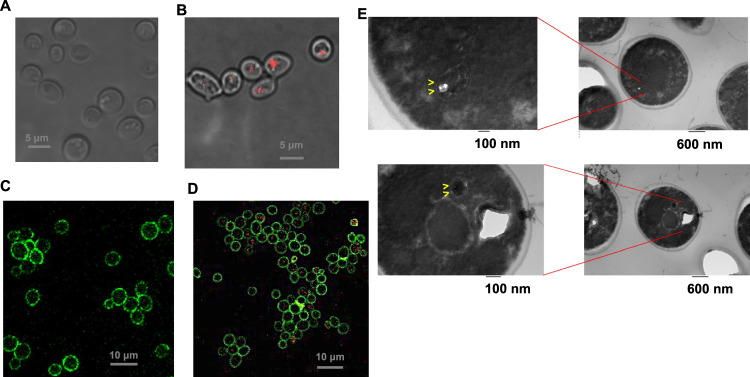
Fig. 3. Imaging intracellular cyanobacterial endosymbiont by fluorescent microscopy.
A/B pTIRF microscopic images of control yeast cells, and chimeric cells that were grown under the selection conditions (Ex. = 561 nm: Em. = 653/95 nm). Panels are merged images of pTIRF (red) and brightfield microscopy (gray). The experiment was repeated three times independently with similar results. C/D Fluorescence confocal microscopy images of the control yeast cells and the chimeric cells, which were grown under the selection conditions. The yeast cell wall was stained with Conn A-FITC (green, Ex.  = 488 nm; Em. = 510/20 nm) and the presence of cyanobacteria was monitored by cyanobacterial fluorescence (red, Ex. = 561 nm; Em. = 650/20 nm). The experiment was repeated three times independently with similar results. E Samples imaged by transmission electron microscopy (TEM). Yellow arrows show characteristic cyanobacterial structures within the cytoplasm of the yeast cells. The experiment was repeated twice independently (n = 2) with similar results.
Fig. 4
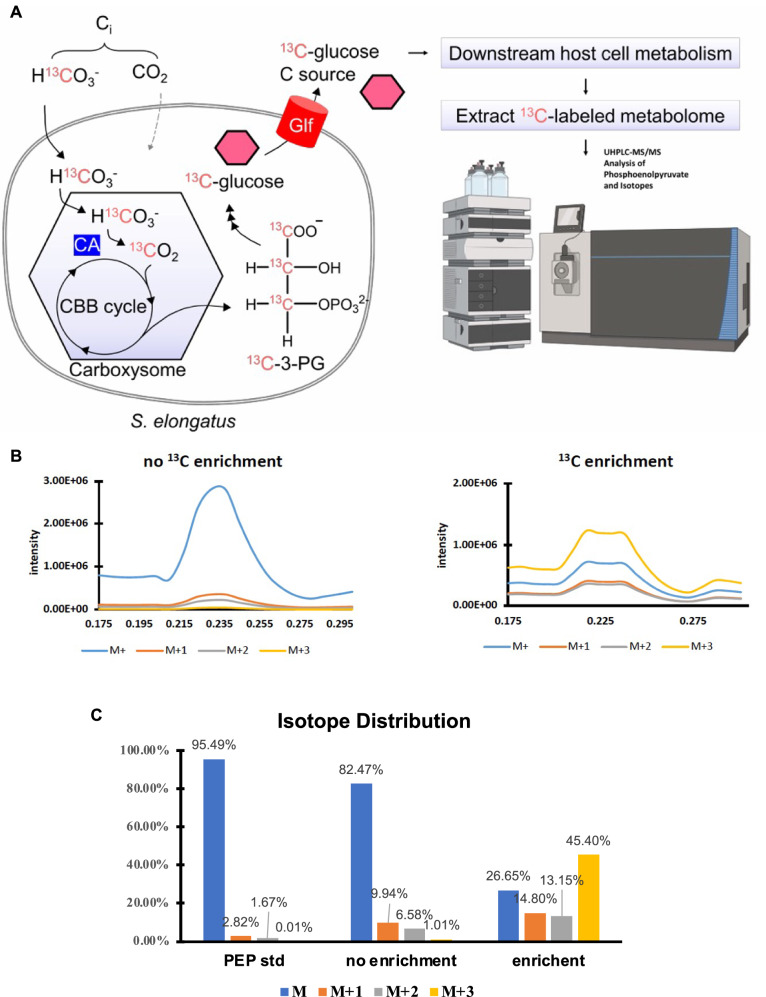
Fig. 4. Metabolomics approach to detect isotope enrichment.
A The sources of inorganic carbon (Ci) utilized by air-grown Syn7942 are 13C-labeled HCO3- in the culture medium and atmospheric CO2. 13C-labeled HCO3- is transported into the cell and is converted into CO2 in the carboxysome, where it is subsequently converted into organic carbon via C3 fixation. 13C-labeled sugars are exported by Syn7942 and act as yeast feedstock and are metabolized further. Ethanolic extracts of the yeast/cyanobacteria chimera metabolome are analyzed by LC/MS to search for yeast metabolites labeled with 13C originating from Ci. B Targeted analysis (n = 1) of unlabeled PEP (M + , blue) was measured at m/z 169, as well as 13C-labeled PEP isotopes of the precursor measured at three charged states: M + 1 (M + 13C, m/z 170, orange), M + 2 (M + 213C, m/z 171, gray), and M + 3 (M + 313C, m/z 172, yellow). Visual representation of total ion chromatogram (TIC) scaled based on relative isotope distribution % of PEP and its charged states. Extracted ion chromatograms are included in Supplementary Fig. 6. C Isotope distribution in the PEP std. No 13C enrichment in PEP detected (1% M + 3) when S. cerevisiae cox2-60–SynYLG6 chimeras were grown in unlabeled bicarbonate containing medium. 13C enrichment was detected in S. cerevisiae cox2-60–SynYLG6 chimeras were grown in 13C labeled bicarbonate containing medium. Final results in Panel C are based data from extracted ion chromatograms included in Supplementary Fig. 6. Panel A was created with BioRender.com released under a Creative Commons Attribution-NonCommercial-NoDerivs 4.0 International license. Source data are provided as a Source Data file.
Fig. 5
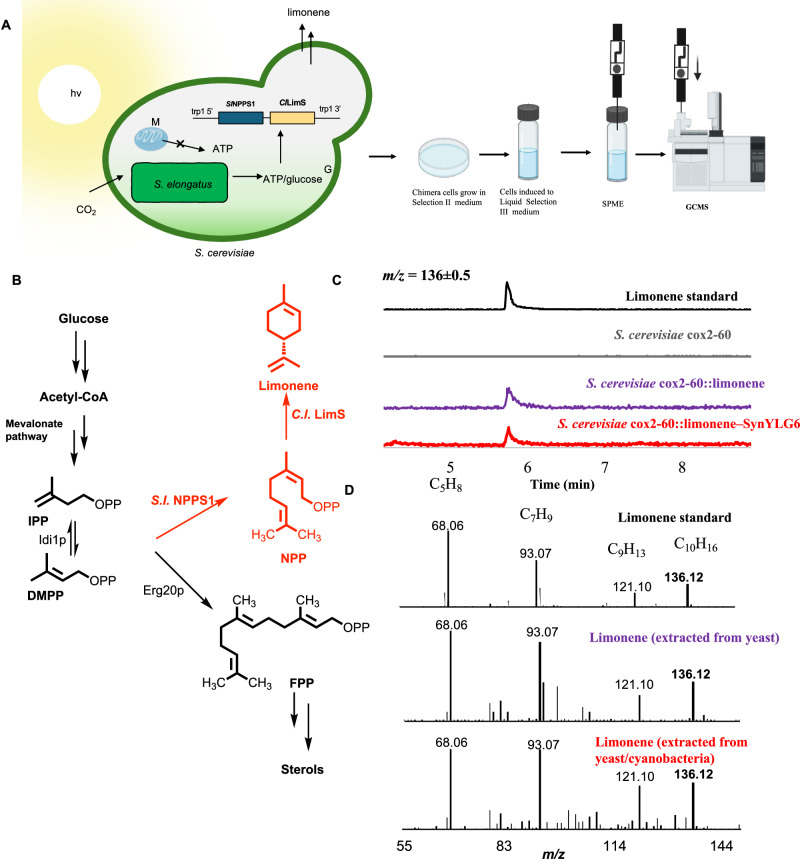
Fig. 5. Directed endosymbiosis for biosynthesis of a monoterpene.
A Our approach to coupling cyanobacterial photosynthesis to yeast metabolism using endosymbiosis to produce monoterpene, limonene. Figure was prepared using BioRender. B Engineering orthogonal pathway for limonene production using metabolic engineering. C GCMS experiments (n = 1) to detect limonene production. Extracted ion chromatograms (m/z = 136 ± 0.5) corresponding to limonene to demonstrate the production of limonene in yeast/cyanobacteria chimera (red trace) and in engineered yeast strains possessing limonene biosynthetic pathway (purple trace) but not in control yeast samples lacking limonene biosynthetic pathway (gray trace). Black trace corresponds to commercially purchased limonene standard. D Mass spectra for limonene production: limonene standard, limonene extracted from engineered yeast strains and limonene extracted from engineered yeast/cyanobacteria chimera. Panel (A) was created with BioRender.com and released under a Creative Commons Attribution-NonCommercial-NoDerivs 4.0 International license. Source data are provided as a Source Data file.
Fig. 6
Fig. 6. Rescue of respiration deficient phenotype by YPH500 nfuΔ::LEU2 isu1Δ::URA3 mis1Δ::HIS3 -SynYLG6 chimeras expressing a glf and invA protein.
A Low levels of growth for YPH500 nfuΔ::LEU2 isu1Δ::URA3 mis1Δ::HIS3 under glycerol as the carbon source. Nfu1: Protein involved in Fe-S cluster transfer to the mitochondrial proteins; Isu1: performs a scaffolding function during the assembly of iron-sulfur clusters; Mis1: Mitochondrial C1-tetrahydrofolate synthase. The figure was prepared using BioRender. B Growth of S. cerevisiae YPH500 nfuΔ::LEU2 isu1Δ::URA3 mis1Δ::HIS3-SynYLG6-chimeras on selection medium. The experiment was repeated three times independently with similar results and as listed the respective P-values are <0.0001, <0.0001 and 0.002. C Growth trends of S. cerevisiae YPH500 nfuΔ::LEU2 isu1Δ::URA3 mis1Δ::HIS3 (yeast only strain), S. cerevisiae YPH500 nfuΔ::LEU2 isu1Δ::URA3 mis1Δ::HIS3-SynJEC3, S. cerevisiae YPH500 nfuΔ::LEU2 isu1Δ::URA3 mis1Δ::HIS3-SynYLG6 chimeras. Cells (3.00 × 103) from each round were spotted on subsequent selection medium as described in the methods section and the final number of cells/spot on plate were determined after 48 h of growth (n  =  5 technical replicates; data are presented as mean values + /− SEM). D Total DNA of the yeast-SynJEC3/SynYLG6 chimeras contains yeast MATα and SynJEC3/SynYLG6 CAT genes. The experiment was repeated three times independently with similar results. E Cell count analysis to demonstrate the effect of (3-(3,4-dichlorophenyl) −1,1-dimethylurea), DCMU, on S. cerevisiae YPH500 nfuΔ::LEU2 isu1Δ::URA3 mis1Δ::HIS3-SynYLG6 chimeras (n  =  5 technical replicates; data are presented as mean values + /− SEM). P-values were calculated by a two-tailed t-test comparing the two means. As listed the P-values for No DCMU and 20 µM DCMU treatment was <0.0001, for No DCMU and 40 µM DCMU was <0.0001 and 20 µM DCMU and 40 µM DCMU was 0.0004. F pTIRF microscopic images of the chimeric cells that were grown under selection conditions (Ex. = 561 nm: Em. = 653/95 nm). Panels are merged images of pTIRF (green) and brightfield microscopy (gray). The experiment was repeated twice independently (n = 2) with similar results. G Fluorescence confocal microscopy images of the chimeric cells, which were grown under selection conditions. The experiment was repeated twice independently (n = 2) with similar results. Source data are provided as a Source Data file.

Comment in

  • Autotrophic yeast.
    Nielsen J. Nielsen J. Nat Commun. 2024 Jul 16;15(1):5948. doi: 10.1038/s41467-024-49586-2. Nat Commun. 2024. PMID: 39013898 Free PMC article.

References

    1. Claassens, N. J., Sousa, D. Z., dos Santos, V. A. P. M., de Vos, W. M. & van der Oost, J. Harnessing the power of microbial autotrophy. Nat. Rev. Microbiol.14, 692–706 (2016). - PubMed
    1. Zhuang, Z.-Y. & Li, S.-Y. Rubisco-based engineered Escherichia coli for in situ carbon dioxide recycling. Bioresour. Technol.150, 79–88 (2013). - PubMed
    1. Gassler, T. et al. The industrial yeast Pichia pastoris is converted from a heterotroph into an autotroph capable of growth on CO 2. Nat. Biotechnol.38, 210–216 (2020). - PMC - PubMed
    1. Xia, P.-F. et al. Recycling carbon dioxide during xylose fermentation by engineered Saccharomyces cerevisiae. ACS Synth. Biol.6, 276–283 (2017). - PubMed
    1. Li, Y.-J. et al. Engineered yeast with a CO 2 -fixation pathway to improve the bio-ethanol production from xylose-mixed sugars. Sci. Rep.7, 43875 (2017). - PMC - PubMed

MeSH terms

LinkOut - more resources