


Synthesis and characterization of chromium aluminum carbide MAX phases (CrxAlCx-1) for potential biomedical applications
- PMID: 39021388
- PMCID: PMC11252007
- DOI: 10.3389/fchem.2024.1413253
Synthesis and characterization of chromium aluminum carbide MAX phases (CrxAlCx-1) for potential biomedical applications
Abstract
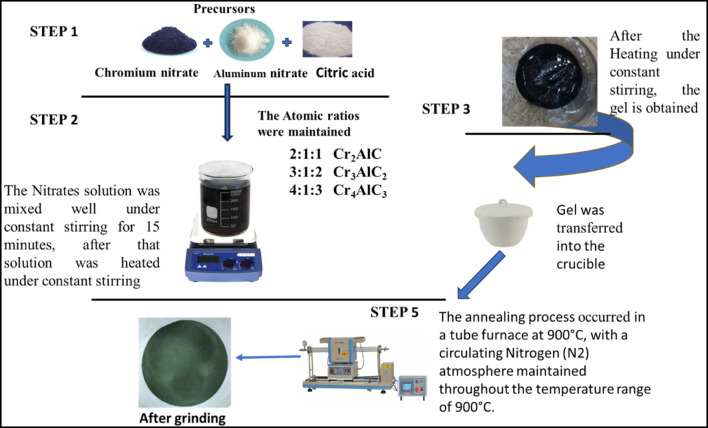
MAX phases, characterized as nanolaminates of ternary carbides/nitrides structure, possess a unique combination of ceramic and metallic properties, rendering them pivotal in materials research. In this study, chromium aluminum carbide ternary compounds, Cr2AlC (211), Cr3AlC2 (312), and Cr4AlC3 (413) were successfully synthesized with high purity using a facile and cost-effective sol-gel method. Structural, morphological, and chemical characterization of the synthesized phases was conducted to understand the effects of composition changes and explore potential applications. Comprehensive characterization techniques including XRD for crystalline structure elucidations, SEM for morphological analysis, EDX for chemical composition, Raman spectroscopy for elucidation of vibrational modes, XPS to analyze elemental composition and surface chemistry, and FTIR spectroscopy to ensure the functional groups analysis, were performed. X-ray diffraction analysis indicated the high purity of the synthesized Cr2AlC phase as well as other ternary compounds Cr3AlC2 and Cr4AlC3, suggesting its suitability as a precursor for MXenes production. Additionally, the antimicrobial activity against Candida albicans and biocompatibility assessments against Escherichia coli (E. coli), Staphylococcus aureus (S. aureus), and HepG2 cell line were investigated. The results demonstrated significant antifungal activity of the synthesized phases against Candida albicans and negligible impact on the viability of E. coli and S. aureus. Interestingly, lower concentrations of Cr2AlC MAX phase induced cytotoxicity in HepG2 cells by triggering intercellular oxidative stress, while Cr3AlC2 and Cr4AlC3 exhibited lower cytotoxicity compared to Cr2AlC, highlighting their potential in biomedical applications.
Keywords: Candida albicans; HepG2; MAX phase; biomedical applications; metal carbide; sol-gel.
Copyright © 2024 Shahbaz, Sabir, Amin, Zulfiqar and Zahid.
Conflict of interest statement
The authors declare that the research was conducted in the absence of any commercial or financial relationships that could be construed as a potential conflict of interest.
Figures


References
-
- Abdelkader A. M. (2016). Molten salts electrochemical synthesis of Cr2AlC. J. Eur. Ceram. Soc. 36 (1), 33–42. 10.1016/j.jeurceramsoc.2015.09.003 - DOI
-
- Al-Thubaiti E. H., El-Megharbel S. M., Albogami B., Hamza R. Z. (2022). Synthesis, spectroscopic, chemical characterizations, anticancer capacities against HepG-2, antibacterial and antioxidant activities of cefotaxime metal complexes with Ca (II), Cr (III), Zn (II), Cu (II) and Se (IV). Antibiotics 11 (7), 967. 10.3390/antibiotics11070967 - DOI - PMC - PubMed
-
- Bakht J., Islam A., Shafi M. (2011). Antimicrobial potential of Eclipta alba by well diffusion method. Pak. J. Bot. 43, 161–166.
-
- Bentzel G. W., Naguib M., Lane N. J., Vogel S. C., Presser V., Dubois S., et al. (2016). High‐temperature neutron diffraction, Raman spectroscopy, and first‐principles calculations of Ti3SnC2 and Ti2SnC. Raman Spectrosc. first‐principles Calc. Ti3SnC2 Ti2SnC J. Am. Ceram. Soc. 99 (7), 2233–2242. 10.1111/jace.14210 - DOI
LinkOut - more resources
Full Text Sources
