


Demoralization and well-being among self-employed individuals with cardiac disease: the role of intolerance of uncertainty
- PMID: 39021650
- PMCID: PMC11253239
- DOI: 10.3389/fpsyg.2024.1388032
Demoralization and well-being among self-employed individuals with cardiac disease: the role of intolerance of uncertainty
Abstract
Background: Individuals with cardiac disease (CD) who are self-employed may experience ability limitations and especially intensive challenges and uncertainties. These challenges may cause demoralization and impaired well-being.
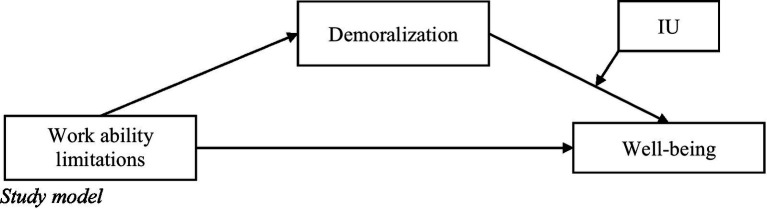
Objectives: To examine: (a) whether work ability limitations are related to demoralization and well-being among self-employed people with CD; (b) rates of demoralization; and (c) how demoralization and intolerance of uncertainty (IU) are associated with well-being.
Methods: The study involved 120 self-employed individuals with CD. The PROCESS macro was used to analyze mediation and moderation processes.
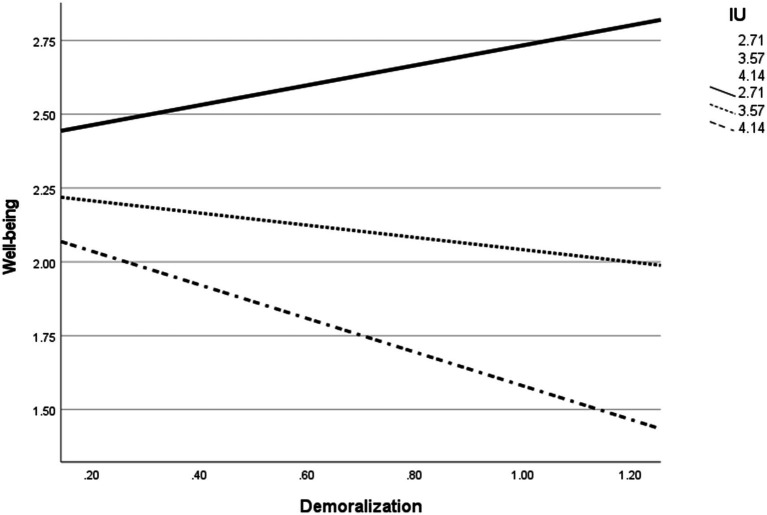
Results: The prevalence of demoralization syndrome was 37.4%. Work ability-limitations were associated with higher demoralization levels. Demoralization was associated with well-being only among participants with high IU. Further, demoralization mediated the relationship between work ability limitations and well-being only for individuals with high IU.
Conclusion: Encountering limitations among self-employed was associated with demoralization and lower levels of well-being, especially among those with high IU. In addition, demoralization syndrome is prevalent among individuals with CD in general. Early recognition and treatment of demoralization as a treatable psychological syndrome are essential for preventing its degeneration into more complex forms. In addition to uncertainty related to health, it is important to pay special attention to other sources of uncertainty.
Keywords: cardiac disease; demoralization; intolerance of uncertainty; self-employed; well-being; work ability limitations.
Copyright © 2024 Sowan and Kissane.
Conflict of interest statement
The authors declare that the research was conducted in the absence of any commercial or financial relationships that could be construed as a potential conflict of interest.
Figures
References
-
- Behan D. (2018). Demoralization during medical illness: a case of common factors treatment. Clin. Soc. Work. J. 47, 266–275. doi: 10.1007/s10615-018-0660-y - DOI
-
- Bobevski I., Kissane D., McKenzie D., Murphy G., Perera C., Payne I., et al. . (2022). The demoralization interview: reliability and validity of a new brief diagnostic measure among medically ill patients. Gen. Hosp. Psychiatry 79, 50–59. doi: 10.1016/j.genhosppsych.2022.10.002, PMID: - DOI - PubMed
-
- Bobevski I., Kissane D. W., Vehling S., Mehnert-Theuerkauf A., Murri M. B., Grassi L. (2021). Demoralisation and its link with depression, psychological adjustment and suicidality among cancer patients: a network psychometrics approach. Cancer Med. 11, 815–825. doi: 10.1002/cam4.4406, PMID: - DOI - PMC - PubMed
LinkOut - more resources
Full Text Sources
