Different Categories of Social Media Use and Their Association With Body Image Among Adolescents in 42 Countries
- PMID: 39022445
- PMCID: PMC11252497
- DOI: 10.3389/ijph.2024.1606944
Different Categories of Social Media Use and Their Association With Body Image Among Adolescents in 42 Countries
Abstract
Objectives: Social media has become integrated into adolescents' lives and influences body image perceptions. Our study examined four patterns of social media use (SMU): non-active, active, intensive, and problematic. We hypothesised that intensive SMU and problematic SMU would be associated with negative body image (negative subjective body weight) and over/underestimated body weight congruence, compared to non-active and active SMU. In addition, we expect these associations to be stronger for girls.
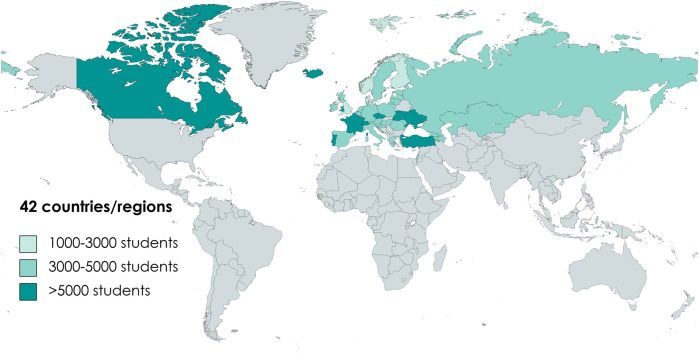
Methods: Data from 190,892 respondents aged 11, 13, and 15 from 42 countries involved in the Health Behaviour in School-aged Children study were analysed.
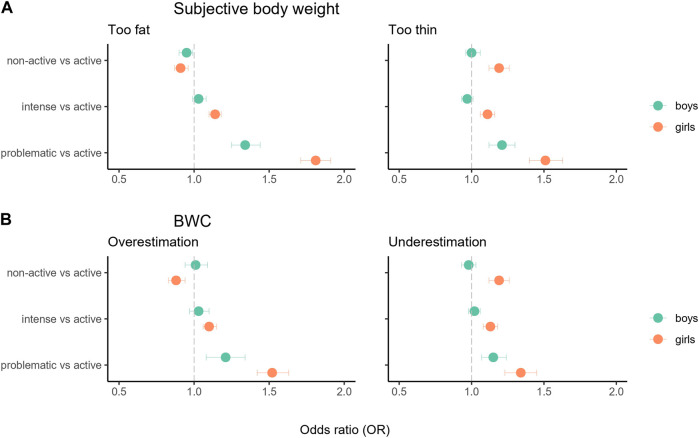
Results: Findings revealed higher rates of intensive or problematic SMU among adolescents who perceived themselves as too fat or too thin. Two-level regression analyses showed intensive and problematic SMU as more likely to perceive themselves as too fat or too thin than active users. The association was significant among intensive and problematic girl social media users, whereas, among boys, the relationship was only significant for problematic users.
Conclusion: Our findings highlight the importance of assessing SMU patterns to evaluate associations with body image.
Keywords: HBSC; adolescence; body image; body weight congruence; social media use.
Copyright © 2024 Boniel-Nissim, Bersia, Canale, Lahti, Ojala, Ercan, Dzielska, Inchley and Dalmasso.
Conflict of interest statement
The authors declare that they do not have any conflicts of interest.
Figures
References
-
- Vogels EA, Gelles-Watnick R, Massarat N. Teens, Social Media, and Technology 2022. United States: Pew Research Center; (2022).
-
- Smahel D, Machackova H, Mascheroni G, Dedkova L, Staksrud E, Ólafsson K, et al. Kids Online 2020: Survey Results From 19 Countries (2020).
-
- Inchley J, Currie D, Budisavljevic S, Torsheim T, Jåstad A, Cosma A. Spotlight on Adolescent Health and Well-Being. Findings From the 2017/2018 Health Behaviour in School-Aged Children (HBSC) Survey in Europe and Canada. International Report. Volume 1. Key Findings. Copenhagen: WHO Regional Office for Europe; (2020).
MeSH terms
Grants and funding
LinkOut - more resources
Full Text Sources