. 2024 Jul 18;22(1):669.
doi: 10.1186/s12967-024-05444-9.

Interactions between patterns of multimorbidity and functional status among hospitalized older patients: a novel approach using cluster analysis and association rule mining

Affiliations

Interactions between patterns of multimorbidity and functional status among hospitalized older patients: a novel approach using cluster analysis and association rule mining

Francesco Piacenza et al. J Transl Med. .

Abstract

Background: Multimorbidity (MM) is generally defined as the presence of 2 or more chronic diseases in the same patient and seems to be frequently associated with frailty and poor quality of life. However, the complex interplay between MM and functional status in hospitalized older patients has not been fully elucidated so far. Here, we implemented a 2-step approach, combining cluster analysis and association rule mining to explore how patterns of MM and disease associations change as a function of disability.

Methods: This retrospective cohort study included 3366 hospitalized older patients discharged from acute care units of Ancona and Cosenza sites of Italian National Institute on Aging (INRCA-IRCCS) between 2011 and 2017. Cluster analysis and association rule mining (ARM) were used to explore patterns of MM and disease associations in the whole population and after stratifying by dependency in activities of daily living (ADL) at discharge. Sensitivity analyses in men and women were conducted to test for robustness of study findings.

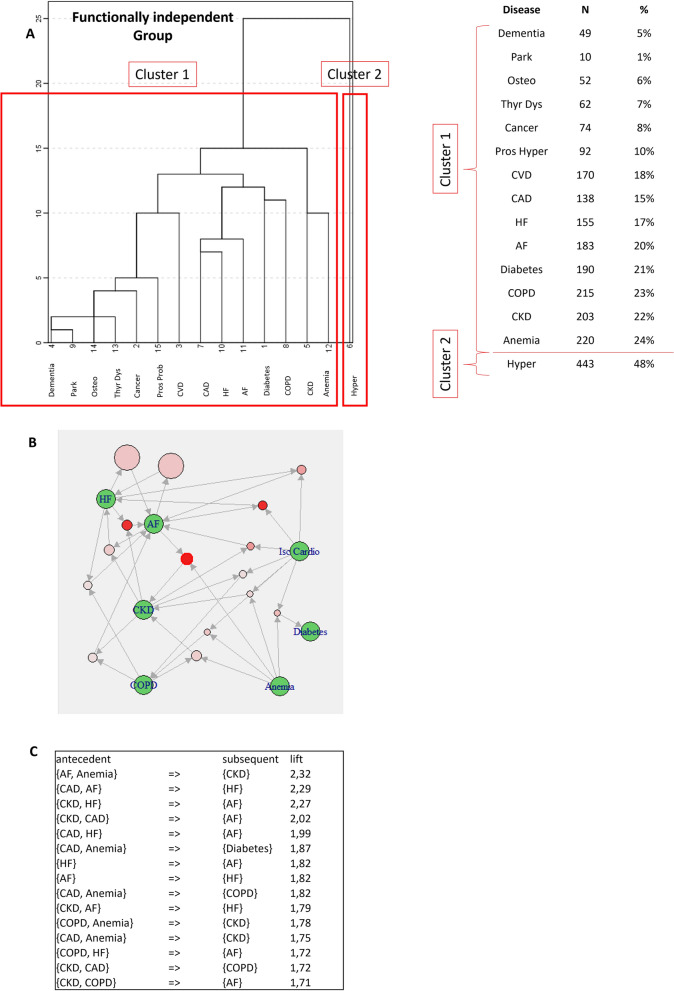
Results: Out of 3366 included patients, 78% were multimorbid. According to functional status, 22.2% of patients had no disability in ADL (functionally independent group), 22.7% had 1 ADL dependency (mildly dependent group), and 57.4% 2 or more ADL impaired (moderately-severely dependent group). Two main MM clusters were identified in the whole general population and in single ADL groups. ARM revealed interesting within-cluster disease associations, characterized by high lift and confidence. Specifically, in the functionally independent group, the most significant ones involved atrial fibrillation (AF)-anemia and chronic kidney disease (CKD) (lift = 2.32), followed by coronary artery disease (CAD)-AF and heart failure (HF) (lift = 2.29); in patients with moderate-severe ADL disability, the most significant ARM involved CAD-HF and AF (lift = 1.97), thyroid dysfunction and AF (lift = 1.75), cerebrovascular disease (CVD)-CAD and AF (lift = 1.55), and hypertension-anemia and CKD (lift = 1.43).

Conclusions: Hospitalized older patients have high rates of MM and functional impairment. Combining cluster analysis to ARM may assist physicians in discovering unexpected disease associations in patients with different ADL status. This could be relevant in the view of individuating personalized diagnostic and therapeutic approaches, according to the modern principles of precision medicine.

Keywords: Association rule mining; Cluster analysis; Functional status; Hospitalization; Multimorbidity; Older patients.


Conflict of interest statement

All Authors declare to have no conflict of interest with the content of this manuscript.

Figures
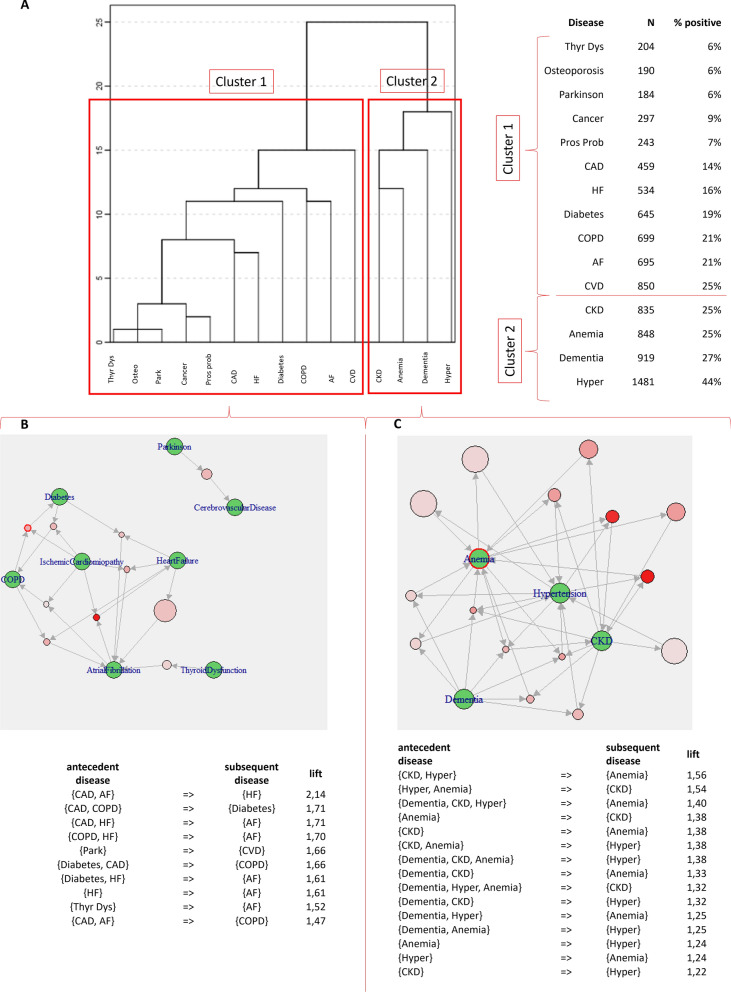
Fig. 1
Fig. 1
Patterns of MM by cluster analysis & ARM in the whole population. A Aggregation of diseases according to hierarchical cluster analysis; prevalence of disease contributing to each cluster is also reported; B ARM showing the most significant rules in cluster 1 in the whole population; C ARM showing the most significant rules in cluster 2 in the whole population. AF: atrial fibrillation; CAD: coronary artery disease/ischemic cardiomyopathy; CKD: chronic kidney disease; COPD: chronic obstructive pulmonary disease; CVD: cerebrovascular disease; HF: heart failure
Fig. 2
Fig. 2
Patterns of MM by cluster analysis and ARM in the ADL = 0 group. A Aggregation of diseases according to hierarchical cluster analysis; prevalence of disease contributing to each cluster is also reported; B ARM graph showing the most significant rules in cluster 1 in the ADL = 0 group; C ARM table reporting the most significant rules in order of descending lift. AF: atrial fibrillation; CAD: coronary artery disease/ischemic cardiomyopathy; CKD: chronic kidney disease; COPD: chronic obstructive pulmonary disease; CVD: cerebrovascular disease; HF: heart failure
Fig. 3
Fig. 3
Patterns of MM by cluster analysis and ARM in the ADL = 1 group. A Aggregation of diseases according to hierarchical cluster analysis; prevalence of disease contributing to each cluster is also reported; B ARM graph showing the most significant rules in cluster 1 in the ADL = 1 group; C ARM table reporting the most significant rules in order of descending lift. AF: atrial fibrillation; CAD: coronary artery disease/ischemic cardiomyopathy; CKD: chronic kidney disease; COPD: chronic obstructive pulmonary disease; CVD: cerebrovascular disease; HF: heart failure
Fig. 4
Fig. 4
Patterns of MM by cluster analysis and ARM in the ADL = 2 group. A Aggregation of diseases according to hierarchical cluster analysis; prevalence of disease contributing to each cluster is also reported; B ARM graph showing the most significant rules in cluster 1 in the ADL = 2 group; panel C ARM table reporting the most significant rules in order of descending lift for cluster 1 in the ADL = 2 group; D ARM graph showing the most significant rules in cluster 2 in the ADL = 2 group; E ARM table reporting the most significant rules in order of descending lift for cluster 2 in the ADL = 2 group. AF: atrial fibrillation; CAD: coronary artery disease/ischemic cardiomyopathy; CKD: chronic kidney disease; COPD: chronic obstructive pulmonary disease; CVD: cerebrovascular disease; HF: heart failure

References

    1. Skou ST, Mair FS, Fortin M, Guthrie B, Nunes BP, Miranda JJ, et al. Multimorbidity. Nat Rev Dis Primers. 2022;8(1):48. 10.1038/s41572-022-00376-4. 10.1038/s41572-022-00376-4 - DOI - PMC - PubMed
    1. Johnston MC, Crilly M, Black C, Prescott GJ, Mercer SW. Defining and measuring multimorbidity: a systematic review of systematic reviews. Eur J Pub Health. 2019;29(1):182–9. 10.1093/eurpub/cky098. 10.1093/eurpub/cky098 - DOI - PubMed
    1. Zhou Y, Dai X, Ni Y, Zeng Q, Cheng Y, Carrillo-Larco RM, et al. Interventions and management on multimorbidity: an overview of systematic reviews. Ageing Res Rev. 2023;87: 101901. 10.1016/j.arr.2023.101901. 10.1016/j.arr.2023.101901 - DOI - PubMed
    1. Soley-Bori M, Ashworth M, Bisquera A, Dodhia H, Lynch R, Wang Y, et al. Impact of multimorbidity on healthcare costs and utilisation: a systematic review of the UK literature. Br J Gen Pract. 2021;71(702):e39–46. 10.3399/bjgp20X713897. 10.3399/bjgp20X713897 - DOI - PMC - PubMed
    1. Kingston A, Robinson L, Booth H, Knapp M, Jagger C. Projections of multi-morbidity in the older population in England to 2035: estimates from the Population Ageing and Care Simulation (PACSim) model. Age Ageing. 2018;47(3):374–80. 10.1093/ageing/afx201. 10.1093/ageing/afx201 - DOI - PMC - PubMed

LinkOut - more resources