. 2024 Jul 19;10(29):eadm9577.
doi: 10.1126/sciadv.adm9577. Epub 2024 Jul 19.

R-loop resolution by ARIP4 helicase promotes androgen-mediated transcription induction

Affiliations

R-loop resolution by ARIP4 helicase promotes androgen-mediated transcription induction

Raissa Regina Ng et al. Sci Adv. .

Abstract

Pausing of RNA polymerase II (Pol II) at transcription start sites (TSSs) primes target genes for productive elongation. Coincidentally, DNA double-strand breaks (DSBs) enrich at highly transcribed and Pol II-paused genes, although their interplay remains undefined. Using androgen receptor (AR) signaling as a model, we have uncovered AR-interacting protein 4 (ARIP4) helicase as a driver of androgen-dependent transcription induction. Chromatin immunoprecipitation sequencing analysis revealed that ARIP4 preferentially co-occupies TSSs with paused Pol II. Moreover, we found that ARIP4 complexes with topoisomerase II beta and mediates transient DSB formation upon hormone stimulation. Accordingly, ARIP4 deficiency compromised release of paused Pol II and resulted in R-loop accumulation at a panel of highly transcribed AR target genes. Last, we showed that ARIP4 binds and unwinds R-loops in vitro and that its expression positively correlates with prostate cancer progression. We propose that androgen stimulation triggers ARIP4-mediated unwinding of R-loops at TSSs, enforcing Pol II pause release to effectively drive an androgen-dependent expression program.


Figures

Fig. 1.
Fig. 1.. ARIP4 enforces androgen-dependent induction of AR target genes.
(A) Representative images of different ARIP4 expression levels (scored 0 to 3) in normal prostatic tissue and prostate cancer TMA sections. (B) Quantification of ARIP4 staining scores in primary prostate tumor and paired nontumor tissue (n = 100). (C) Quantification of ARIP4 staining scores from prostatectomy and TURP TMA of various Gleason scores (total n = 160) compared to benign prostatic tissue of noncancer patients (n = 19). Data are presented as means ± SD. (D) mRNA expression of ARIP4 in ARIP4-depleted RNA-seq datasets. sgControl indicates cells expressing empty vector control, while sgARIP4-1 and sgARIP4-2 are ARIP4-depleted cells expressing CRISPR-Cas9 and two distinct sgRNAs targeting ARIP4. (E) Volcano plot of differentially expressed genes with and without androgen (R1881) (P-adjusted < 0.05) in WT (sgControl) LNCaP cells. (F) Box and whisker plots of fold induction of AR target gene expression upon 1 nM R1881 treatment with and without ARIP4.
Fig. 2.
Fig. 2.. ARIP4 is enriched at promoter proximal regions.
(A) Heatmap of ARIP4 ChIP-seq peaks from LNCaP cells expressing Dox inducible ARIP4 (TRE-ARIP4-SFB) stimulated with androgens (1 nM R1881 for 5 hours) or ethanol (EtOH) control. Left: ARIP4 enrichment at AR genes (n = 245). Right: ARIP4 enrichment at non-AR genes (n = 12,551). (B) Integrated Genome Viewer (IGV) display of ARIP4 ChIP-seq enrichment (in RPKM) at AR target genes TMPRSS2 and NKX3.1. Independent replicates are denoted as T1 to T3. (C) Genome-wide distribution of ARIP4 ChIP-seq peaks relative to TSS at all genes with and without androgen treatment. (D) List of ARIP4 copurifying proteins from tandem affinity purification of ARIP4 protein complexes harvested from HEK293T cells. (E) Representative Western blot showing immunoprecipitation (IP) experiment by streptavidin pull-down of SFB-ARIP4 (with SFB-vector as a negative control) transiently transfected HEK293T cells, immunoblotted (IB) against indicated antibodies. (F) Average enrichment of ARIP4, chromatin features (histone marks and open chromatin regions), and ARIP4-interactors (TOP2A, TOP2B, PARP1, and DYRK1A) relative to TSS. Metaplots were generated from publicly available ChIP-seq data (see table S3 for details).
Fig. 3.
Fig. 3.. ARIP4 enforces transcriptional induction in reporter cells.
(A) Schematic representation of the U2OS DISC reporter system. The U2OS DISC reporter (U2OS 263) cell line stably expresses YFP-tagged MS2 protein. Dox treatment (+Dox) induces the expression of the MS2 mRNA (stem-loop structure), which is recognized by the YFP-MS2 protein (green). The reporter also contains LacO repeats, which are recognized by mCherry–Lac I (red). (B) Representative images of DISC reporter cells. (Left) Without Dox, YFP-MS2 is evenly distributed in the nucleus. mCherry–Lac I (red dot) recognizes the LacO array, denoting the reporter cassette (arrowhead). (Right) Upon Dox addition, nascently transcribed MS2 mRNA is recognized by YFP-MS2, forming a bright green dot at the reporter cassette (arrowhead). (C) Representative time-lapse images of a Dox-induced reporter cell expressing mCherry-ARIP4. Arrowheads indicate the position of the reporter locus. (D) Immunofluorescence images of Dox-induced reporter cells upon depletion of ARIP4. (E) Representative Western blot of ARIP4-depleted DISC reporter cells used in (D). (F) Quantification of nascent transcription marked by YFP-MS2 accumulation (YFPMS2+) upon ARIP4 depletion of data represented in (D). (G) Immunofluorescence images of ARIP4-depleted Dox-induced reporter cells reconstituted with gRNA-2–resistant WT and helicase-dead (DE462/463AA and K310A) mutants of V5-ARIP4-3XFLAG. (H) Quantification of nascent transcription marked by YFP-MS2 accumulation upon ARIP4 reconstitution shown in (G). (I) Immunofluorescence images of Dox-induced reporter cells treated with TOP2 inhibitors (TOP2i). Cells were pretreated with 25 μM etoposide or 50 μM merbarone for 4 hours before Dox treatment for an additional 4 hours. DMSO, dimethyl sulfoxide. (J) Quantification of nascent transcription marked by YFP-MS2 accumulation upon TOP2i. (K) Immunofluorescence images of Dox-induced reporter cells treated with indicated siRNAs. Cells were harvested at least 48 hours after siRNA treatment and 4 hours after Dox treatment. (L) Quantification of nascent transcription marked by YFP-MS2 accumulation upon indicated siRNA treatment.
Fig. 4.
Fig. 4.. ARIP4 is necessary for androgen-dependent break formation at promoter proximal regions of AR target genes.
(A) (Top) Schematic of AR target genes KLK3 and TMPRSS2 and target regions used for break labeling ChIP-qPCR amplification. (Bottom) Break labeling assay upon 1 nM R1881 treatment at indicated time points (0 to 30 min). Biotin-dUTP incorporated into breaks formed upon androgen treatment was immunoprecipitated against immunoglobulin G (IgG) (negative control) or anti-biotin antibody. (B) Break labeling assay of ARIP4-depleted LNCaP cells. (C) Break labeling assay upon TOP2i and ARIP4 depletion. LNCaP cells were cultured in charcoal-stripped FBS for at least 48 hours and treated with merbarone (50 μM) for 4 hours prior to R1881 stimulation. (D) Break labeling assay upon flavopiridol (FP) and wash out (FP+wash) treatment as depicted in fig. S7F was conducted at indicated time points after 1 nM R1881 stimulation.
Fig. 5.
Fig. 5.. ARIP4 suppresses R-loop accumulation at promoter proximal regions of a subset of highly expressed AR target genes.
(A) Representative Western blot showing immunoprecipitation experiment by streptavidin pull-down of ARIP4-SFB in LNCaP cells stably expressing TRE-ARIP4-SFB immunoblotted against indicated antibodies. (B) Metaplots of Pol II and ARIP4 at the TSS of paused (PI > 2), nonpaused (PI ≤ 2), and no Pol II genes. (C) IGV display of Pol II ChIP-seq of ARIP4-depleted LNCaP cells at KLK3, KLK2, and ACTB. RPKM values denote the read count TSS ± 500 bp. (D) Distribution of PI values of AR target genes with and without ARIP4 (n = 216). (E) Distribution of TRs of AR target genes upon R1881 treatment with and without ARIP4 (n = 216). TR denotes the fold change in PI upon R1881 treatment. Statistical significance was determined by paired Student’s t test. (F) Metaplots of PRO-seq and R-loops at the TSS of paused, nonpaused, and no Pol III genes. (G) Metaplot of ARIP4 ChIP-seq with respect to S9.6 CUT&Tag peaks. (H) Metaplot of Pol II ChIP-seq and S9.6 CUT&Tag peaks at the TSS of all genes. (I) IGV display of S9.6 CUT&Tag profiles at AR target genes KLK2 and KLK3. RPKM values denote the read count TSS ± 500 bp. (J) Scatterplots of the fold change in R-loop read coverage (TSS ± 500 bp) in ARIP4-depleted versus WT cells (sgARIP4/sgControl). Fold changes > 1 in both sgARIP4-1 and sgARIP4-2 are referred to as genes that are dependent on ARIP4 for R-loop resolution (ARIP4dependent). Genes that do not show consistent increase (fold change < 1) are referred to as ARIP4independent genes. (K) Comparison of PIs of ARIP4dependent versus ARIP4independent AR target genes. Statistical significance was determined by two-tailed Mann-Whitney U test. (L) Comparison of gene expression levels of ARIP4dependent versus ARIP4independent AR target genes. Statistical significance was determined by two-tailed Mann-Whitney U test.
Fig. 6.
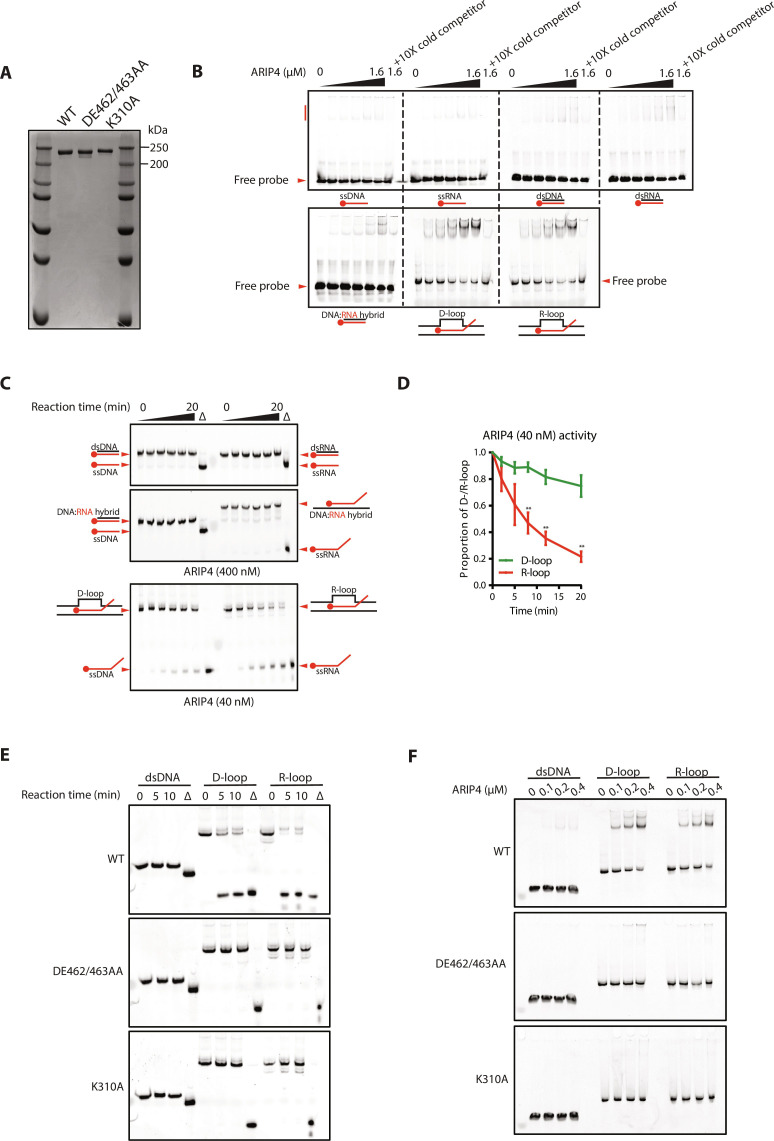
Fig. 6.. ARIP4 preferentially binds and unwinds R-loops in vitro.
(A) Purified ARIP4 and ARIP4 helicase mutants used in in vitro assays. (B) In vitro binding assay of increasing concentrations of ARIP4 with indicated nucleic acid structures (30 nM). (C) In vitro unwinding assay of indicated nucleic acid structures (10 nM) in the presence of ARIP4. dsDNA, dsRNA, and DNA:RNA hybrids were incubated with 400 nM ARIP4, while D-loops and R-loops were incubated with 40 nM ARIP4. Δ indicates reactions that were heat denatured as a positive control. (D) Quantification of ARIP4 unwinding activity against D-loops and R-loops by band intensities normalized to band intensity at 0 min. (E) In vitro unwinding assay of indicated nucleic acid structures (10 nM) in the presence of WT or helicase-dead (DE462/463AA and K310A) ARIP4. (F) In vitro binding assay of indicated nucleic acid structures (30 nM) in the presence of WT and helicase-dead (DE462/463AA and K310A) ARIP4.
Fig. 7.
Fig. 7.. Working model.
(Top) The promoter proximal region is a nexus where Pol II pauses, R-loops form, DSBs are generated, and ARIP4 is enriched. Androgen-dependent transcriptional induction requires ARIP4 (purple) R-loop unwinding activity at highly transcribed genes. R-loops generated from a paused Pol II (blue) awaiting androgen-dependent signaling can act as physical barriers; hence, R-loop resolution is important in ensuring timely pause release and elongation of subsequent rounds of Pol II (green). (Bottom) Upon pause release cues in the form of androgen signaling activation, progression of the transcriptional machinery distorts the DNA in the form of topological constraints, which are resolved by TOP2β (magenta), where occasional DSBs are formed. This model links R-loop resolution to both Pol II pause release and TOP2β-dependent DSB formation and direct impacts of R-loops on transcriptional output.

References

    1. Core L. J., Waterfall J. J., Lis J. T., Nascent RNA sequencing reveals widespread pausing and divergent initiation at human promoters. Science 322, 1845–1848 (2008). - PMC - PubMed
    1. Core L., Adelman K., Promoter-proximal pausing of RNA polymerase II: A nexus of gene regulation. Genes Dev. 33, 960–982 (2019). - PMC - PubMed
    1. Levine M., Paused RNA polymerase II as a developmental checkpoint. Cell 145, 502–511 (2011). - PMC - PubMed
    1. Huggins C., Hodges C. V., Studies on prostatic cancer. I. The effect of castration, of estrogen and androgen injection on serum phosphatases in metastatic carcinoma of the prostate. CA Cancer J. Clin. 22, 232–240 (1972). - PubMed
    1. Tomlins S. A., Rhodes D. R., Perner S., Dhanasekaran S. M., Mehra R., Sun X. W., Varambally S., Cao X., Tchinda J., Kuefer R., Lee C., Montie J. E., Shah R. B., Pienta K. J., Rubin M. A., Chinnaiyan A. M., Recurrent fusion of TMPRSS2 and ETS transcription factor genes in prostate cancer. Science 310, 644–648 (2005). - PubMed

Publication types

MeSH terms