


Gravity- vs Wall Suction-Driven Large-Volume Thoracentesis: A Randomized Controlled Study
- PMID: 39029784
- PMCID: PMC11806342
- DOI: 10.1016/j.chest.2024.05.046
Gravity- vs Wall Suction-Driven Large-Volume Thoracentesis: A Randomized Controlled Study
Abstract
Background: Prior studies have found no differences in procedural chest discomfort for patients undergoing manual syringe aspiration or drainage with gravity after thoracentesis. However, whether gravity drainage could protect against chest pain due to the larger negative-pressure gradient generated by wall suction has not been investigated.
Research question: Does wall suction drainage result in more chest discomfort compared with gravity drainage in patients undergoing large-volume thoracentesis?
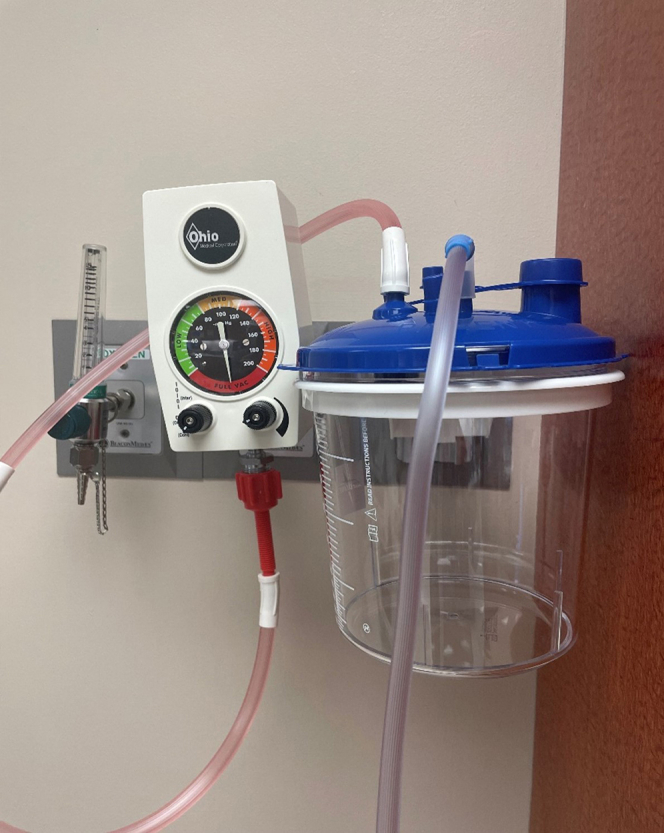
Study design and methods: In this multicenter, single-blinded, randomized controlled trial, patients with large free-flowing effusions of ≥ 500 mL were assigned at a 1:1 ratio to wall suction or gravity drainage. Wall suction was performed with a suction system attached to the suction tubing and with vacuum pressure adjusted to full vacuum. Gravity drainage was performed with a drainage bag placed 100 cm below the catheter insertion site and connected via straight tubing. Patients rated chest discomfort on a 100-mm visual analog scale before, during, and after drainage. The primary outcome was postprocedural chest discomfort at 5 minutes. Secondary outcomes included measures of postprocedure chest discomfort, breathlessness, procedure time, volume of fluid drained, and complication rates.
Results: Of the 228 patients initially randomized, 221 were included in the final analysis. The primary outcome of procedural chest discomfort did not differ significantly between the groups (P = .08), nor did the secondary outcomes of postprocedural discomfort and dyspnea. Similar volumes were drained in both groups, but the procedure duration was longer in the gravity arm by approximately 3 minutes. No differences in rate of pneumothorax or reexpansion pulmonary edema were noted between the two groups.
Interpretation: Thoracentesis via wall suction and gravity drainage results in similar levels of procedural discomfort and dyspnea improvement.
Clinical trial registry: ClinicalTrials.gov; No.: NCT05131945; URL: www.
Clinicaltrials: gov.
Keywords: complications; pleural effusion; suction; thoracentesis.
Copyright © 2024 American College of Chest Physicians. Published by Elsevier Inc. All rights reserved.
Conflict of interest statement
Financial/Nonfinancial Disclosures The authors have reported to CHEST the following: F. M. reports conflicts of interest with Pleural Dynamics, Medtronic, and Rocket Medical. K. K. reports conflicts of interest with Astra Zeneca. L. D. reports conflicts of interest with Intuitive Surgical and Elucent Medical. None declared (S. S., J. Pannu, L. Y., A. F., C. MacR, R. B., L. D., Z. S. DeP., S. A. F., C. A. J., S. K. A., E. V., A. DeM., L. B., T. F., R. A., G. A. E., D. E. O., S. B., A. K., V. S., A. S., R. F. C., S. E. E., K. P., N. C., D. D. B., V. P., R. L., C. P., L. R., J. M., J. Z., J. L., L. V., E. O., G. Y., J. A., C. B., R.-R. A., M. S., J. Pettee, L. Z. M., M. H. A., H. B. G.).
Figures


References
-
- Mummadi S.R., Stoller J.K., Lopez R., Kailasam K., Gillespie C.T., Hahn P.Y. Epidemiology of adult pleural disease in the United States. Chest. 2021;160(4):1534–1551. - PubMed
-
- Owings M.F., Kozak L.J. Ambulatory and inpatient procedures in the United States, 1996. Vital Health Stat 13. 1998;139:1–119. - PubMed
-
- American Thoracic Society Management of malignant pleural effusions. Am J Respir Crit Care Med. 2000;162(5):1987–2001. - PubMed
-
- Havelock T., Teoh R., Laws D., Gleeson F. Pleural procedures and thoracic ultrasound: British Thoracic Society pleural disease guideline 2010. Thorax. 2010;65(suppl 2):ii61–ii76. - PubMed
-
- Feller-Kopman D., Berkowitz D., Boiselle P., Ernst A. Large-volume thoracentesis and the risk of reexpansion pulmonary edema. Ann Thorac Surg. 2007;84(5):1656–1661. - PubMed
Publication types
MeSH terms
Associated data
Grants and funding
LinkOut - more resources
Full Text Sources
Medical
