. 2024 Jul 19;15(1):57.
doi: 10.1186/s13293-024-00612-4.

Sex differences in the social motivation of rats: Insights from social operant conditioning, behavioural economics, and video tracking

Affiliations

Sex differences in the social motivation of rats: Insights from social operant conditioning, behavioural economics, and video tracking

Joel S Raymond et al. Biol Sex Differ. .

Abstract

Background: Social behaviour plays a key role in mental health and wellbeing, and developing greater understanding of mechanisms underlying social interaction-particularly social motivation-holds substantial transdiagnostic impact. Common rodent behavioural assays used to assess social behaviour are limited in their assessment of social motivation, whereas the social operant conditioning model can provide unique and valuable insights into social motivation. Further characterisation of common experimental parameters that may influence social motivation within the social operant model, as well as complementary methodological and analytical approaches, are warranted.

Methods: This study investigated the effects of biological sex, housing condition, and time-of-day, on social motivation using the social operant model. This involved training rats to lever press (FR1) for 60-s access to a social reward (same-sex conspecific stimulus). Subjects were male and female Wistar rats, housed under individual or paired conditions, and sessions were conducted either in the mid-late light phase (ZT6-10) or early-mid dark phase (ZT13-17). A behavioural economics approach was implemented to measure social demand and the influence of stimulus partner sex (same- vs. opposite-sex stimulus) on social operant responding. Additionally, video tracking analyses were conducted to assess the degree of convergence between social appetitive and consummatory behaviours.

Results: Biological sex, housing conditions, the interaction between sex and housing, and stimulus partner sex potently influenced social motivation, whereas time-of-day did not. Behavioural economics demonstrated that sex, housing, and their interaction influence both the hedonic set-point and elasticity of social demand. Video analysis of social interaction during social operant sessions revealed that social appetitive and consummatory behaviours are not necessarily convergent, and indicate potential social satiety. Lastly, oestrus phase of female experimental and stimulus rats did not impact social motivation within the model.

Conclusions: Social isolation-dependent sex differences exist in social motivation for rats, as assessed by social operant conditioning. The social operant model represents an optimal preclinical assay that comprehensively evaluates social motivation and offers a platform for future investigations of neurobiological mechanisms underlying sex differences in social motivation. These findings highlight the importance of continued consideration and inclusion of sex as a biological variable in future social operant conditioning studies. Humans are social creatures-our everyday interactions with others and the support this provides play a key role in our wellbeing. For those experiencing mental health conditions, people's motivation to engage with others can wane, which can lead them to withdraw from those who support them. Therefore, to develop better treatment strategies for these conditions, we need to gain a deeper understanding of social motivation. Studying social behaviour in animals can facilitate this investigation of social motivation as it allows for a causal understanding of underlying neurobiology that is not possible in human experiments. An optimal way to study social motivation in animals is using the social operant conditioning model, where rats learn to press a lever that opens a door and allows them to interact with another rat for a short time. This study characterised the social operant model by testing whether sex, housing conditions, time-of-day, and the sex of the stimulus partner influence rats' motivation to seek interaction with another rat. We found that female rats were more socially motivated than males, and that rats living alone were more motivated than those living with another rat; interestingly, this effect of housing affected females more than males. Regardless of sex, rats were more motivated to interact with a rat of the opposite sex. These findings provide insights into sex differences in social motivation in rats and new insights into the social operant model which will help guide future research into social motivation and other mental health conditions.

Keywords: Behavioural economics; Biological sex; Housing; Rat; Sex difference; Social behaviour; Social motivation; Social operant conditioning; Time-of-day; Video tracking analysis.


Conflict of interest statement

In addition to his academic role, MTB is co-founder and Chief Scientific Officer of Kinoxis Therapeutics Pty Ltd, an Australian-based company developing novel small molecule treatments for brain disorders, including the treatment of substance use disorders and social impairments in psychiatric conditions. NAE is Head of Behavioural Neuroscience at Kinoxis Therapeutics. MTB and NAE receive research funding from Kinoxis Therapeutics. The work presented in this manuscript is unrelated to MTB’s and NAE’s role with Kinoxis Therapeutics. The remaining authors (JSR, SR, and MHJ) declare that they have no competing interests.

Figures
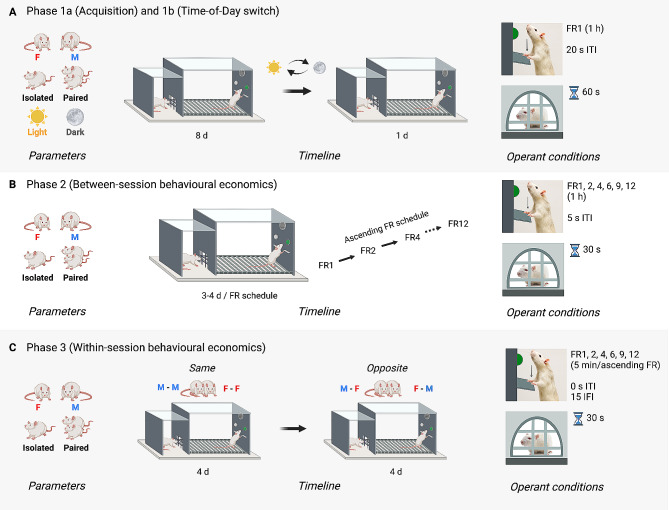
Fig. 1
Fig. 1
Experimental design and procedures. Schematic of the experimental design, timeline, and procedures involved in (A) Phase 1a– Acquisition and 1b– Time-of-Day switch; (B) Phase 2– Between-session behavioural economics; and (C) Phase 3– Within-session behavioural economics. During Phase 1a, the impact of experimental parameters [biological sex (female vs. male), housing condition (isolated vs. paired), and ToD (light vs. dark phase)] on acquisition of social operant responding were assessed over the course of eight days. This was followed by an additional social operant session involving the switching of ToD under which rats were tested (Phase 1b). Operant conditions for Phase 1a involved 1-h daily sessions of FR1 schedule, each social reward involved temporary access to a same-sex conspecific for 60 s via a retractable door, and each reward delivery was followed by a 20-s intertrial interval. For Phase 2, the influence of biological sex, housing condition, and effort required for social reward on social motivation was investigated using a between-session behaviour economics approach. Operant conditions for Phase 2 involved 3–4 × 1-h daily social operant sessions at each FR schedule (FR1, 2, 4, 6, 9, 12), social reward was reduced to 30-s access to social stimuli, and 5-s intertrial intervals following delivery of social reward. During Phase 3, the effect of parameters [biological sex, housing condition, stimulus sex (same vs. opposite)] on social motivation was examined using a within-session behavioural economic paradigm. This involved four days of testing with same-sex stimuli followed by four days of opposite-sex stimuli. Each session for Phase 3 involved successive 5-min bins of time for each FR schedule (FR1, 2, 4, 6, 9, 12) presented in an ascending order and separated by 15-s intervals (interFR intervals); social reward was 30-s access to social stimuli, and 0-s intertrial intervals following the delivery of a social reward. Note that for Phase 2 and 3, ToD was variable was removed—all social operant testing was conducted during the early-mid dark phase—and only the top-half of highest responders were included. d– Day(s); F– female; FR– fixed ratio; IFI– interFR-interval; ITI– intertrial interval; M– male, opposite– opposite-sex stimulus, same– same-sex stimulus. This figure was created with BioRender.com.
Fig. 2
Fig. 2
The influence of sex and housing conditions on outcomes of acquisition in social operant conditioning. Effects of experimental parameters of biological sex and housing conditions on social rewards (A), difference in active-inactive lever presses (B), latency to first active lever press (C), locomotor activity (D), within-session time course of mean social rewards averaged over sessions 7 and 8 (E), total time with nose in open door (F), proportion of open-door time with nose in door (G), within-session proportion of open-door time with nose in door averaged over sessions 7 and 8 (H), total time with nose in closed door (I), and proportion of closed-door time with nose in door (J). Sample sizes were n = 8 per factorial condition, except for locomotion, total time with nose in open door, total time with nose in closed door, and proportion of closed-door time with nose in door (F-Iso-L: n = 7, F-Pair-L: n = 7, F-Iso-D: n = 6, F-Pair-D: n = 6, M-Iso-L: n = 7, M-Pair-L: n = 8, M-Iso-D: n = 6, M-Pair-D: n = 6); and proportion of open-door time with nose in door (F-Iso-L: n = 7, F-Pair-L: n = 7, F-Iso-D: n = 6, F-Pair-D: n = 6, M-Iso-L: n = 6, M-Pair-L: n = 8, M-Iso-D: n = 6, M-Pair-D: n = 4). Data represent mean values ± S.E.M. and individual data points represent individual subject data. Statistical significance is indicated by the following: Sex– biological sex; H– housing condition; ToD– time-of-day; Ss– session, Time– timepoint during session. Level of statistical significance is indicated by the number of * symbols: one– p <.05, two– p <.01, three– p <.001
Fig. 3
Fig. 3
The influence of sex and housing conditions on social operant outcomes from between-session behavioural economics. Effects of biological sex, housing condition, and effort required for social reward on mean adjusted social rewards (A); population social demand curves (B); social demand at null cost (C); social demand elasticity (D); total time with nose in open door (E); proportion of open door time with nose in open door (F); total time with nose in closed door (G); and proportion of closed door time with nose in closed door (H). Sample sizes are detailed as follows: population demand curves (n = 8 per factorial condition); social demand at null cost and social demand elasticity, (F-Iso: n = 6, F-Pair: n = 7, M-Iso: n = 6, M-Pair: n = 6); total time with nose in open door, total time with nose in closed door, and proportion of closed door time with nose in closed door (F-Iso: n = 8, F-Pair: n = 7, M-Iso: n = 8, M-Pair: n = 7); proportion of open door time with nose in open door (F-Iso: n = 8, F-Pair: n = 6, M-Iso: n = 7, M-Pair: n = 5). Note that demand elasticity data was log transformed for analysis and inverted for ease of visualisation. Data represent mean values ± S.E.M and data points represent individual subject data. Statistical significance is indicated by the following: Sex– biological sex; H– housing condition; FR– FR schedule. Level of statistical significance is indicated by the number of * symbols: one– p <.05, two– p <.01, three– p <.001
Fig. 4
Fig. 4
The influence of sex, housing, and stimulus sex on social operant outcomes from within-session behavioural economics. Effects of biological sex, housing conditions, and stimulus partner sex on population social demand curves for females (A) and males (B), mean adjusted social rewards (C), social demand at null cost (D), social demand elasticity (E), total time with nose in open door (F), proportion of open-door time with nose in door (G), total time with nose in closed door (H), and proportion of closed-door time with nose in door (I). Sample sizes are detailed as follows: mean social rewards and population demand curves (n = 8 per factorial condition); social demand at null cost and social demand elasticity (F-Iso: n = 8, F-Pair: n = 7, M-Iso: n = 7, M-Pair: n = 7); total time with nose in open door, proportion of open-door time with nose in door, total time with nose in closed door, and proportion of closed-door time with nose in door (F-Iso: n = 7, F-Pair: n = 8, M-Iso: n = 8, M-Pair: n = 8). Note that demand elasticity data was log transformed for analysis and inverted for ease of visualisation. Data represent mean values ± S.E.M and data points represent individual subject data. Statistical significance is indicated by the following: Sex– biological sex; H– housing condition; St– Stimulus sex. Level of statistical significance is indicated by the number of * symbols: one– p <.05, two– p <.01, three– p <.001
Fig. 5
Fig. 5
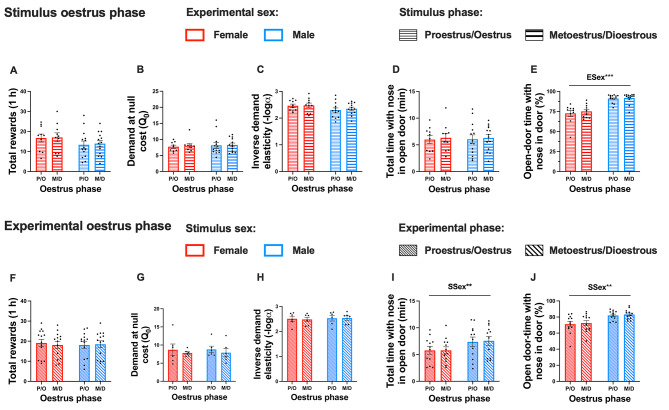
The effect of stimulus and experimental oestrus phase on social operant outcomes from within-session behavioural economics. Effects of stimulus rat oestrus phase on mean total social rewards (A), social demand at null cost (B), social demand elasticity (C), total time with nose in open door (D), and proportion of open-door time with nose in door (E). The influence of experimental rat oestrus phase on mean total social rewards (F), social demand at null cost (G), social demand elasticity (H), total time with nose in open door (I), and proportion of open-door time with nose in door (J). Sample sizes are detailed as follows: stimulus phase on mean social rewards, total time with nose in open door, and proportion of open door time with nose in open door (F-P/O: n = 10, F-M/D: n = 14; M-P/O: n = 10, M-P/O: n = 14); stimulus phase on demand at null cost and demand elasticity (F-P/O: n = 10, F-M/D: n = 13; M-P/O: n = 10, M-P/O: n = 13); experimental phase on mean social rewards (all n = 14); stimulus phase on demand at null cost and demand elasticity (all n = 6); and experimental phase on total time with nose in open door and proportion of open-door time with nose in door (all n = 12). Note that demand elasticity data was log transformed for analysis and inverted for ease of visualisation. Data represent mean values ± S.E.M and data points represent individual subject data. Statistical significance is indicated by the following: ESex– Experimental rat sex; SSex– Stimulus rat sex. Level of statistical significance is indicated by the number of * symbols: one– p <.05, two– p <.01, three– p <.001

References

    1. Baumeister RF, Leary MR. The need to belong: Desire for interpersonal attachments as a fundamental human motivation. Interpers Dev. 2017:57–89. - PubMed
    1. Fiske ST. Social beings: core motives in social psychology. Wiley; 2018.
    1. Kawachi I, Berkman LF. Social ties and mental health. J Urb Health. 2001;78(3):458–67.10.1093/jurban/78.3.458 - DOI - PMC - PubMed
    1. Golden J, Conroy RM, Bruce I, Denihan A, Greene E, Kirby M, et al. Loneliness, social support networks, mood and wellbeing in community-dwelling elderly. Int J Geriatric Psychiatry: J Psychiatry late life Allied Sci. 2009;24(7):694–700.10.1002/gps.2181 - DOI - PubMed
    1. Umberson D, Karas Montez J. Social relationships and health: a flashpoint for health policy. J Health Soc Behav. 2010;51(1suppl):S54–66. 10.1177/0022146510383501 - DOI - PMC - PubMed

LinkOut - more resources